Filters

32 filtered results

Clear all filters
Favorites
With answer key
Interactive

32 filtered results

Difficulty Level

Grade


Check out this FREE Math Trial Lesson for age 5!

Sorting Objects into 3 Categories

Favorites
With answer key
Interactive
  • Math
  • 5
  • With answer key
Geometry - Assessment 2 Worksheet Preview

Geometry – Assessment 2 Worksheet

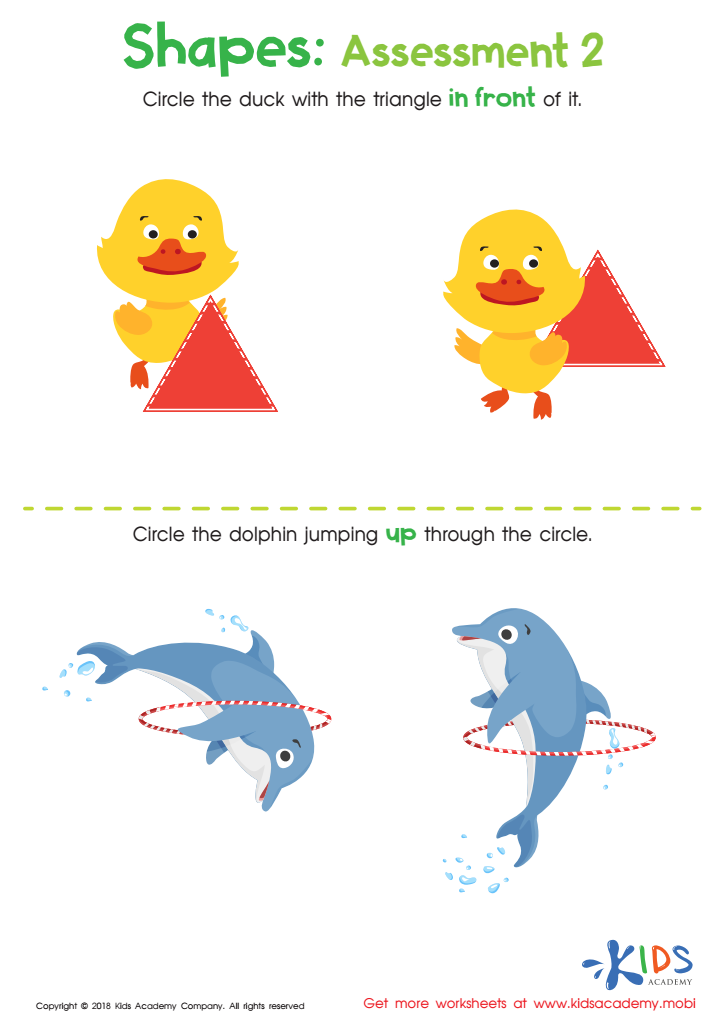
Preschoolers will learn to identify circles and triangles and practice using terms like "in front of" to place objects. This skill is key to further learning and is an important part of development.
Geometry – Assessment 2 Worksheet
Worksheet
Counting: Assessment 3 Worksheet

Counting: Assessment 3 Worksheet

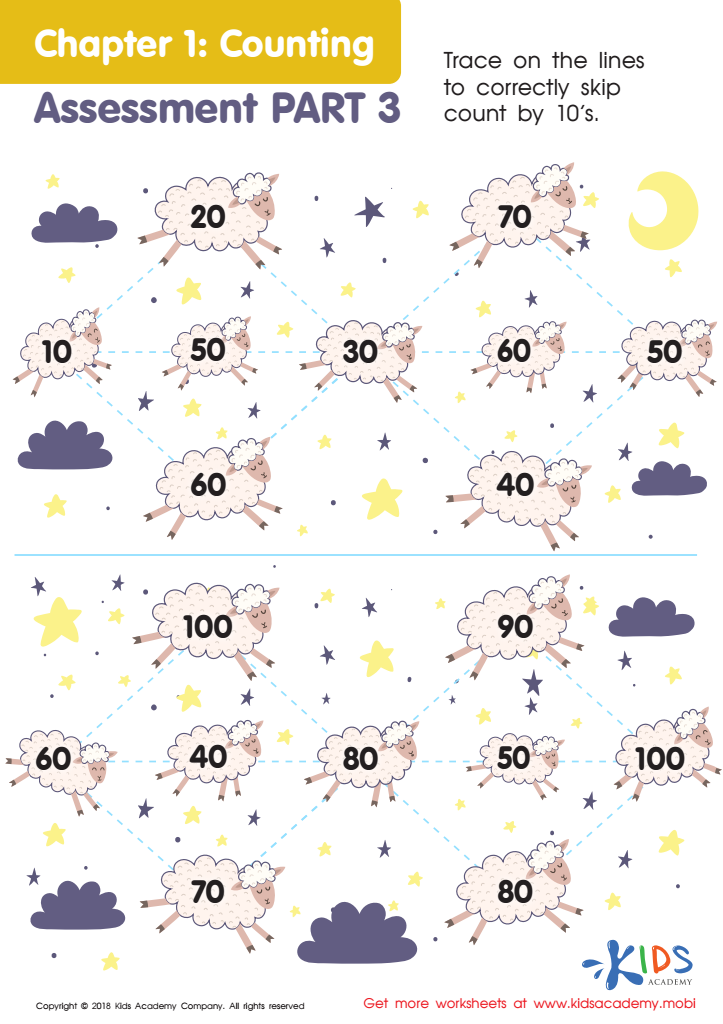
This worksheet is great for assessing your child's counting skills. It's a bit more challenging than the usual 'count to fifty' exercises. Have them trace the lines and skip count by 10's to help them learn counting in tens.
Counting: Assessment 3 Worksheet
Worksheet
The Unknown Number - Assessment 3 Worksheet

The Unknown Number - Assessment 3 Worksheet

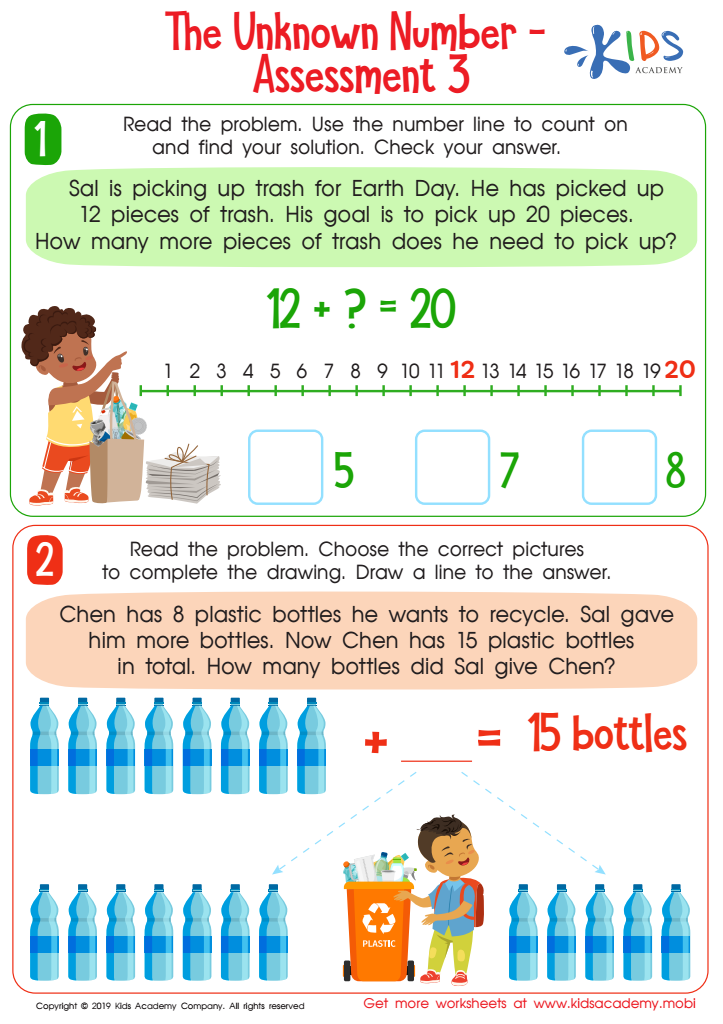
Read the Earth Day-themed word problem aloud to your kids, pointing to the pictures as you go. Use the number line to help them count on and find the answer. Then check it together. Doing this can help them learn more about Earth Day and meet other children who are doing their part to keep it clean.
The Unknown Number - Assessment 3 Worksheet
Worksheet
Data: Assessment 1 Worksheet

Data: Assessment 1 Worksheet

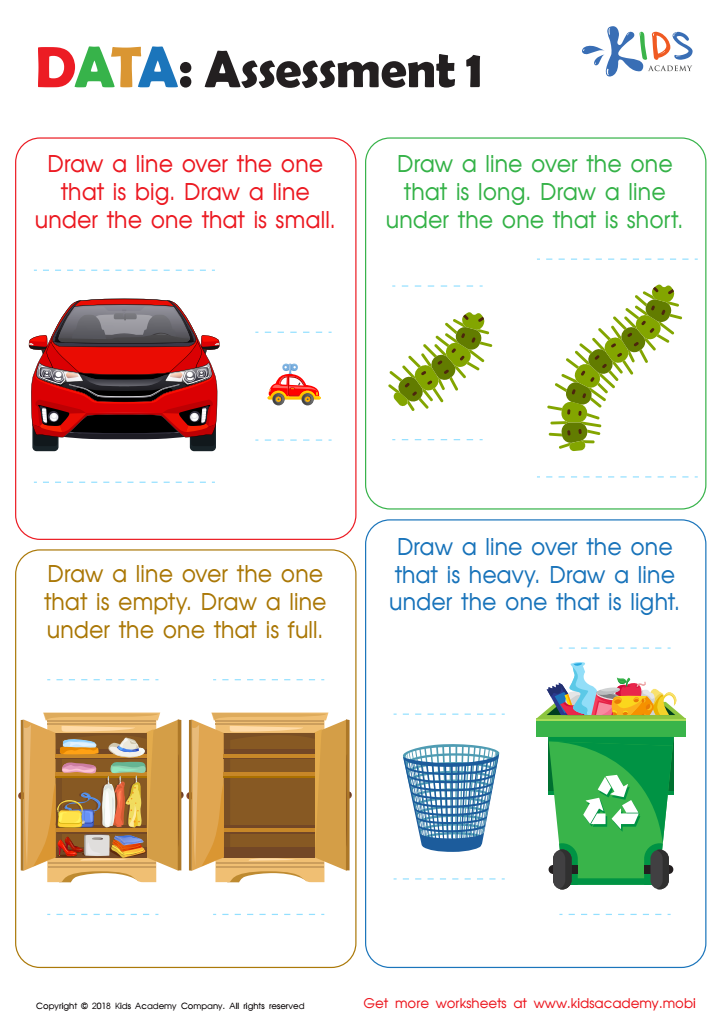
Assess your students' knowledge of measurement words with this worksheet. Have them compare and describe objects/quantities using words like "big", "small", "long", "short", "empty", "full", "heavy" and "light". Encourage further learning by asking students to provide examples of each word meaning.
Data: Assessment 1 Worksheet
Worksheet
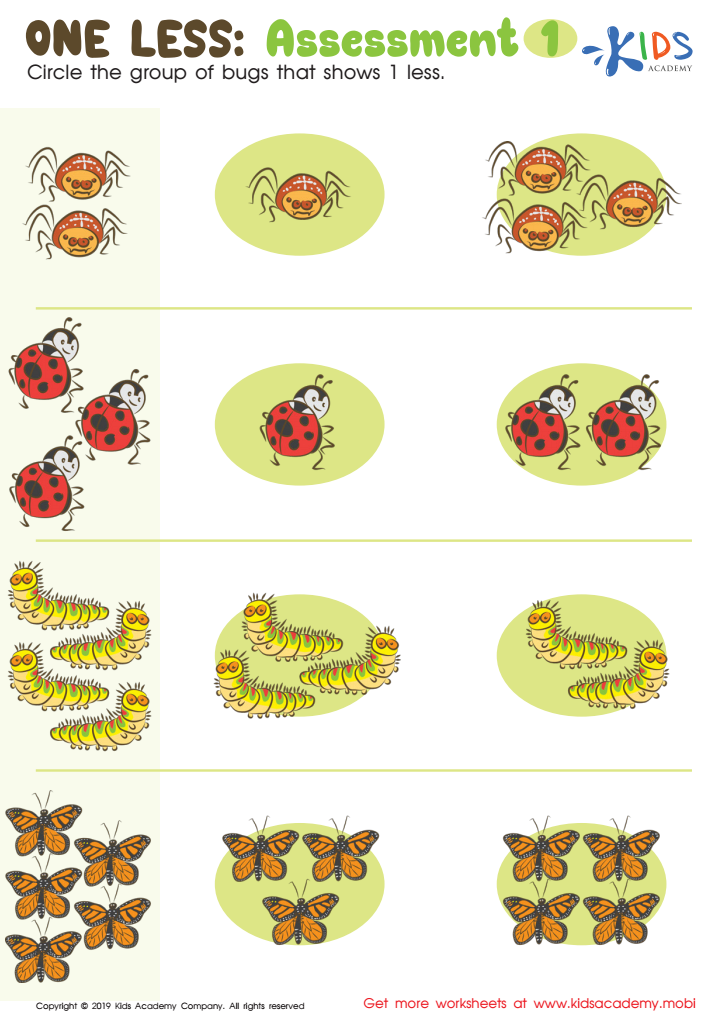
One Less: Assessment 1 Worksheet

One Less: Assessment 1 Worksheet

Help your kids with counting using this worksheet that has pictures of bugs! There are four different bugs and insects. Show them each one and ask them to count, then circle the group that has 1 less than the previous group. Don't worry if your kids don't like bugs - it's just a picture!
One Less: Assessment 1 Worksheet
Worksheet
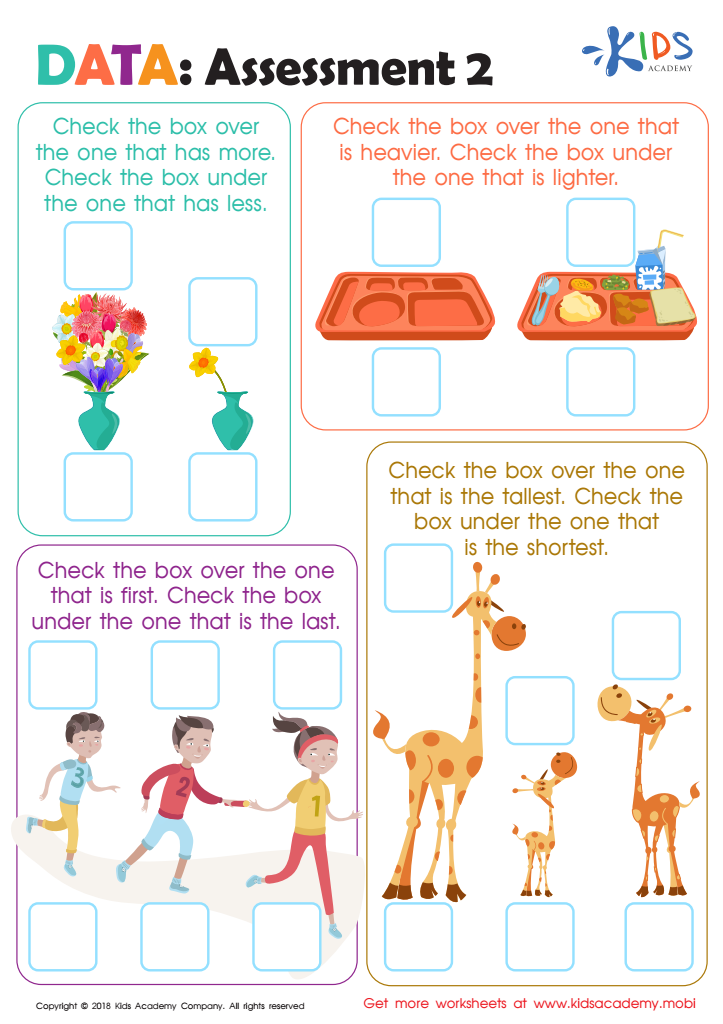
Data: Assessment 2 Worksheet

Data: Assessment 2 Worksheet

This printable worksheet tests students' understanding of words related to quantity and measurement, such as "more", "less", "heavy", "light", "first", "last", "tall", and "short". It helps children compare and contrast when solving measurement problems. Ideal for math classes, it encourages students to gain the essential skills needed in subjects like math, science, and reading.
Data: Assessment 2 Worksheet
Worksheet
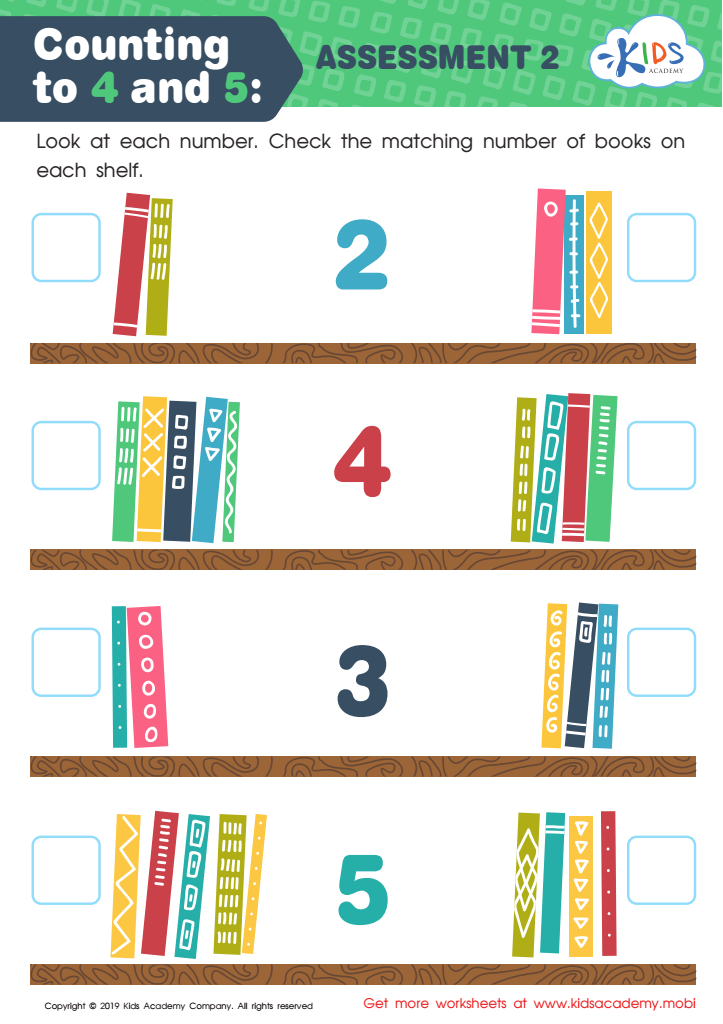
Counting to 4 and 5: Assessment 2 Worksheet

Counting to 4 and 5: Assessment 2 Worksheet

Counting is a key skill for math success. Help your kids get off to a good start by counting the books on each shelf in the pictured printout. Point to each set of books, counting aloud, and then look for the matching number in the centre. With this simple worksheet, your kids can get the practice they need before taking on more advanced math skills.
Counting to 4 and 5: Assessment 2 Worksheet
Worksheet
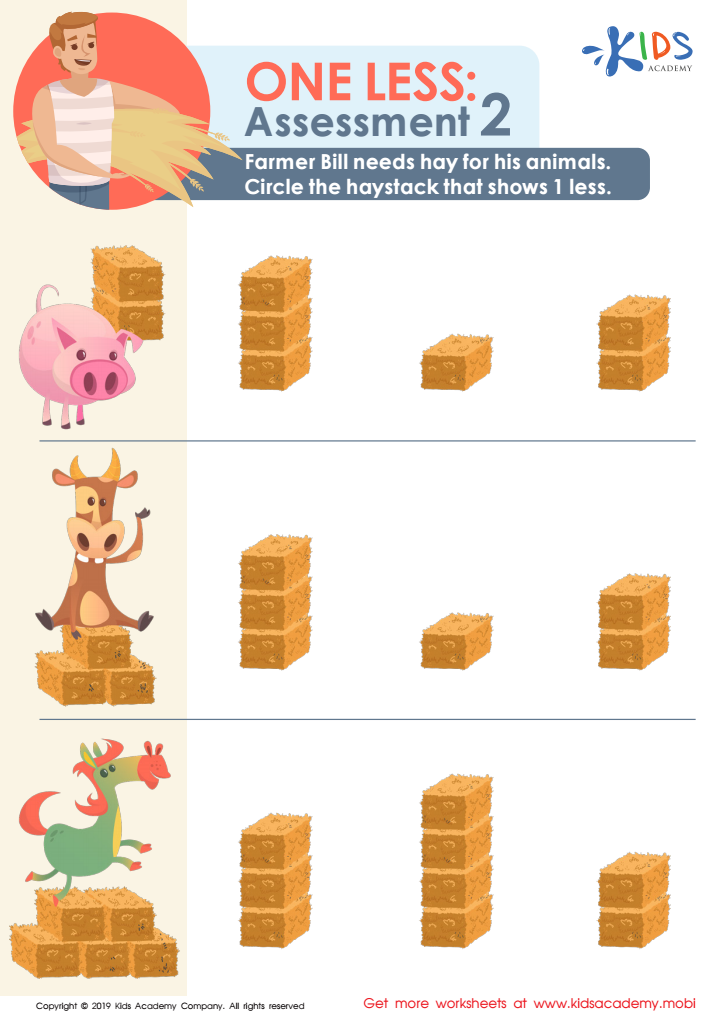
One Less: Assessment 2 Worksheet


One Less: Assessment 2 Worksheet

Farmers are vital to our community. They raise animals and crops which provide us with food. Kids can learn a lot by visiting a farm—ask them to name the animals and crops they saw! Farmer Bill in this worksheet needs hay. Point to the haystacks, and ask your child to circle the one with 1 less.
One Less: Assessment 2 Worksheet

Worksheet


Math Worksheets Activities with Answers are a valuable resource for learners at all levels, fundamentally enhancing the comprehension and application of mathematical concepts. These activities are not just about practicing equations or solving problems; they are meticulously designed to engage students in a way that textbooks alone cannot. Here are several reasons why Math Worksheets Activities with Answers are particularly useful.

Targeted Practice

One of the primary benefits of Math Worksheets Activities is the targeted practice they offer. Each worksheet can focus on a specific mathematical concept or problem type, allowing students to hone their skills in particular areas where they may need improvement. This targeted approach ensures that students can progressively build their understanding and confidence in various math topics, from basic arithmetic to more complex algebraic equations.

Immediate Feedback

The inclusion of answers is another significant advantage. Immediate feedback is crucial in the learning process, allowing students to identify mistakes and correct them in real time. This not only helps in reinforcing correct methods but also in understanding why certain approaches may not work, fostering a deeper comprehension of mathematical principles.

Independent Learning

Math Worksheets Activities with Answers promote independent learning. Students can work through the problems at their own pace, making these activities an excellent tool for both classroom use and home study. This self-paced approach encourages learners to take ownership of their educational journey, developing critical thinking and problem-solving skills that are invaluable beyond the classroom.

Versatility

These worksheets are incredibly versatile. They can be used as a warm-up activity to recap previous lessons, as a main activity to introduce new concepts, or as a revision tool before exams. Teachers can also use them to differentiate instruction, providing varying levels of difficulty to cater to the diverse learning needs within a classroom.

In summary, Math Worksheets Activities with Answers are a fundamental tool in the learning process. They offer focused practice, immediate feedback, support independent learning, and can be tailored to fit a wide range of educational needs. By incorporating these activities into their study routine, students can significantly improve their mathematical skills and confidence.