Subtraction Worksheets for Ages 5-9 - Page 5
97 filtered results
-
From - To
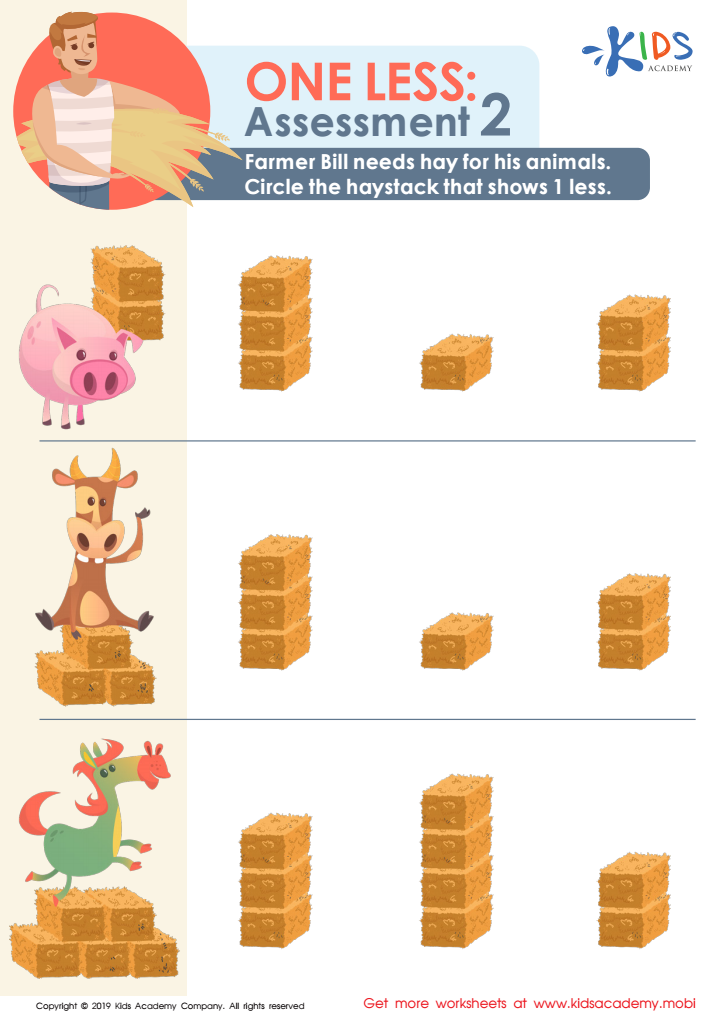
One Less: Assessment 2 Worksheet
 Assign to My Students








Subtraction is a foundational math skill that plays a crucial role in a child's cognitive development and everyday life. For children aged 5-9, understanding subtraction not only enhances their numerical fluency but also fosters critical thinking and problem-solving abilities. Parents and teachers should care about this crucial skill for several reasons.
Firstly, subtraction is vital for developing number sense. Children learn to see relationships between numbers, which aids them in understanding more complex mathematical concepts later on. Mastering subtraction helps kids make connections between addition and subtraction, allowing them to solve problems more efficiently.
Secondly, subtraction has practical applications in daily life, such as counting change, measuring time, and sharing resources. Equipping children with strong subtraction skills empowers them with the confidence to navigate various real-world situations.
Lastly, a solid grasp of subtraction lays the groundwork for future academic success. As they advance in school, students encounter more challenging mathematical concepts that rely heavily on their understanding of basic operations.
By nurturing these skills early, parents and teachers play a pivotal role in ensuring that children develop not only mathematic competency but also a love for learning that will benefit them throughout their educational journeys and beyond.








