Numbers up to 100 Worksheets for Ages 6-8 - Page 3
50 filtered results
-
From - To
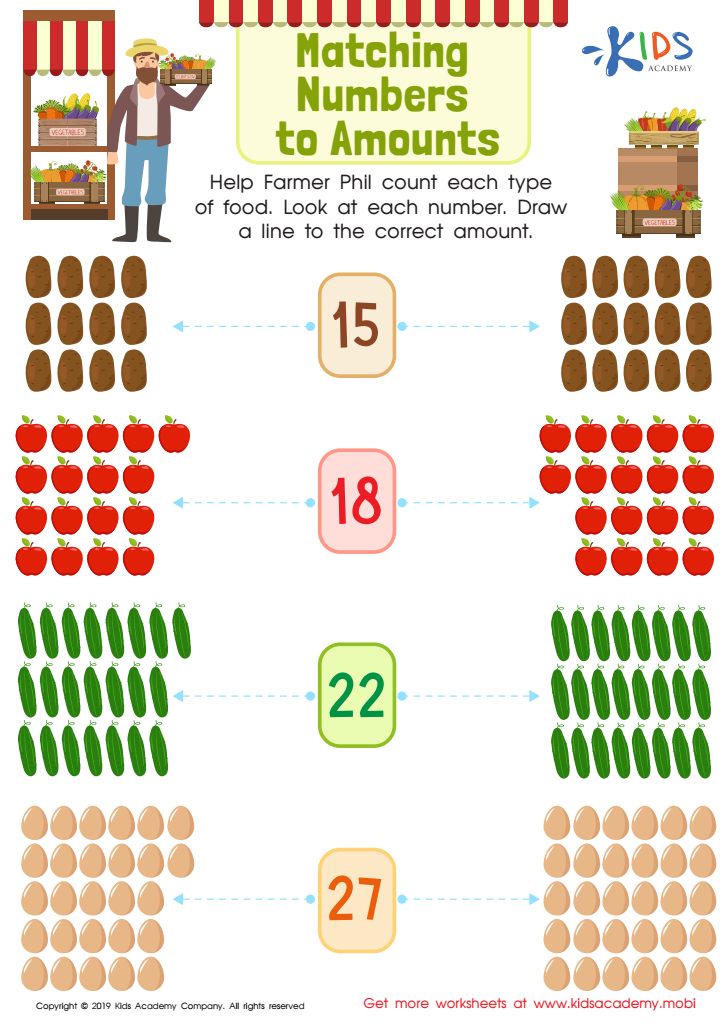
Matching Numbers to Amounts Worksheet
 Assign to My Students

Counting on the City Skyline: Dot-to-Dot Worksheet


%20(1).jpg)





Understanding numbers up to 100 is essential for children aged 6 to 8 as it lays the foundational skills for their future mathematical learning and everyday problem-solving. At this stage, children develop number sense, which involves recognizing and manipulating numbers, understanding their relationships, and mastering basic mathematical operations such as addition and subtraction. Mastery of numbers up to 100 helps children to not only perform calculations accurately but also to grasp concepts like place value, patterns, and sequencing.
Parents and teachers should care about this developmental milestone because it promotes confidence and positive attitudes towards math. When children are comfortable working with numbers, they become more willing to tackle complex mathematical concepts in later grades, reducing anxiety around math as they progress.
Additionally, number fluency enhances critical thinking and analytical skills that are applicable across various subjects and in real-life scenarios. Engaging in activities that reinforce counting, comparing, and problem-solving with numbers helps set the stage for concepts they will encounter later, such as multiplication, division, and even basic statistics. Overall, focusing on numbers up to 100 supports holistic cognitive development and prepares children for success in their academic journeys and everyday life.