
Easy Word Problems Worksheets for 6-Year-Olds
41 filtered results
Difficulty Level
Grade
Age
-
From - To
Subject
Activity
Standards
Introducing our Easy Word Problems worksheets, perfectly tailored for six-year-old learners! These school downloadable worksheets are crafted to enhance early math skills through fun and engaging problems that cover basic arithmetic concepts. Each worksheet is designed to build confidence and improve problem-solving skills, helping young students grasp the essentials of mathematics in a playful and enjoyable manner. Ideal for both classroom and home use, our worksheets provide a fantastic resource for teachers and parents alike. Equip your child with the foundational skills they need for academic success with our Easy Word Problems worksheets. Start their journey towards becoming a math whiz today!
Favorites
With answer key
Interactive
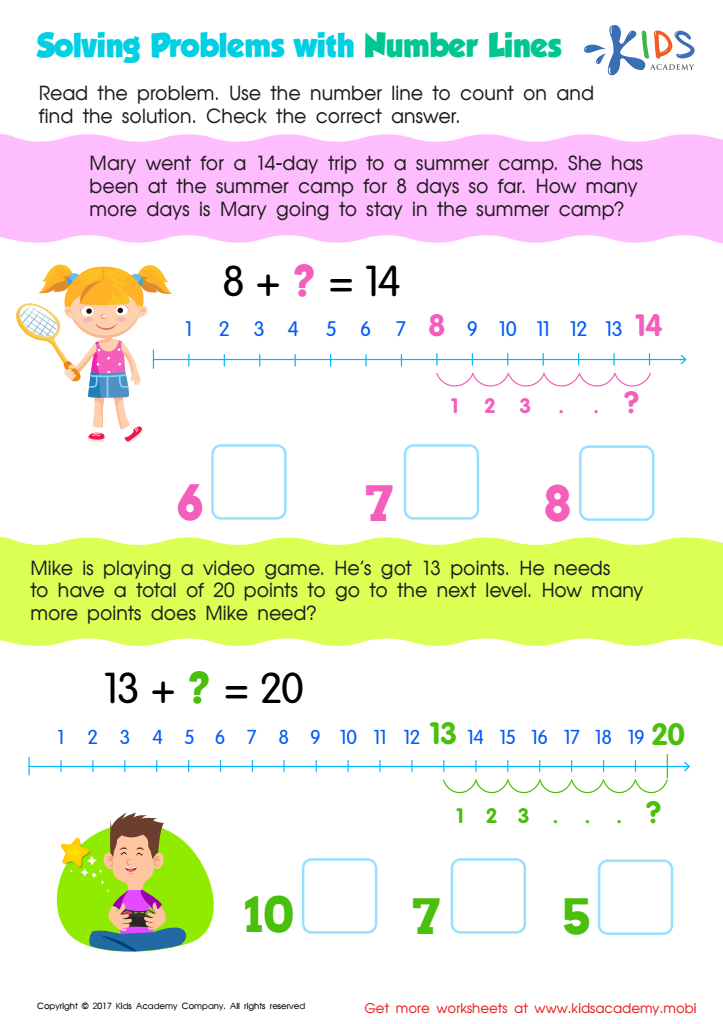
Solving Problems: Number Lines Worksheet
Number lines are fun and help build number sense and reasoning. This worksheet uses them to help students count on to find a solution to an equation. They'll have fun counting with familiar numbers and 10-bases, while also working on algebraic reasoning.
 Assign to My Students
Solving Problems: Number Lines Worksheet
Worksheet
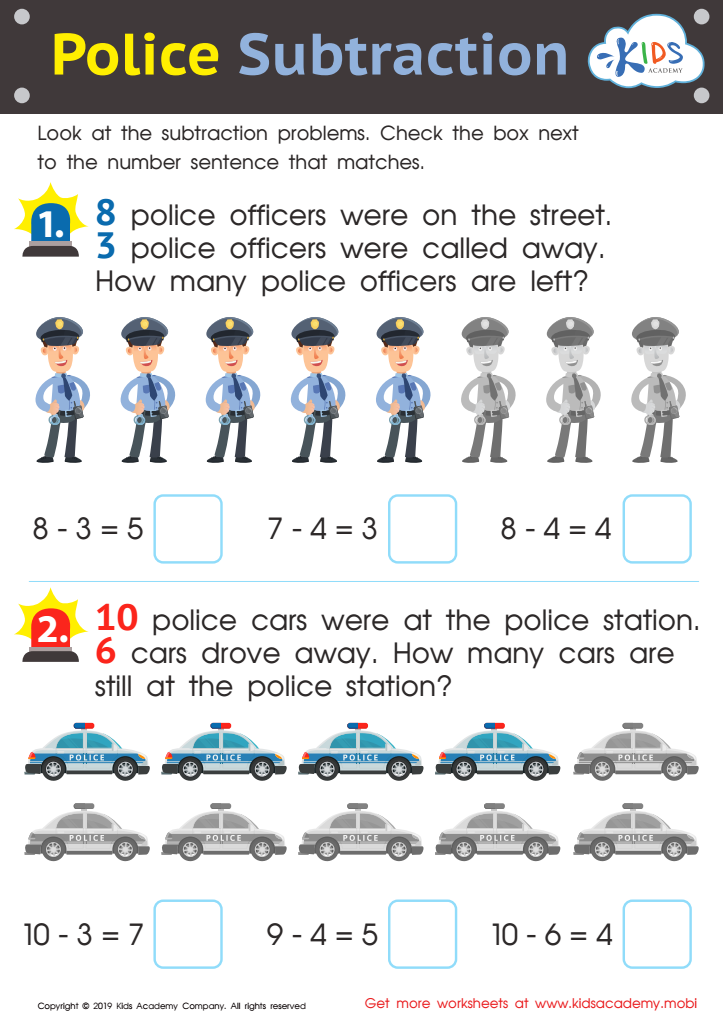
Police Subtraction Worksheet
Police protect citizens and do more in the community. Kids can learn numbers with this math worksheet: two subtraction problems in the downloadable PDF. Read the problems with your kids, then check the box next to the number sentences that are correct.
Police Subtraction Worksheet
Worksheet
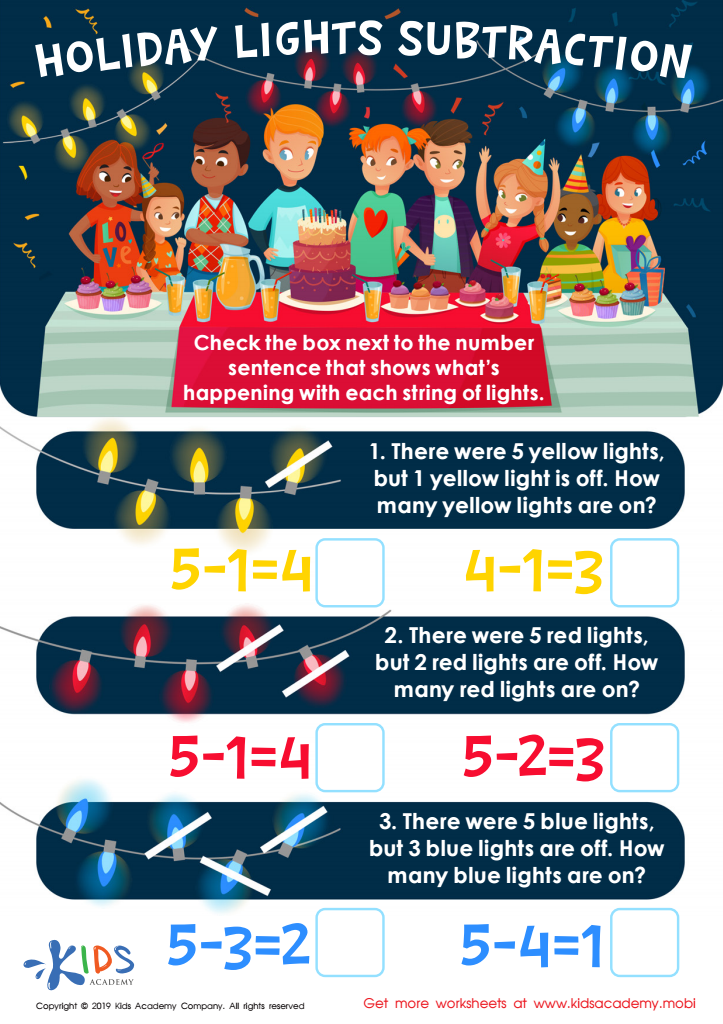
Holiday Lights Subtraction Worksheet
Before tackling the math problem, get your kids ready by asking them to share their favorite holiday and why. Then, look at the picture on the worksheet with them. Help them examine the numbers and problems, and select the number sentence that shows what's happening with each string of light. 80 words.
Holiday Lights Subtraction Worksheet
Worksheet
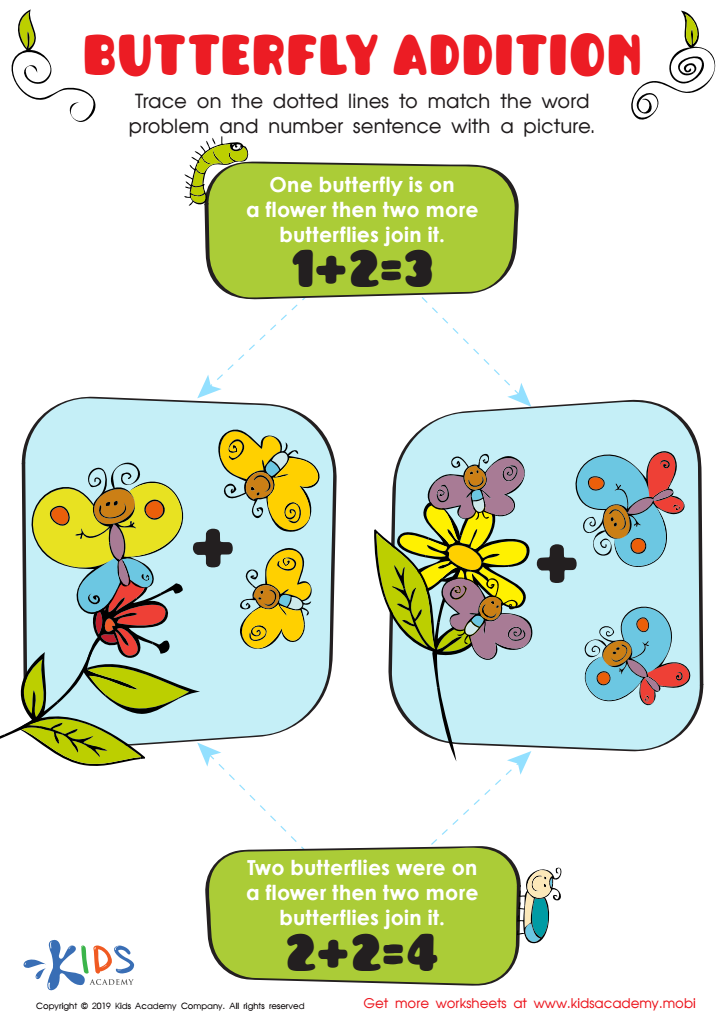
Butterfly Addition Worksheet
This tracing sheet is great for kids to work on math skills and have fun too. Read the word problems to them, then help them trace the dotted lines to match the problem and number sentence to a picture. Not only is it educational, it's beautiful too - your kids will love learning about butterflies!
Butterfly Addition Worksheet
Worksheet
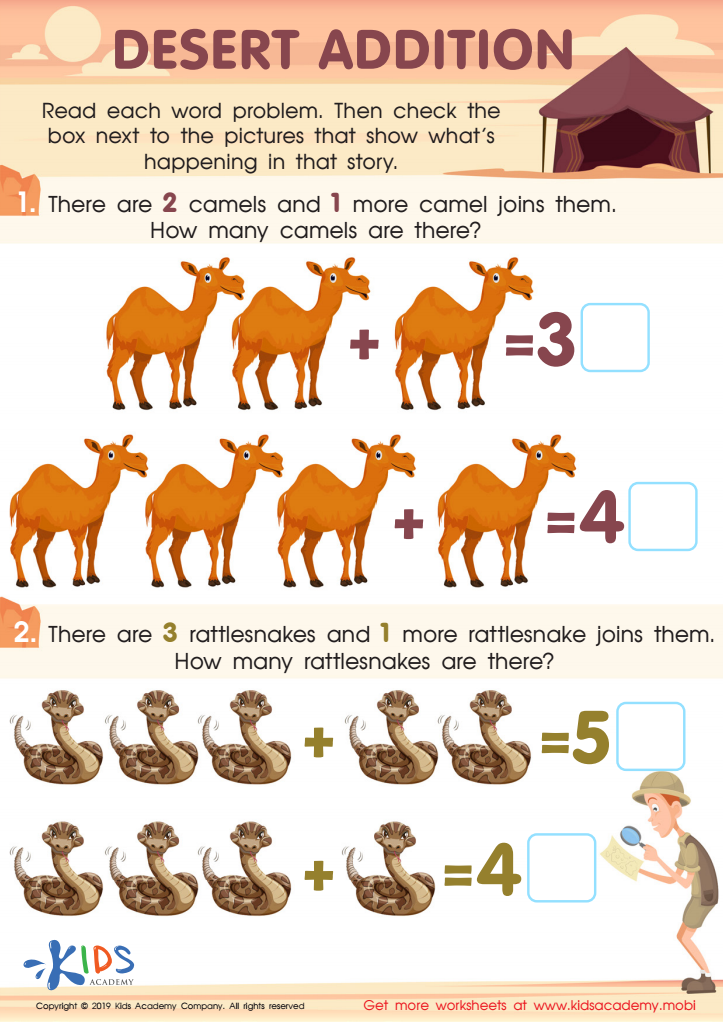
Desert Addition Worksheet
In the desert, scorching heat and little water mean animals must adapt to survive. Show kids pictures of these animals and teach their names. Then, read the word problems in the worksheet, and have them check the box next to the pictures that portray each story. 80 words
Desert Addition Worksheet
Worksheet
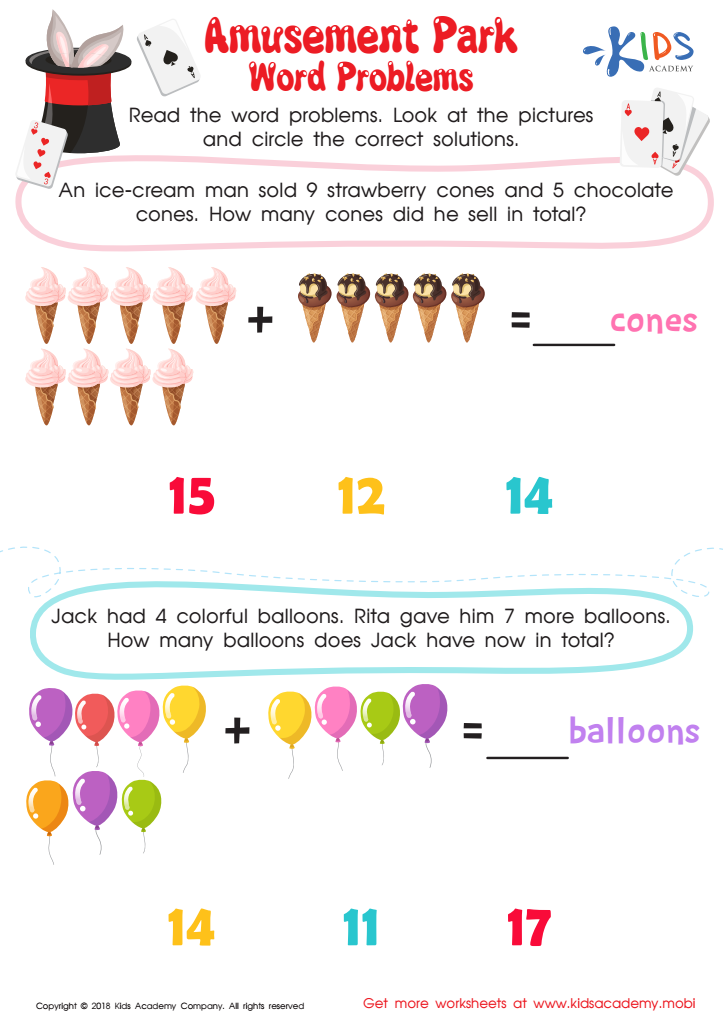
Amusement Park Word Problems Worksheet
Engage kids with math by making it realistic and incorporating manipulatives or pics they like! This worksheet helps kids understand word problems. Read the problem, note numbers and key phrases like "in total," then count the pics to find the total!
Amusement Park Word Problems Worksheet
Worksheet
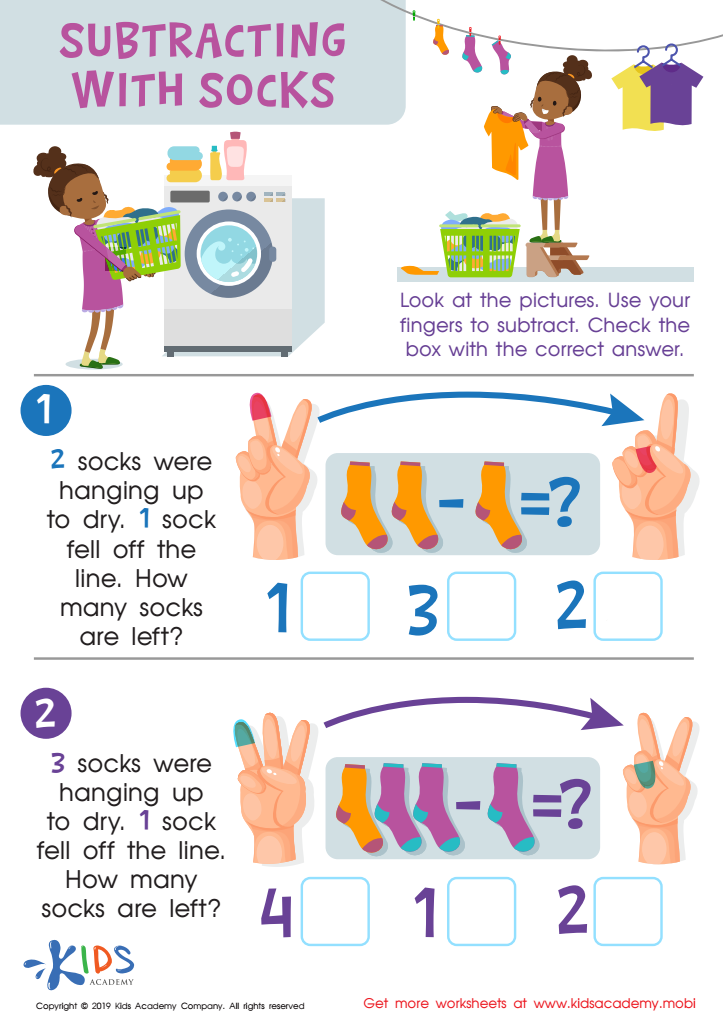
Subtracting Socks Worksheet
Before beginning this exercise with your children, warm them up with a counting game. If math is not their favorite subject, use this worksheet. Help them read the two word problems, then use their fingers to count and subtract. Ask them to select the correct answer and check the box.
Subtracting Socks Worksheet
Worksheet
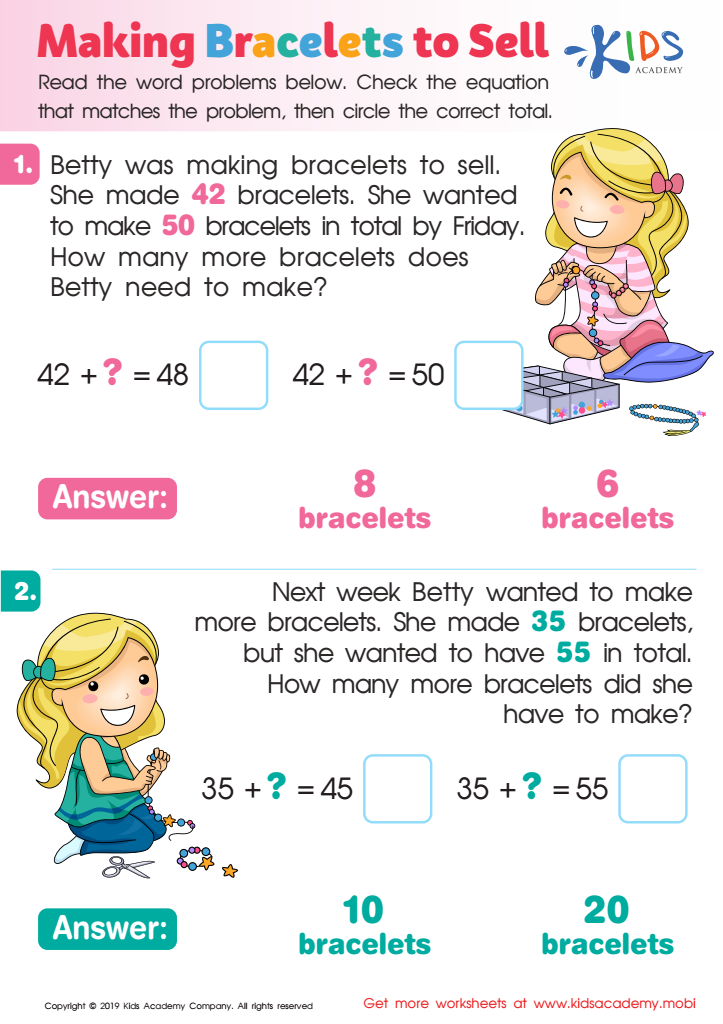
Making Bracelets to Sell Worksheet
Got kids who love crafting? This worksheet will be right up their alley! Let them use their creative and problem-solving skills to check equations and decide the correct total. It's just like making beads into a bracelet but on paper! Print out this downloadable PDF and get ready for a fun craft session.
Making Bracelets to Sell Worksheet
Worksheet
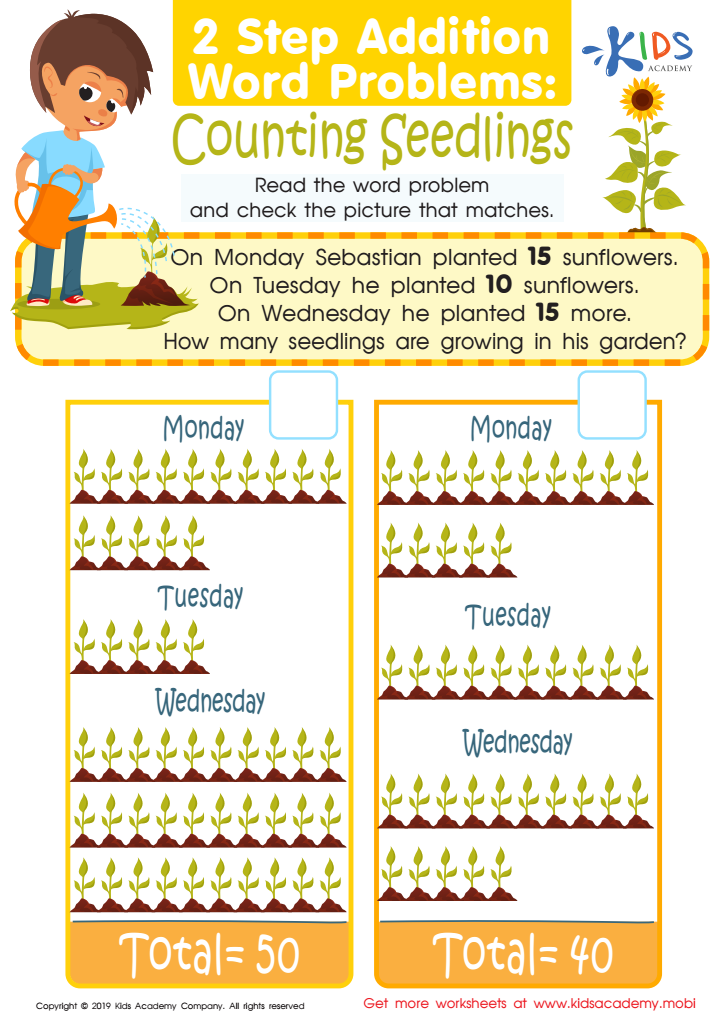
Counting Seedlings Worksheet
Understanding math word problems is key. Multiple steps can prove challenging - this free worksheet provides one-to-one picture representation to help kids solve multi-step addition word problems. Strengthen addition skills by choosing the matching picture to the answer.
Counting Seedlings Worksheet
Worksheet
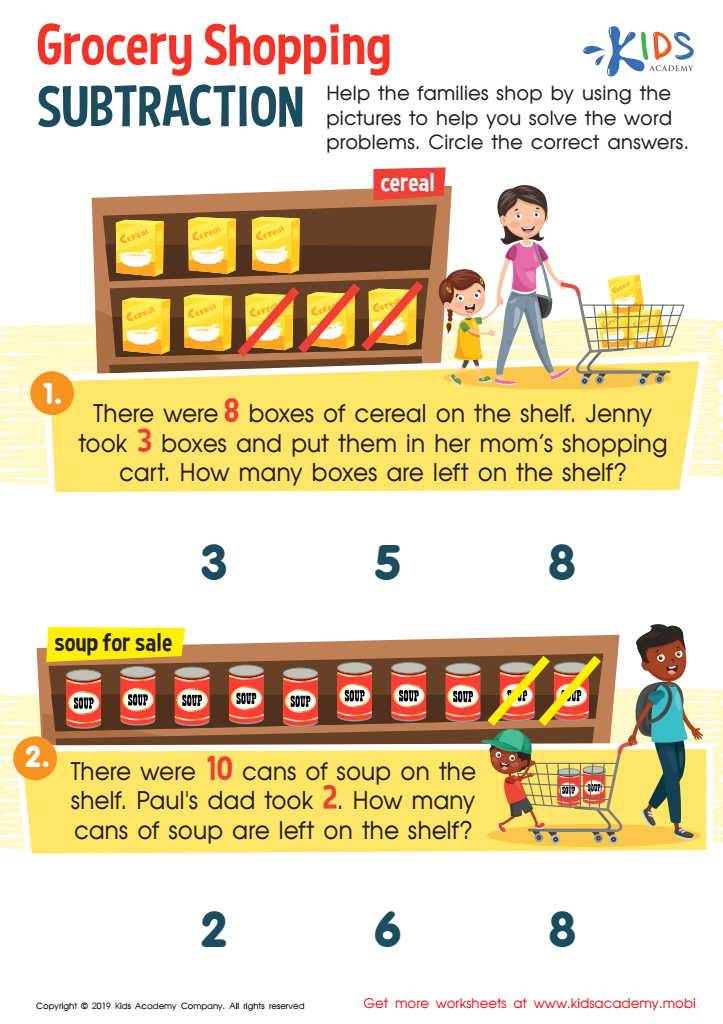
Grocery Shopping Subtraction Worksheet
Take your kids on a virtual grocery trip with this worksheet! Help them read the two word problems and use the pictures to solve them. Then, have them circle the correct answers. It's an easy, fun way to get kids comfortable with math while also getting them excited about grocery shopping!
Grocery Shopping Subtraction Worksheet
Worksheet
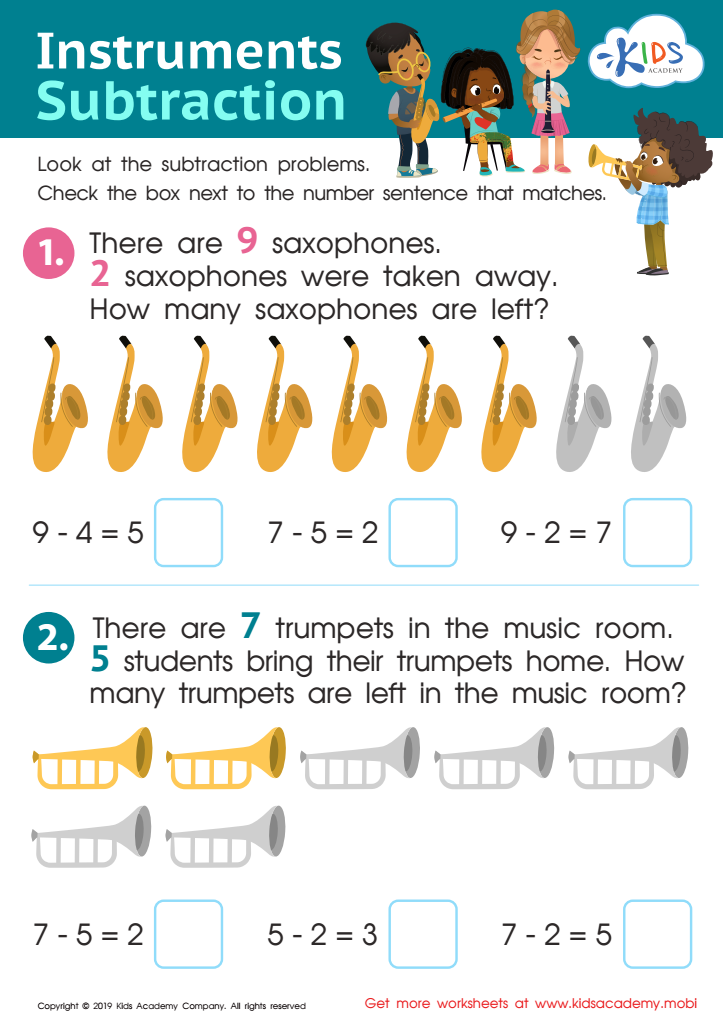
Instrument Subtraction Worksheet
Encourage kids to practice their addition and subtraction by having them identify the musical instruments on the worksheet, then read the subtraction problems and check the box with the matching number sentences.
Instrument Subtraction Worksheet
Worksheet
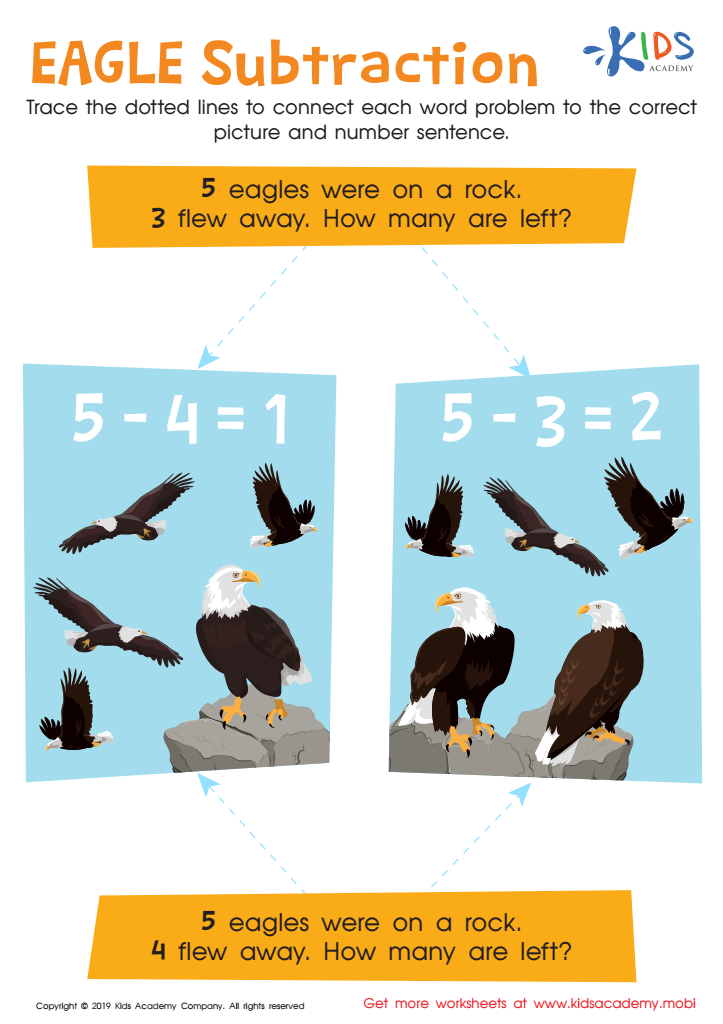
Eagle Subtraction Worksheet
Help your kids become math experts! Through practice and adult guidance, even addition and subtraction can seem simple. Show them how with this worksheet - get them to trace the dotted lines to connect each word problem to the correct picture and solve the number sentence with some eagles!
Eagle Subtraction Worksheet
Worksheet
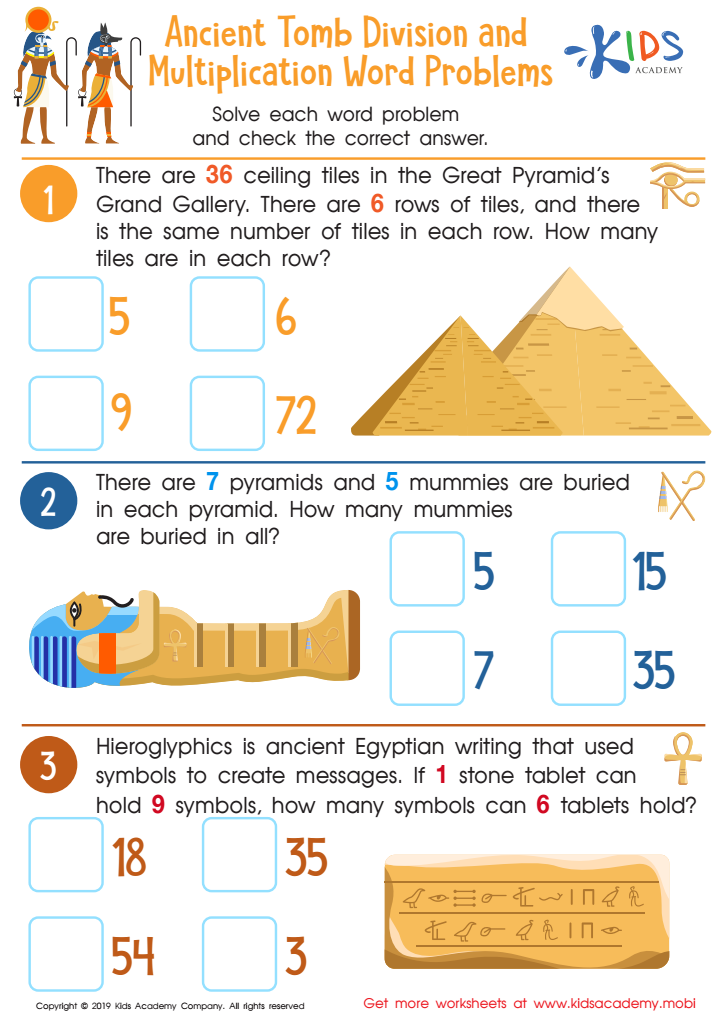
Ancient Tomb Division and Multiplication Word Problems Worksheet
This worksheet teaches kids math, plus a bit about ancient Egypt. Read the text and point to the pictures to explain them. There are three word problems - help kids interpret and solve each one, then find and check the answer. 80 words
Ancient Tomb Division and Multiplication Word Problems Worksheet
Worksheet
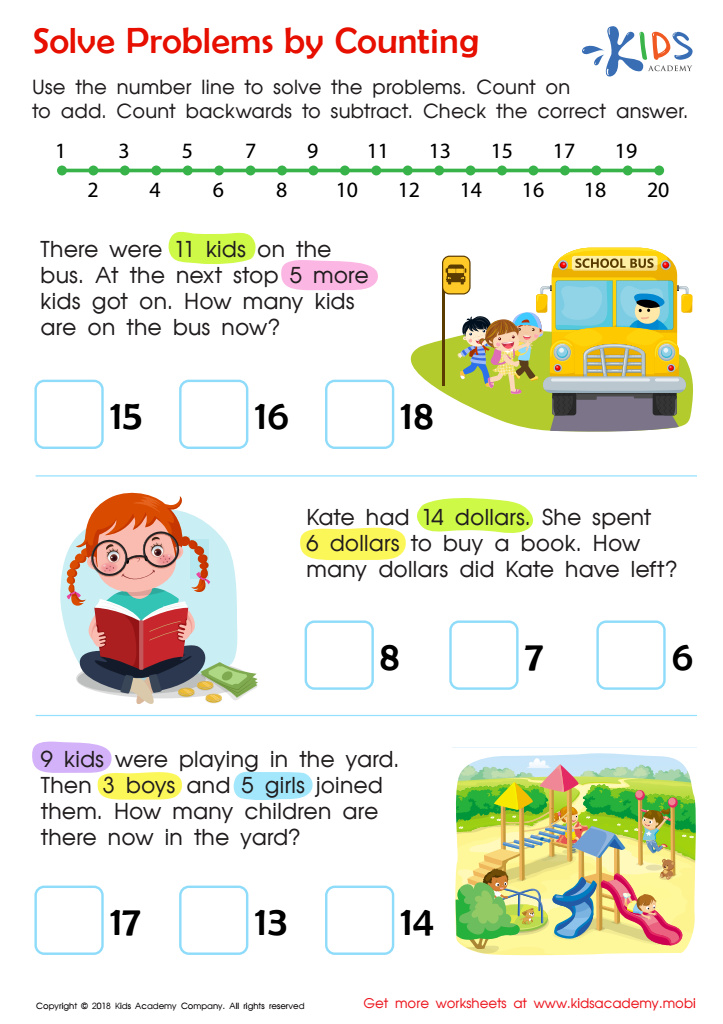
Solve Problems by Counting Worksheet
Download this free colorful worksheet and give your young math student practice with a number line. Counting on or back, they will learn to solve basic addition and subtraction word problems with ease. Ultimately, it will help them develop automaticity for later efficiency with addition and subtraction.
Solve Problems by Counting Worksheet
Worksheet
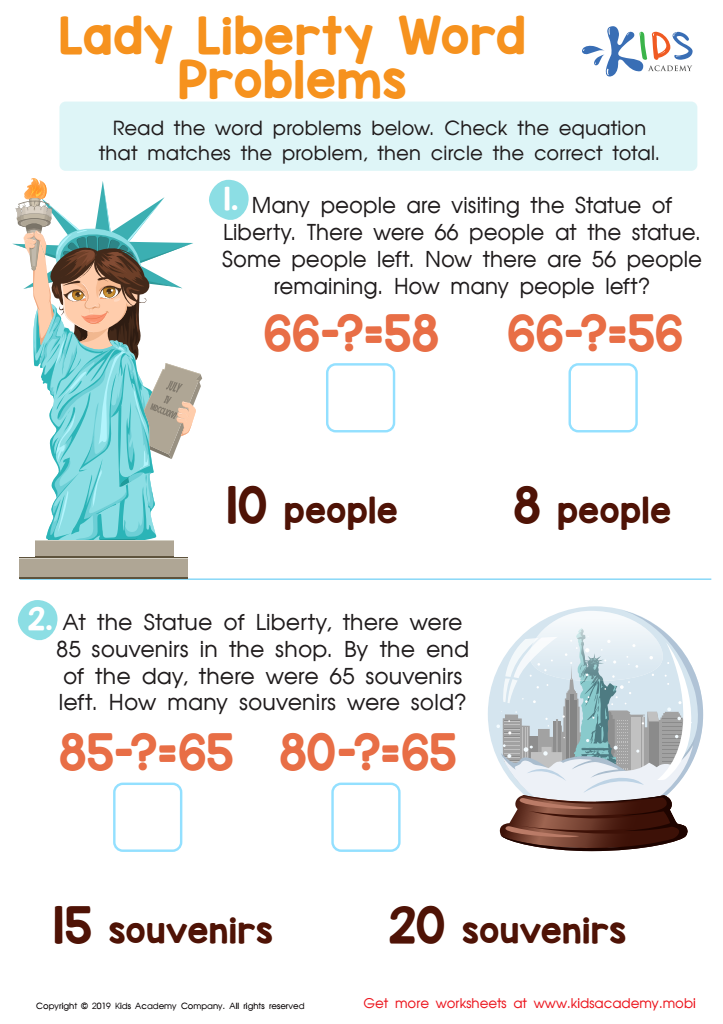
Lady Liberty Worksheet
Have your students ever been to the Statue of Liberty? Ask them to tell you where it is and what it looks like. Every day, the statue draws a crowd admiring its beauty, taking pics and learning more about it. Pose a word problem and help them check the answer. Circle the correct total. (80 words)
Lady Liberty Worksheet
Worksheet
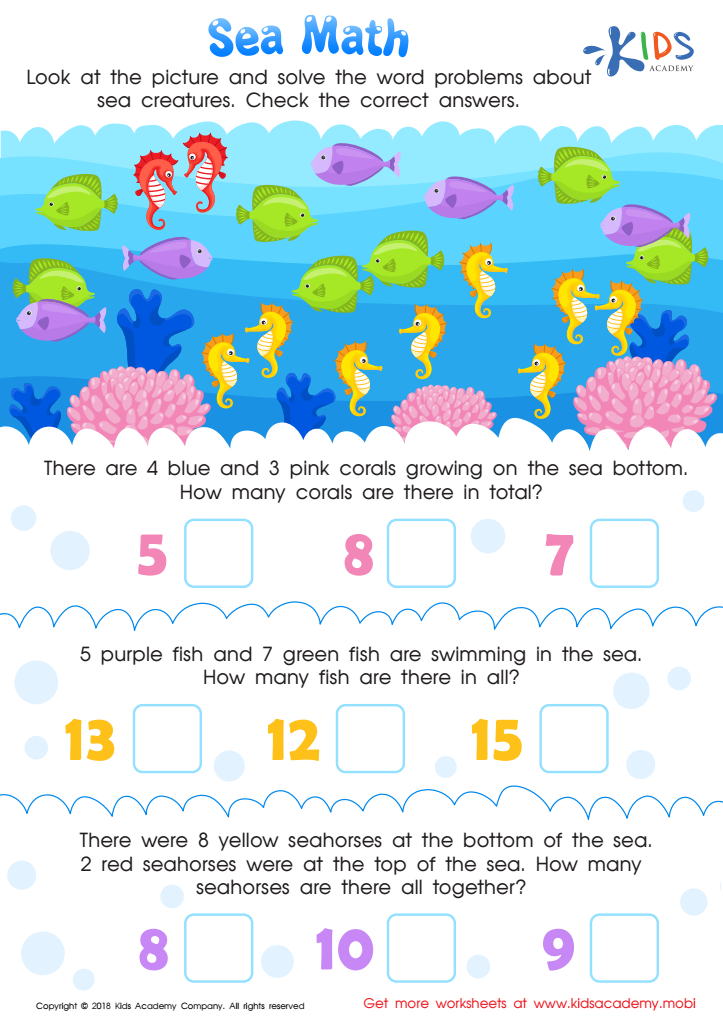
Sea Math Worksheet
Dive into an ocean of addition with this fun math worksheet! Help your little mathematician count and add colorful coral and fish. Point out phrases like "in total" or "all together" as a reminder to use addition. Watch them add to find the answer and check the boxes to finish!
Sea Math Worksheet
Worksheet
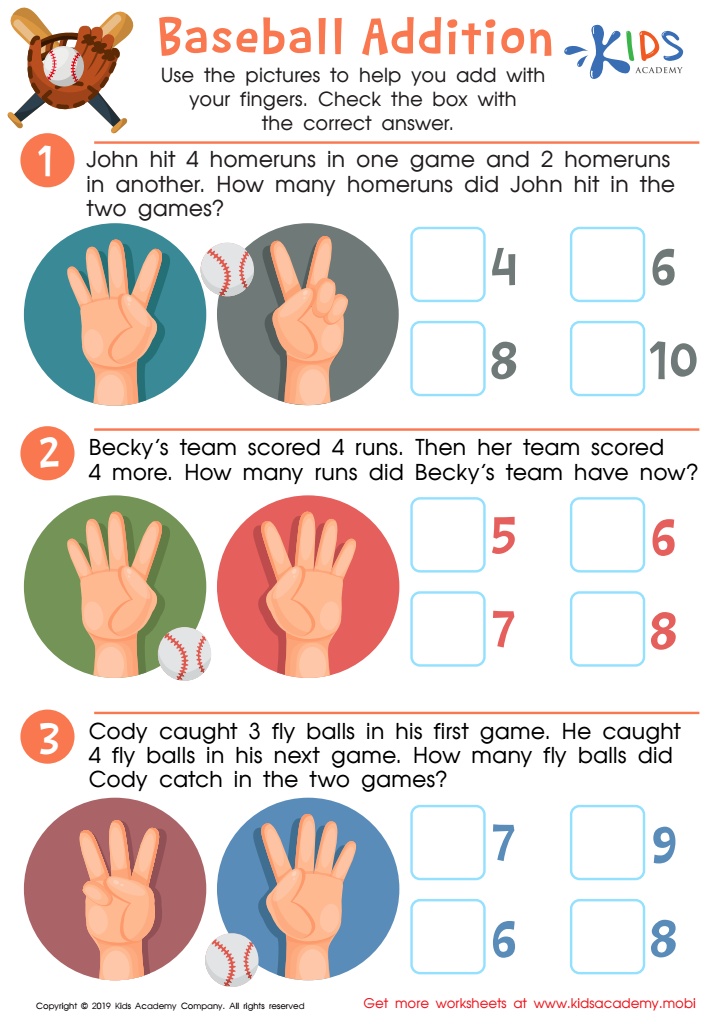
Baseball Addition Worksheet
Let your kids have fun with this baseball-themed addition worksheet! Read the three simple word sentences with them, then use the pictures to help them add with their fingers. Ask them to copy the fingers held up in the pictures, then check the box with the right answer. Kids who love baseball will enjoy this activity!
Baseball Addition Worksheet
Worksheet
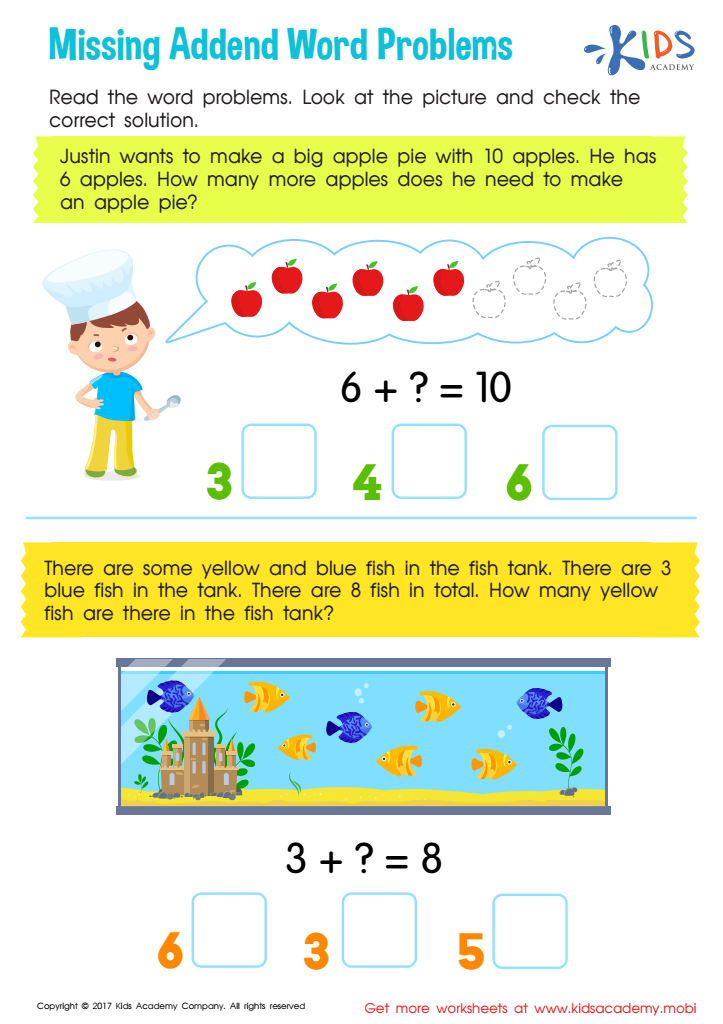
Missing Addend Word Problems Worksheet
Doing many addition and subtraction problems is key for fluency and mastery. Word problems can help kids understand how math works in everyday life. Our math worksheet uses fun scenarios and pictures to teach how to find the missing addend. It's the perfect tool to help kids understand math better!
Missing Addend Word Problems Worksheet
Worksheet
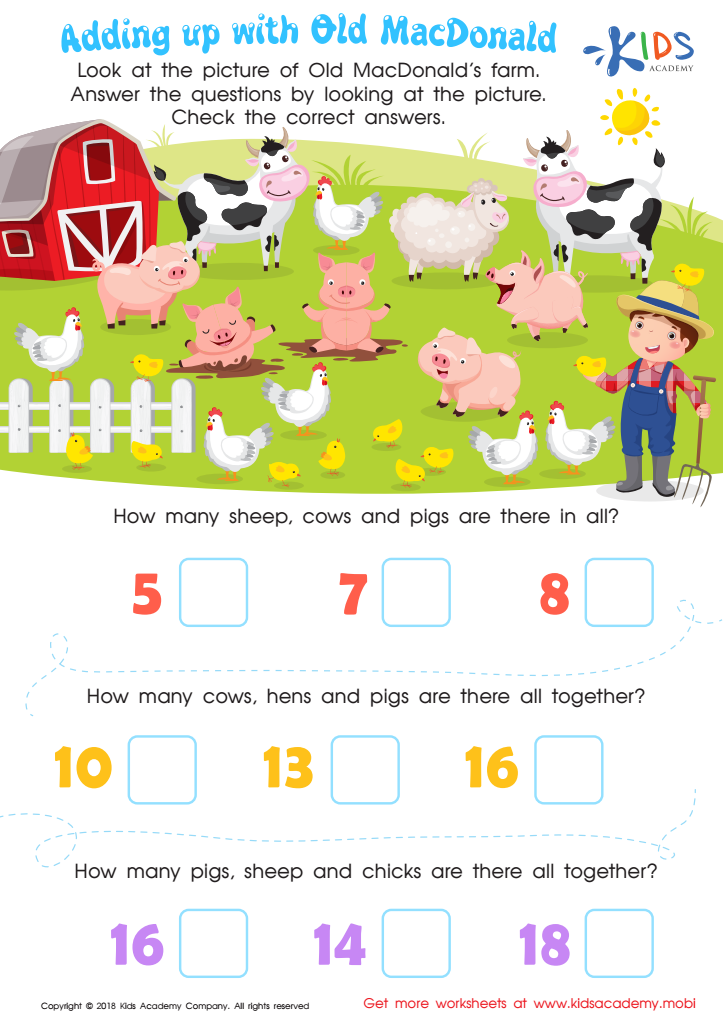
Adding Up with Old MacDonald Worksheet
Old MacDonald needs help counting his animals! Give your little math whiz a fun challenge with a free PDF worksheet. They'll love counting the animals and doing basic addition with two or three addends. Who knew math could be so much fun on the farm?
Adding Up with Old MacDonald Worksheet
Worksheet
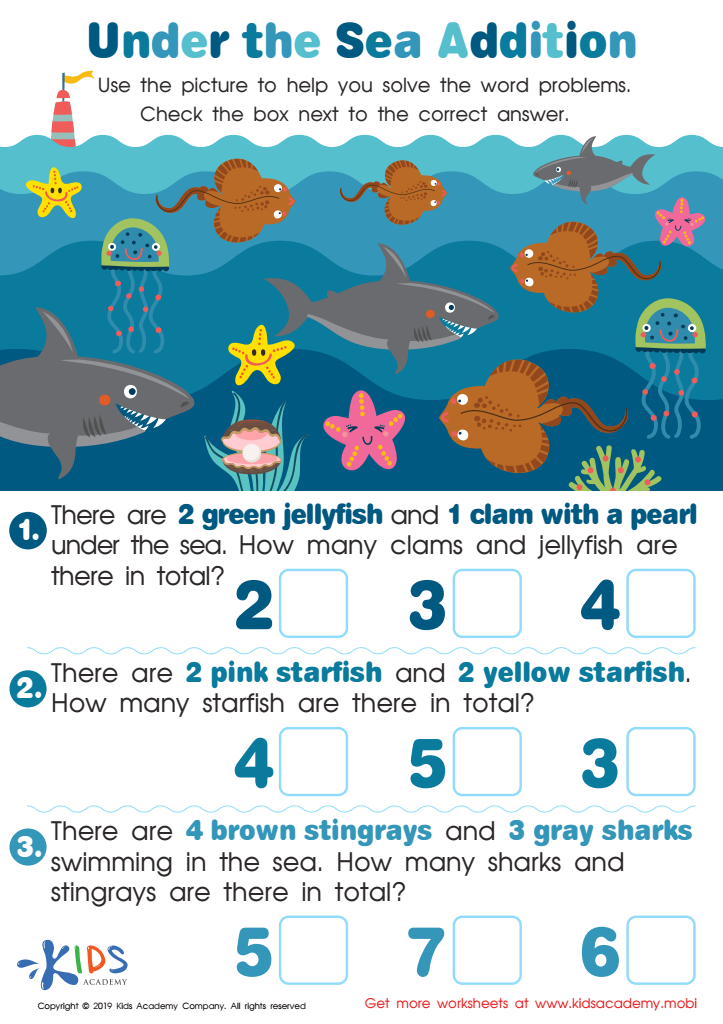
Under the Sea Addition Worksheet
Ask your kids to identify undersea animals in a picture, then solve the word problems at the bottom with it! If they're into the nature channel or marine life, they'll love this worksheet. Check the box next to the correct answer for each one. 80 words
Under the Sea Addition Worksheet
Worksheet
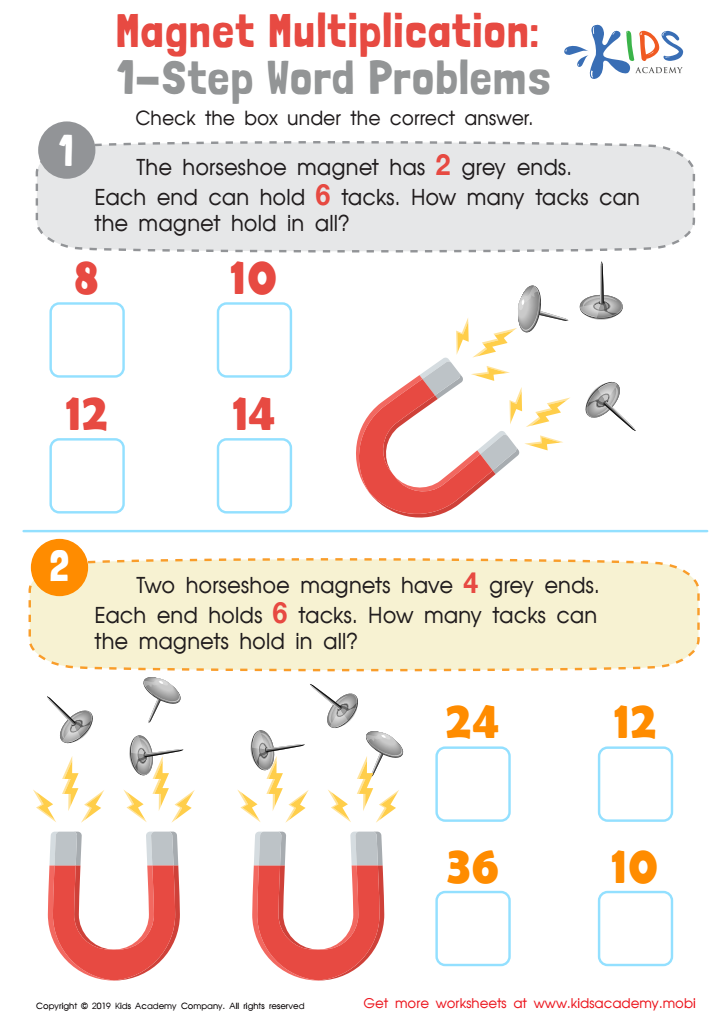
Magnet Multiplication: 1-Step Word Problems Worksheet
Refresh your students' knowledge about magnets with a simple math worksheet. Download the PDF with two word problems, along with pictures to help. Read the problems to the class, and help them identify the correct answer by checking the box. This activity will help them harness their science knowledge and practice their math skills.
Magnet Multiplication: 1-Step Word Problems Worksheet
Worksheet
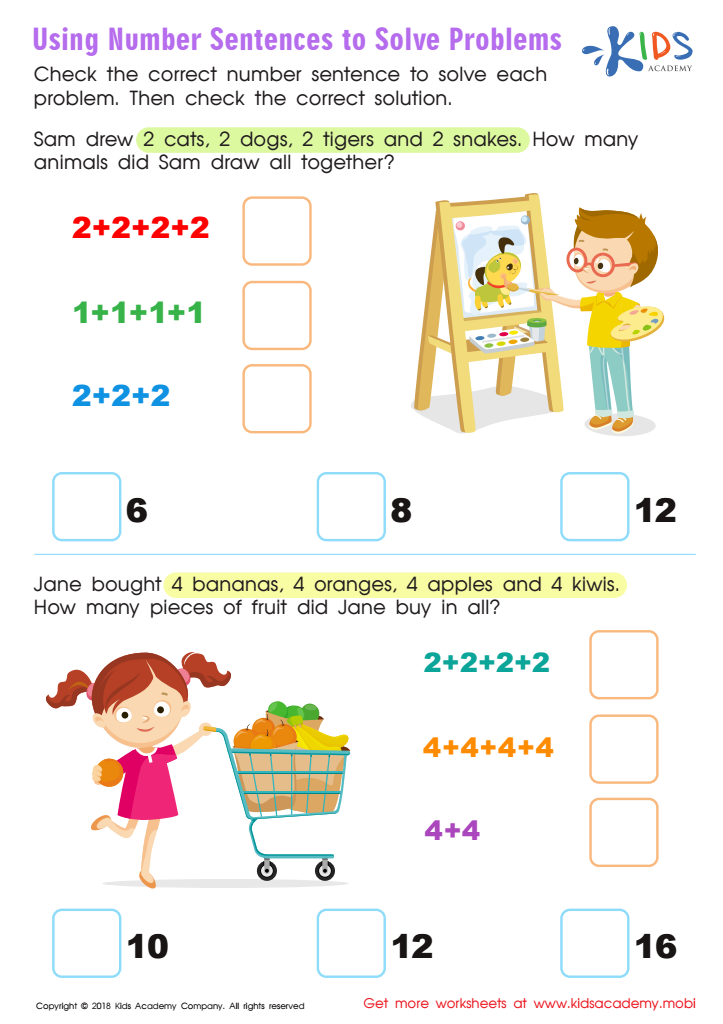
Using Number Sentences to Solve Problems Worksheet
Solving math problems requires an efficient strategy. Picture representation can help young mathematicians with basic addition problems, especially when it involves repeated addends. As they gain confidence, they'll be able to apply their number sentence solving abilities to more complex equations.
Using Number Sentences to Solve Problems Worksheet
Worksheet
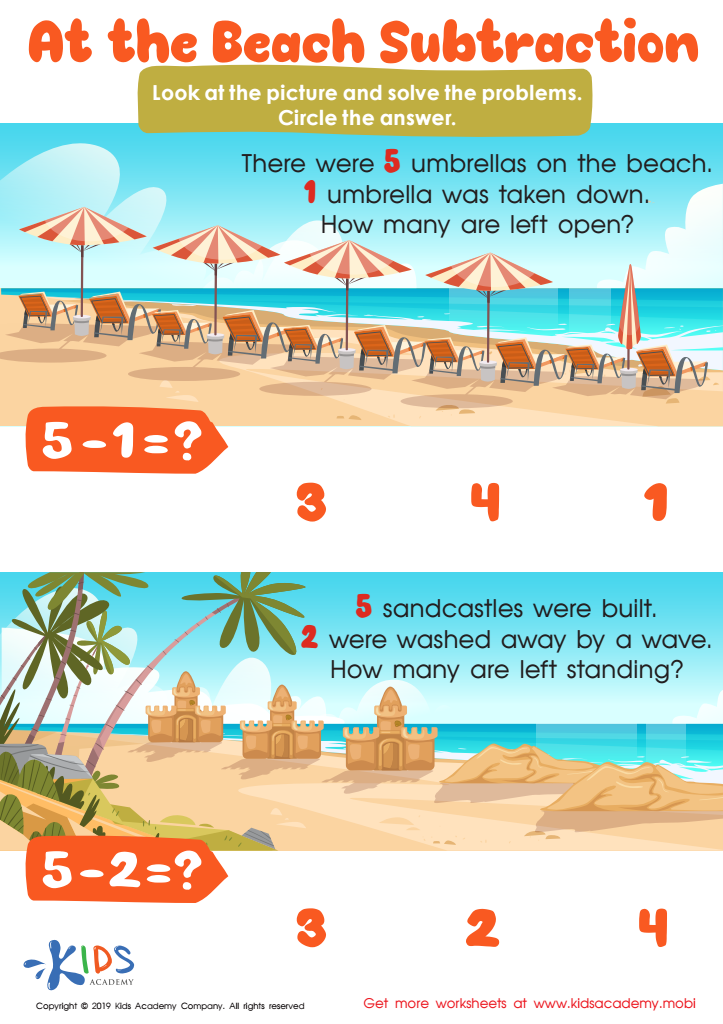
At the Beach Subtraction Worksheet
Take your kids to the beach and show them that math can be fun! Look at the picture on the worksheet, then help them solve the addition and subtraction problems. Check the answers together and enjoy a day of learning and fun!
At the Beach Subtraction Worksheet
Worksheet
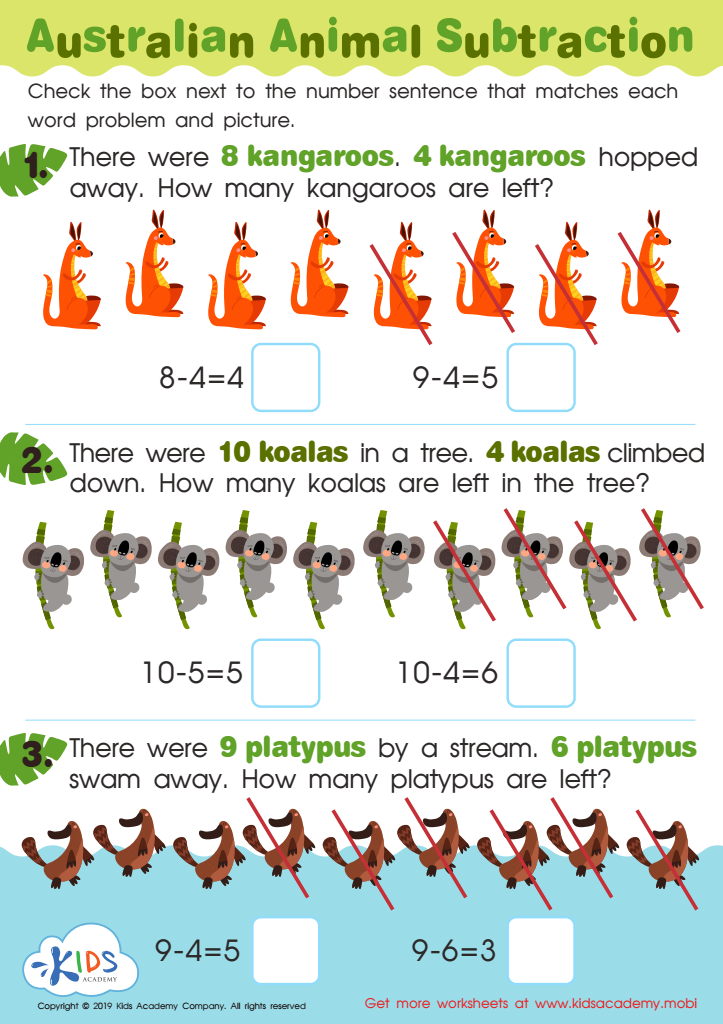
Australian Animal Subtraction Worksheet
Test your child's wildlife knowledge. Ask them to name animals indigenous to Australia or other countries. Show them the animals in this worksheet and have them match each word problem and picture with the correct number sentence.
Australian Animal Subtraction Worksheet
Worksheet
Join Kids Academy for Free
Who is primarily going to use this learning content?





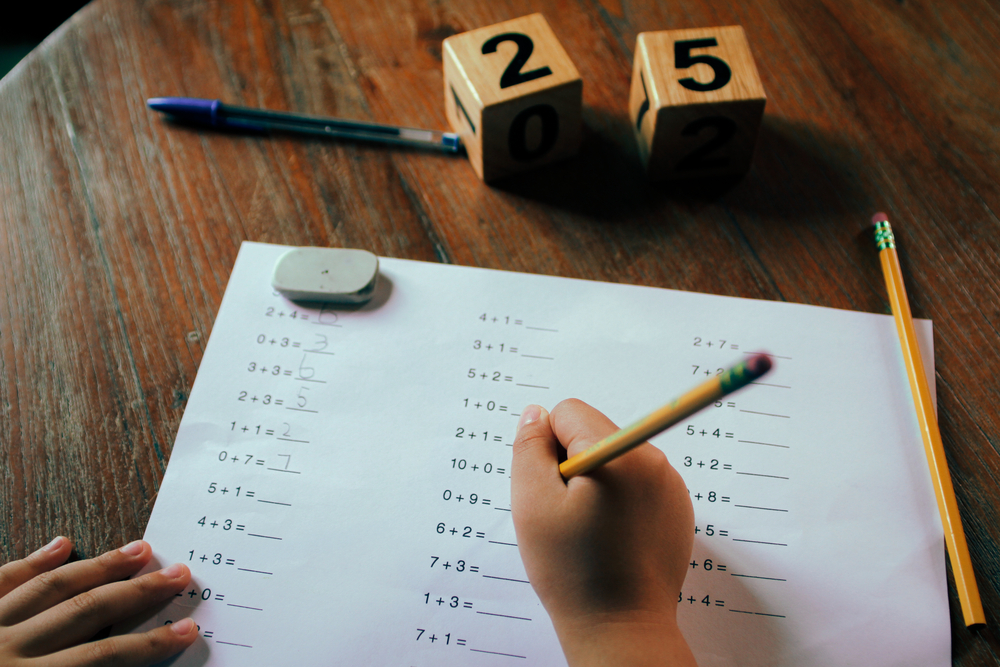


Easy worksheets on Word Problems are an invaluable resource for six-year-old children, facilitating not only their mathematical skills but also enhancing their reading comprehension and problem-solving abilities. These worksheets are particularly useful as part of school homework sheets, providing a structured approach that helps young learners grasp the fundamentals of mathematics in a relatable and practical context.
Word problems are designed to transform abstract mathematical concepts into real-world scenarios, making it easier for children to see the relevance and application of the numbers and operations they learn in class. By the age of six, children are developing crucial cognitive skills and are at a stage where they can begin to handle more complex ideas than simple calculation. Word problems help bridge this transition by encouraging them to think critically and logically.
One of the key advantages of incorporating easy word problems into school homework sheets is that these exercises help children to develop their reading and comprehension skills alongside their mathematical ones. As they read through a problem scenario, they must identify the key pieces of information relevant to solving the question. This dual focus on reading and math not only solidifies their understanding of both subjects but also nurtures a multitasking skill set from an early age.
Additionally, word problems enhance a child’s ability to reason logically and make connections between different pieces of information. This skill is fundamental not just in math but in everyday life. For a six-year-old, easy word problems provide a gentle introduction to the idea of looking beyond the numbers and seeing the story or the problem that these numbers are a part of. This approach helps in developing their analytical skills, as they learn to break down a problem into manageable parts and solve it step-by-step.
Moreover, the use of school homework sheets that include word problems allows parents and teachers to monitor a child’s progress in both reading and mathematics more effectively. These worksheets can be tailored to the individual learning pace and ability of each child, making it possible to address learning gaps early on. They provide a practical tool for reinforcement and practice outside of school hours, allowing children to explore and learn at their own pace in a pressure-free environment at home.
Furthermore, word problems prepare children for higher educational levels where interdisciplinary knowledge and skills become more crucial. They introduce young learners to the concept that math is not just about numbers but about understanding how those numbers interact with the real world. This early introduction paves the way for smoother transitions to more complex mathematical concepts and problems in later years.
In conclusion, easy worksheets on Word Problems are a crucial component of school homework sheets for six-year-olds , enriching their learning experience and building a strong foundation in both math and literacy skills. Through engaging narratives and scenarios, these problems make abstract mathematical concepts tangible and relatable. Moreover, they promote an integrated approach to learning, where children simultaneously enhance their reading comprehension and mathematical problem-solving abilities.
Additionally, the use of word problems in school homework sheets encourages a sense of accomplishment and confidence in young learners. When children successfully comprehend and solve a problem, it boosts their confidence in their own abilities and motivates them to tackle more challenging questions. This positive reinforcement is crucial at an early stage in education, as it fosters a lifelong love for learning and exploration.
Integrating word problems into homework also facilitates greater parent-child interaction. Homework assignments that include these problems give parents a wonderful opportunity to engage with their child’s learning process, helping them to solve problems and explaining concepts in a relatable manner. This not only enhances the child's understanding and retention but also strengthens the bond between parent and child through shared educational activities.
Moreover, easy word problems are designed to be accessible and enjoyable for children. They often involve familiar scenarios, such as playing in the park or grocery shopping, which makes the problems less intimidating and more engaging for young minds. This approach helps in maintaining a child’s interest and curiosity in mathematics, steering away from rote learning to a more understanding-based approach.
Lastly, incorporating word problems in school homework sheets prepares children for standardized testing and real-life situations where they will need to apply their math skills. The ability to extract and utilize information from word problems is a critical skill tested in many standardized exams as children progress through their educational journey. Early exposure to these types of questions can give children a significant advantage by familiarizing them with the format and the skills needed to succeed.
In summary, easy worksheets on Word Problems are essential tools in the educational toolkit for six-year-olds, featured prominently in school homework sheets. They help to cultivate a range of cognitive and interpersonal skills, from mathematical reasoning to reading comprehension, and from problem-solving to collaborative learning with peers or family. By integrating these worksheets into daily homework activities, educators and parents can provide children with a robust educational foundation, setting the stage for academic success and a lifetime of learning.








