Extra Challenge Money Word Problems Worksheets for 3-Year-Olds
1 filtered results
-
From - To
Introducing our Extra Challenge Money Word Problems worksheets, specifically tailored for three-year-old learners! These engaging school online printables are expertly designed to introduce the basics of money through simple, fun word problems. These worksheets not only entertain but also educate, helping young minds develop early mathematical skills and an understanding of monetary concepts in a playful, age-appropriate way. Perfect for both classroom use and home learning, our printables offer a delightful challenge to little learners eager to explore the world of numbers. Equip your child with the foundational skills for future academic success with our user-friendly resources!
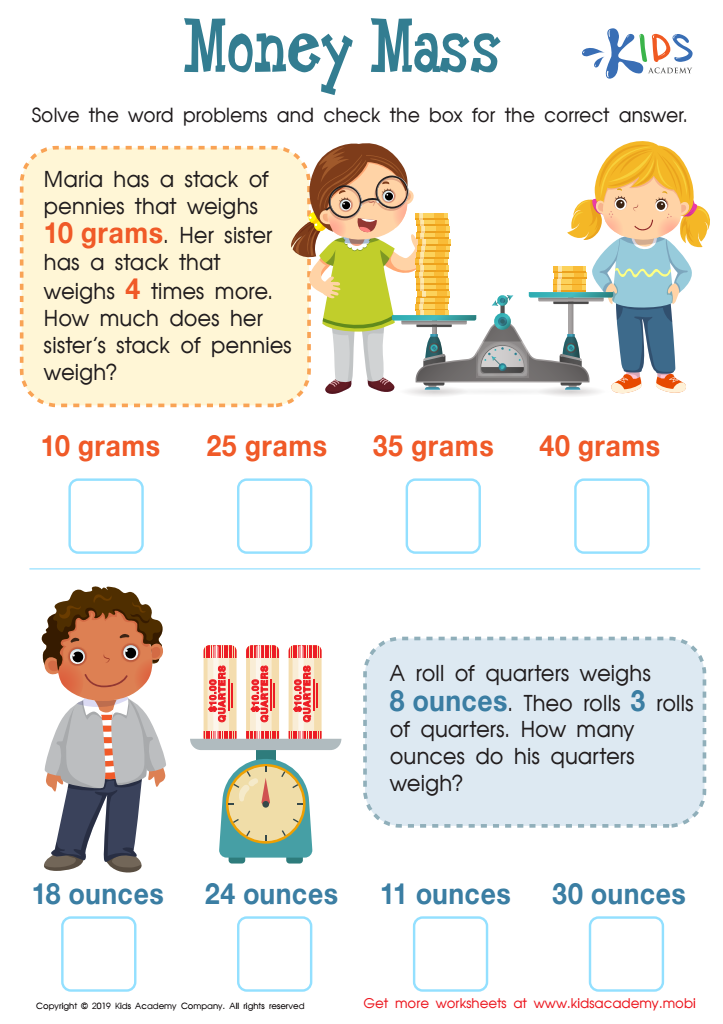
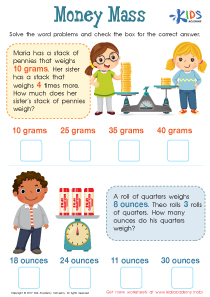
Money Mass Worksheet
 Assign to My Students








The Importance of Extra Challenge Worksheets on Money Word Problems for Three-Year-Olds
In the realm of early childhood education, interactive learning tools are essential for capturing the attention and enhancing the development of young minds. School interactive worksheets, particularly those focusing on money word problems, provide a unique opportunity for three-year-old children to explore fundamental mathematical concepts in an engaging and relatable way. Here’s why these worksheets are particularly beneficial:
1. Introduction to Basic Math Concepts
Money word problems in extra challenge worksheets serve as an excellent introduction to basic math skills. These problems typically involve simple addition and subtraction, which are foundational skills in any mathematical learning journey. By incorporating these into everyday scenarios, such as shopping or saving, children are able to see the practical application of numbers and operations early in life.
2. Development of Problem-Solving Skills
School interactive worksheets designed around money word problems encourage young learners to think critically from an early age. Children are prompted to solve problems that require logical reasoning and decision-making, which are crucial skills not only in math but in daily life. This early exposure to problem-solving helps develop confidence and cognitive abilities, setting a strong foundation for future complex reasoning tasks.
3. Understanding Money Management
Though three-year-olds are at the very beginning of their educational journey, introducing the concept of money through these worksheets can plant the seeds of financial literacy. Learning about coins and bills, and how they are used to purchase goods or services, starts to build their understanding of money management. This is a vital life skill that, when introduced early, can enhance personal responsibility and awareness.
4. Enhanced Engagement Through Interaction
The interactive nature of these worksheets makes learning about money both fun and educational. Interactive elements such as drag-and-drop, matching, or even simple animated stories related to money scenarios keep children engaged and interested in the topic. This is particularly important at such a young age, where attention spans are shorter and learning through play is most effective.
5. Customizable Learning Experience
School interactive worksheets often come with different levels of difficulty and can be easily adapted to the learning pace of each child. For three-year-olds, worksheets can be simplified to focus more on the identification of coins and basic addition, while still challenging them just enough to stimulate their thought process. As they grow and develop, the complexity of the money problems can be increased to continuously challenge them.
6. Preparation for School Environment
Using school interactive worksheets at home can prepare three-year-olds for the structured environment of a classroom. Familiarizing them with the format of worksheets and the concept of completing tasks can ease the transition to a more formal educational setting. These learning tools help children understand following directions, completing assignments, and working independently or with minimal guidance, which are all essential skills for school readiness.
7. Encouraging Parent-Child Interaction
Money word problems on interactive worksheets also offer a perfect opportunity for parents to get involved in their child's early education. Working together on these tasks can enhance the learning experience, as parents can provide immediate feedback, explanations, and encouragement. This not only strengthens the educational outcome but also boosts the child’s confidence and enjoyment in learning new concepts.
8. Development of Fine Motor Skills
Engaging with interactive worksheets often requires the use of digital devices or the manipulation of paper and writing tools. For three-year-olds, these activities are a great way to develop fine motor skills. Whether they are tapping on a tablet, dragging items across a screen, or holding a pencil, children improve their hand-eye coordination and manual dexterity, which are important for other areas of learning such as writing, drawing, and physical activities.
9. Reinforcement of Routine and Discipline
Incorporating regular sessions with school interactive worksheets into a three-year-old’s daily routine can teach them about discipline and the importance of regular practice. Even at such a young age, children can begin to understand that setting aside time for learning is part of their daily activities. This routine can instill a sense of responsibility and time management early on.
10. Enjoyment and Satisfaction
Lastly, the sense of achievement that children gain from solving money word problems cannot be overstated. When a child is able to solve a problem, especially one that mimics a real-life scenario, it provides a real sense of accomplishment. This positive reinforcement encourages continual engagement and a love for learning that can last a lifetime.
Conclusion
Extra challenge worksheets on money word problems are not just about learning how to count money; they are a comprehensive educational tool that supports the holistic development of young children. School interactive worksheets cater specifically to the needs and abilities of three-year-olds, making them an invaluable resource in sparking an early interest in math and problem-solving, while also preparing them for future academic and life challenges. By integrating these fun and educational worksheets into their routine, parents and educators can provide children with a strong foundation for continued success in their learning journeys. The benefits of starting early and using tailored, interactive educational tools like these can have long-lasting impacts on a child's ability to grasp more complex concepts as they grow. Moreover, these worksheets help in nurturing a curious and eager mindset towards learning, ensuring that education becomes a joyous and continuous part of life's journey.
These tools also serve to bridge the gap between theoretical knowledge and real-world application, making learning meaningful and directly observable in everyday situations. This relevance to daily life not only makes the concepts stick but also enriches the child's understanding of how the world operates, especially in terms of economics and finance, albeit at a very basic level initially.
In conclusion, school interactive worksheets on money word problems for three-year-olds are much more than just child's play. They are a strategic and effective approach to early childhood education, focusing on developing a range of cognitive, emotional, and practical skills. By introducing these concepts early, we set our children on a path to academic readiness, financial awareness, and a lifelong love for learning, ensuring they have the tools needed to navigate their educational paths and beyond with confidence and curiosity.