
Normal Skip Counting Worksheets for Ages 3-4
1 filtered results
Difficulty Level
Grade
Age
-
From - To
Subject
Activity
Standards
Discover the joy of numbers with our Normal Skip Counting worksheets, specially crafted for Ages 3-4. Designed to introduce young learners to the basics of skip counting, these worksheets are the perfect tool for early math education. Through engaging activities and simple, colorful designs, children will learn to count by twos, fives, and tens in a fun and interactive way. Our Normal Skip Counting worksheets are tailored to captivate and educate toddlers, paving the way for a lifelong love of numbers. Start your child's math journey on the right foot with this essential learning resource.
Favorites
With answer key
Interactive
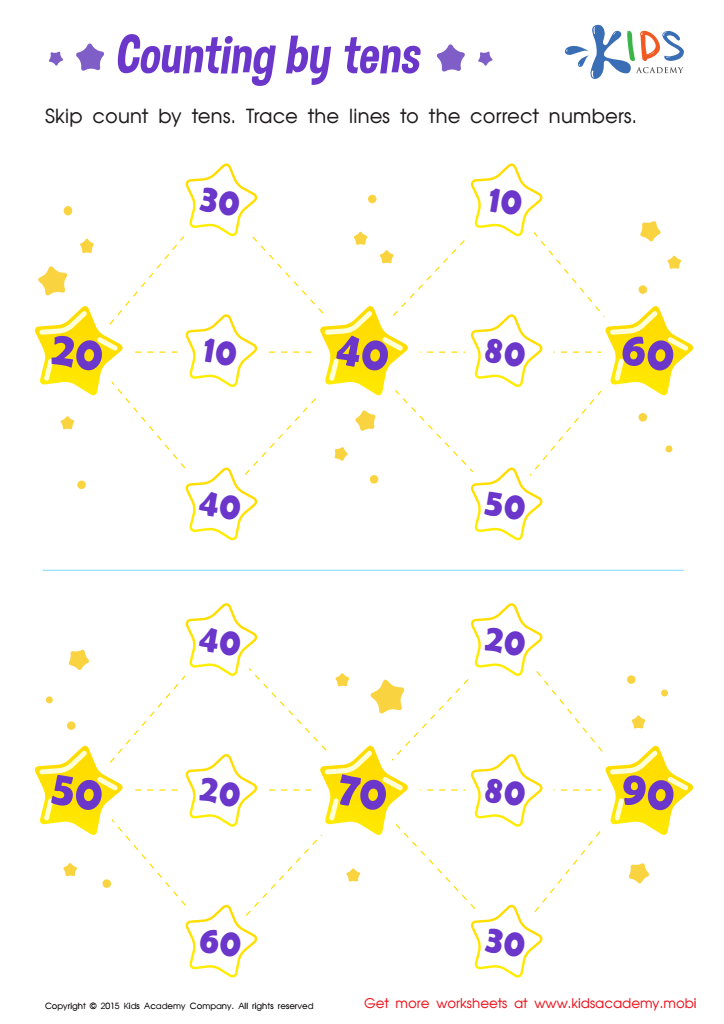
Learn Dozens: Counting by Tens Printable
Kindergartners need to learn skip counting - counting in number groups - to increase number sense and be ready for more advanced math. Our kindergarten worksheet featuring a starry trip to outer space will help your child practice this valuable skill. Your child will choose correct answers to trace the lines to the stars, building fluency in skip counting. They'll also strengthen problem solving and see the pattern it creates. Get your little learner to the next level with this skip counting worksheet!
 Assign to My Students
Learn Dozens: Counting by Tens Printable
Worksheet
Learning Skills
Join Kids Academy for Free
Who is primarily going to use this learning content?








Normal Skip Counting worksheets for Ages 3-4 play a pivotal role in laying the foundation of early mathematical skills among young learners. These specially designed resources are not just about numbers; they are about recognizing patterns, understanding sequences, and building a strong base for future arithmetic operations. Here's why they are incredibly useful:
-
Development of Number Sense: Normal Skip Counting worksheets for Ages 3-4 introduce children to the concept of counting in intervals, helping them grasp the idea of quantity and order. This early exposure is crucial for developing a robust number sense, which is fundamental in mathematics.
-
Enhances Memory: Regular practice with these worksheets aids in memorizing number sequences. Over time, children learn to recall these sequences effortlessly, which is a critical skill in the realm of learning and education.
-
Builds Confidence: Mastering skip counting boosts young learners' confidence in their mathematical abilities. This newfound confidence encourages them to explore more complex concepts with enthusiasm and less apprehension.
-
Preparation for Advanced Math: Skip counting is a stepping stone to understanding multiplication and division. By mastering skip counting through these worksheets, children are indirectly preparing for more advanced mathematical concepts.
In conclusion, Normal Skip Counting worksheets for Ages 3-4 are an essential educational tool. They not only make learning fun but also ensure that children are well-prepared for the mathematical challenges that lie ahead.








