Normal Vowels Worksheets for Ages 5-9 - Page 4
73 filtered results
-
From - To
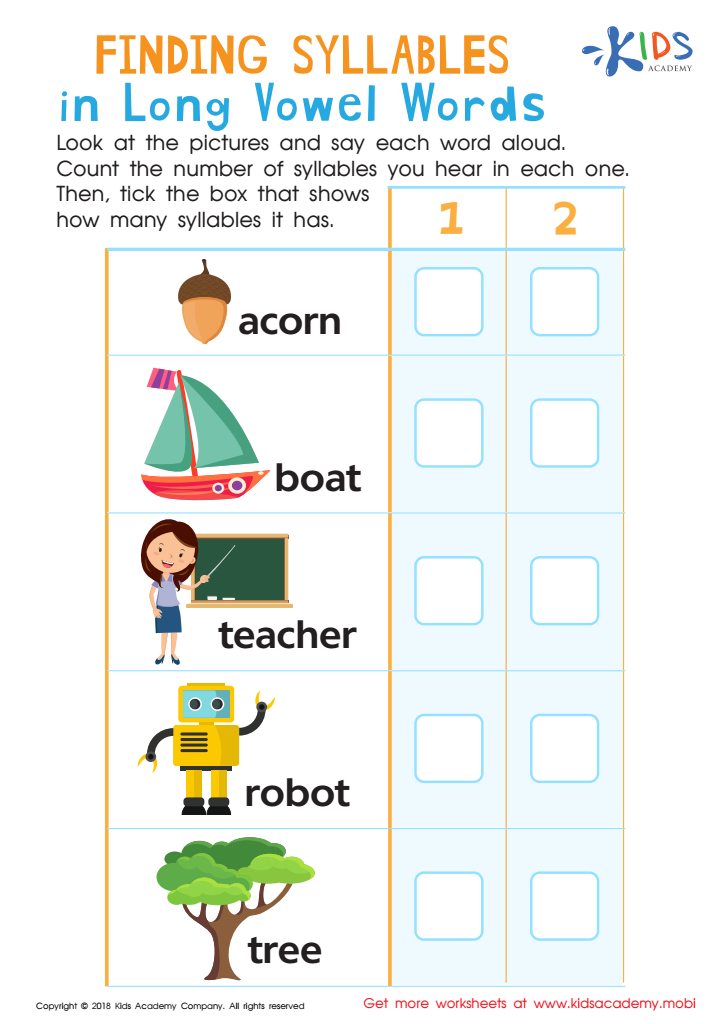
Finding Syllables in Long Vowel Words Worksheet
 Assign to My Students





Parents and teachers should care about normal vowels for children aged 5-9 because vowels form the foundational building blocks of reading and communication. At this critical age, children are developing phonemic awareness—the ability to hear and manipulate sounds in words—which is essential for fluent reading. Understanding normal vowels helps children decode and produce words correctly, leading to better reading comprehension and written expression.
Vowels are especially important because they occur in every syllable of English words. Mastery of these sounds impacts a child's ability to blend sounds together, an essential skill in reading. Mispronouncing vowels can lead to difficulties in spelling, word recognition, and verbal communication.
For young learners, consistent exposure to the correct vowel sounds ensures that they can recognize and reproduce the phonetic patterns of English. This lays a solid groundwork for future literacy. Moreover, early intervention in cases where children struggle with vowel sounds can prevent delayed reading and writing skills, boosting academic confidence and performance.
By focusing on vowel sounds, parents and teachers can offer targeted practice through fun, interactive activities such as phonics games, songs, and storytelling. This method not only reinforces correct pronunciation but also makes learning enjoyable, fostering a lifelong love for reading.