Normal Fun Money Word Problems Worksheets With Answers for Grade 2
1 filtered results
-
From - To
Answer Keys for Normal Money Word Problems Worksheets for Grade 2
Introducing our Normal Money Word Problems worksheets, expertly designed for Grade 2 students. These school downloadable worksheets offer engaging and educational content that helps children master the basics of money management and problem-solving skills. Each worksheet is filled with practical scenarios to enhance understanding of everyday transactions and basic arithmetic. Tailored to align with educational standards, these worksheets provide a perfect blend of challenge and fun, making them an ideal resource for both classroom and home use. Empower your children to become confident with currency concepts through these meticulously crafted exercises. Ideal for young learners eager to excel in math!
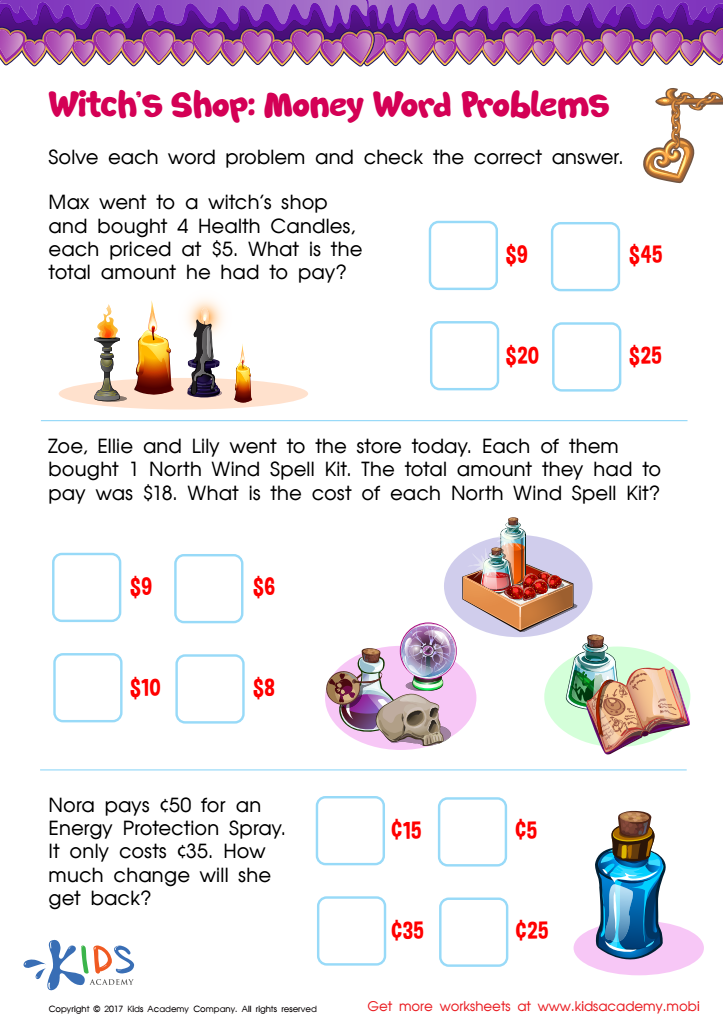
Money Word Problems Printable
 Assign to My Students






The Importance of Normal Worksheets on Money Word Problems for Grade 2 Students
In the formative years of elementary education, it's essential for children to develop a robust foundation in various subjects, including mathematics. Specifically, understanding money and its applications through word problems can significantly enhance a child’s numerical and problem-solving skills. This is where school homework sheets focusing on money word problems become highly beneficial.
Money word problems worksheets are particularly useful for second graders as they begin to encounter real-world applications of math. At this stage, children are usually familiar with basic arithmetic—addition and subtraction—which are crucial in solving money word problems. These worksheets help bridge the gap between theoretical math concepts and their practical uses, making the learning process both engaging and relevant.
Here are some key reasons why normal worksheets on money word problems are an invaluable educational tool for children in Grade 2:
-
Enhanced Problem-Solving Skills: Money word problems require children to read, comprehend, and solve problems based on real-life scenarios involving money. This not only tests their arithmetic skills but also improves their ability to think critically and make decisions. By regularly working on these school homework sheets, children learn to approach problems systematically, breaking them down into more manageable parts.
-
Real-World Application: Understanding money is a fundamental life skill. Through these worksheets, children learn how to count money, make change, and understand the value of different denominations. These are essential skills that children will use throughout their lives, not just in their academic journey but also in everyday situations.
-
Developing Financial Literacy Early: Introducing basic concepts of money management through word problems can spark an early interest in financial literacy. Children learn about saving, spending, and the basics of budgeting through contextual problems tailored for their understanding. This early exposure helps inculcate responsible money habits from a young age.
-
Improved Mathematical Fluency: Regular practice with money word problems increases mathematical fluency. As children solve more problems involving addition, subtraction, and basic multiplication related to money, they become quicker and more accurate in their calculations. This fluency is beneficial across all areas of math.
-
Boosts Confidence: Mastery of a concept as tangible and useful as money can significantly boost a child's confidence in their math skills. This confidence can translate into better performance in other mathematical areas and subjects at school.
-
Engagement and Motivation: School homework sheets with themes like shopping, saving, and other money-related activities can be very engaging for children. They often find it more interesting to solve problems that mimic real-life scenarios they may see their parents or adults around them engaging in. This relevance helps to keep them motivated, making them more likely to complete their homework and actively participate in class discussions.
-
Integration with Other Subjects: Money word problems can also be integrated with other learning areas such as reading comprehension and social studies. By reading through the problems, children improve their literacy skills. Furthermore, discussions around money can lead to a better understanding of economics, community roles, and even global trade basics, thus providing a multidisciplinary learning experience.
-
Preparation for Advanced Concepts: By mastering money calculations and word problems by the second grade, children lay a strong foundation for more complex mathematical concepts and personal finance management in later grades. This early preparation makes subsequent learning less daunting and more intuitive.
-
Parental Involvement: These worksheets offer a great opportunity for parents to get involved in their child's learning process. Money management is practical and relevant for adults, making it easier for them to engage with their children over homework. This can lead to enriching discussions about money, its value, and management, fostering a deeper parent-child bond.
-
Feedback for Improvement: Regular assignments such as school homework sheets provide teachers and parents with a clear assessment of a child’s progress. They can identify areas where the child may be struggling, like understanding certain concepts of money or solving specific types of problems, allowing for targeted intervention and support.
In conclusion, normal worksheets on money word problems are more than just an academic activity for second graders. They are a critical educational tool that helps in the development of numerous skills, including mathematical operations, problem-solving, financial literacy, and real-world application. By incorporating these worksheets into the daily learning routine, educators and parents can significantly enhance the educational journey of children, preparing them for complex future challenges both academically and in everyday life.