Counting skills Easy Subtraction Worksheets for Ages 3-8
4 filtered results
Difficulty Level
Grade
Age
-
From - To
Subject
Activity
Standards
Boost your child’s mathematical confidence with our "Counting Skills Easy Subtraction Worksheets" designed for ages 3-8. These engaging worksheets introduce foundational subtraction concepts through fun and interactive activities. Tailored to various skill levels, children will develop essential counting and subtraction skills while enjoying colorful illustrations and relatable scenarios. Perfect for home or classroom use, these worksheets foster critical thinking and problem-solving abilities. Each worksheet is carefully crafted to ensure that youngsters grasp the relationship between addition and subtraction, making math an enjoyable adventure. Start your child's journey to mathematical mastery today with our easy-to-use resources!
Favorites
With answer key
Interactive
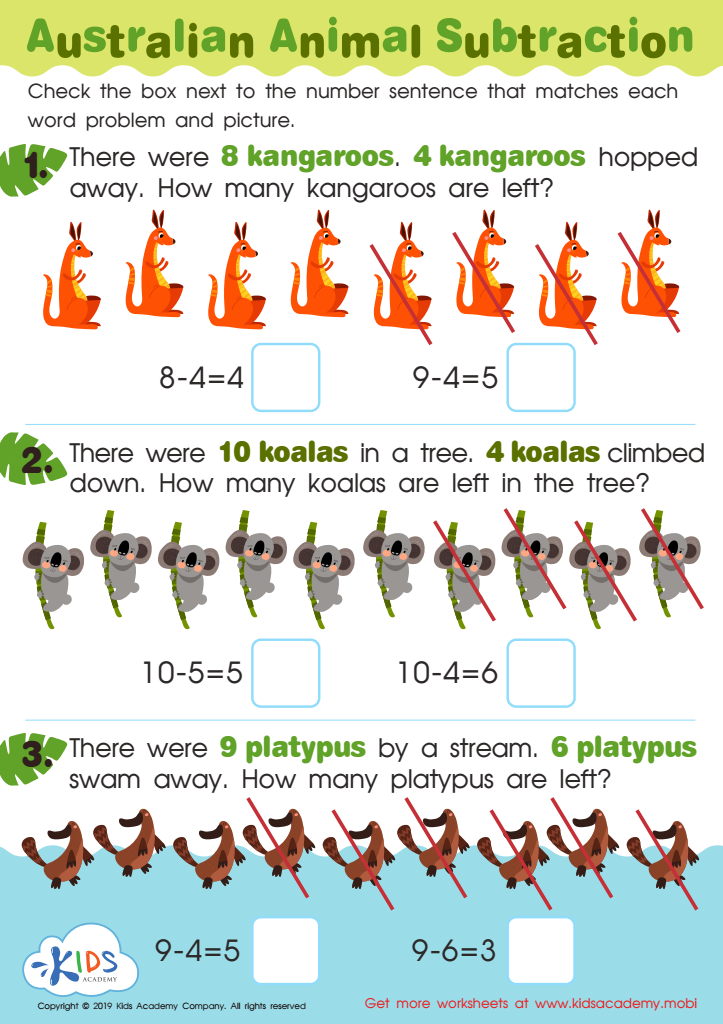
Australian Animal Subtraction Worksheet
Test your child's wildlife knowledge. Ask them to name animals indigenous to Australia or other countries. Show them the animals in this worksheet and have them match each word problem and picture with the correct number sentence.
 Assign to My Students
Australian Animal Subtraction Worksheet
Worksheet
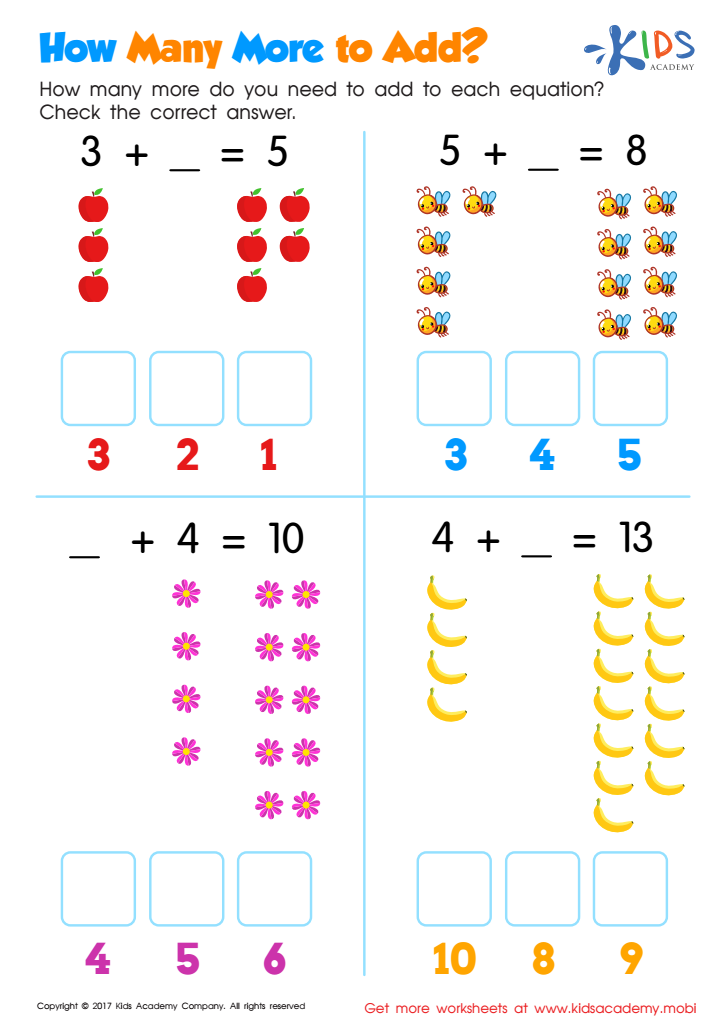
How Many More to Add Worksheet
Sharpen your child's math skills with this pdf worksheet. Help them figure out how many apples, bees, flowers and bananas are needed to reach the answer given. The possible answers are provided at the bottom of the boxes. Have some fun doing some addition and subtraction magic together and get those math skills sharpened!
How Many More to Add Worksheet
Worksheet
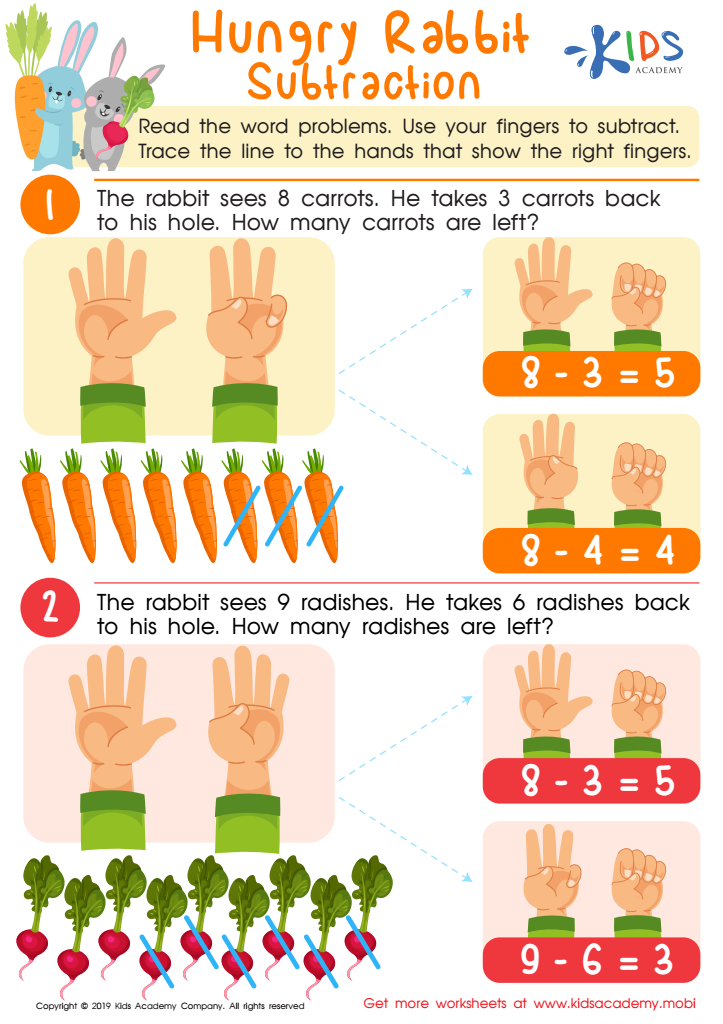
Hungry Rabbit Subtraction Worksheet
Subtractions can be daunting for kids. Help them see math in a new light by using this simple worksheet. Read the word problem out loud and have them use their fingers to subtract. Then, trace the line to the hands that show the answer. This will show them that they don't have to be scared of math and subtraction.
Hungry Rabbit Subtraction Worksheet
Worksheet
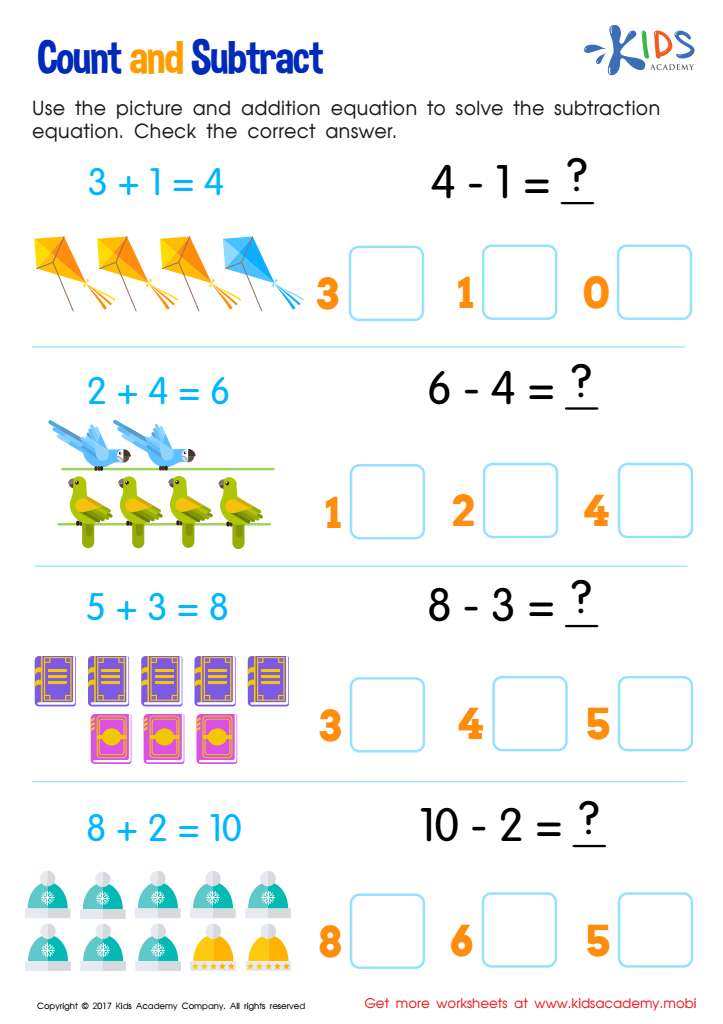
Count and Subtract Worksheet
This worksheet helps your child learn math via colorful pictures and equations. Count the items together, adding and subtracting as necessary. Your child will be challenged to get the correct total, thereby developing their math skills.
Count and Subtract Worksheet
Worksheet
Join Kids Academy for Free
Who is primarily going to use this learning content?








Counting skills and easy subtraction are foundational mathematical concepts essential for children aged 3-8. Developing these skills fosters a strong mathematical foundation, crucial for later academic success. Early counting experiences help children understand the relationship between numbers, laying the groundwork for more complex operations.
As young learners engage with counting and subtraction, they enhance their problem-solving abilities and critical thinking. These skills are not only vital for math but also help in daily life situations, such as budgeting, time management, and measuring. Furthermore, mastering these concepts boosts a child's confidence, encouraging a positive attitude toward learning.
For parents and teachers, nurturing these skills creates a rich educational environment. It allows for supportive interactions that can make learning fun and engaging. Effective strategies, such as using everyday objects for counting or incorporating games, make the learning process enjoyable.
Investment in counting and subtraction during these formative years pays off, ensuring children are better prepared for future academic challenges. Ultimately, fostering these skills equips children with essential life skills while nurturing a lifelong love for learning, making it imperative for caregivers and educators to prioritize this early mathematical instruction.