Spatial reasoning Easy Math Worksheets for Ages 4-8
3 filtered results
-
From - To
Enhance your child’s math skills with our engaging Spatial Reasoning Easy Math Worksheets designed for ages 4-8. These fun, educational printables help young learners develop essential spatial awareness and problem-solving abilities. Each worksheet offers a variety of activities like pattern recognition, shape sorting, and maze navigation, stimulating their imagination and critical thinking. Ideal for early learners, our expertly crafted exercises encourage interactive learning, making math enjoyable and accessible. Perfect for use at home or in the classroom, these worksheets support cognitive growth and a strong mathematical foundation. Empower your child's learning journey today!
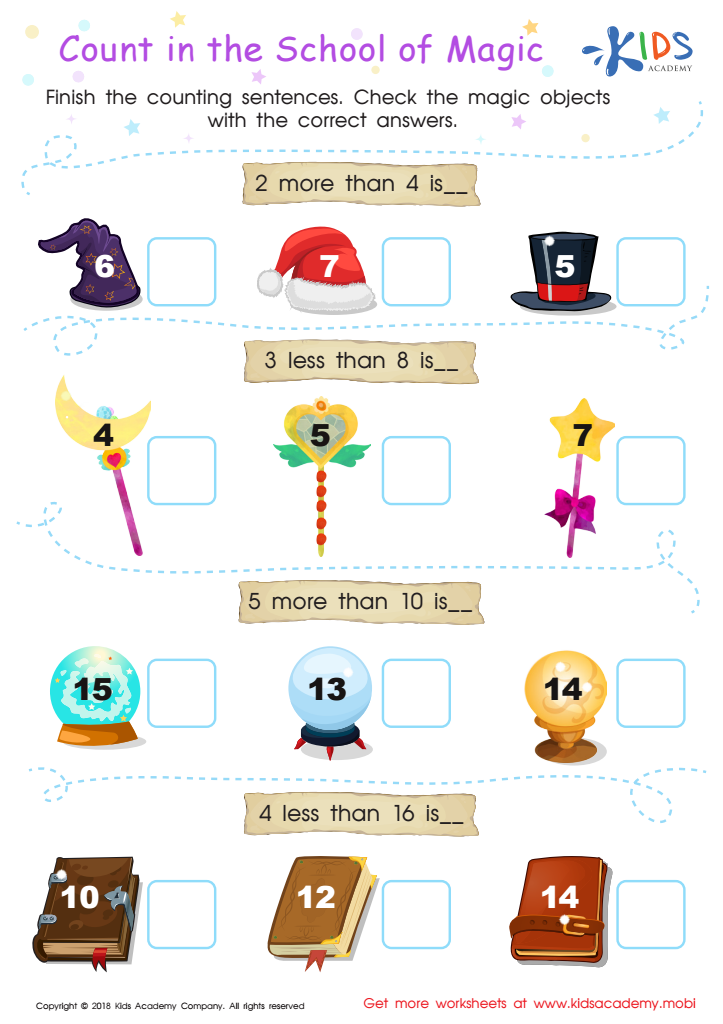
Count in the School of Magic Worksheet
 Assign to My Students
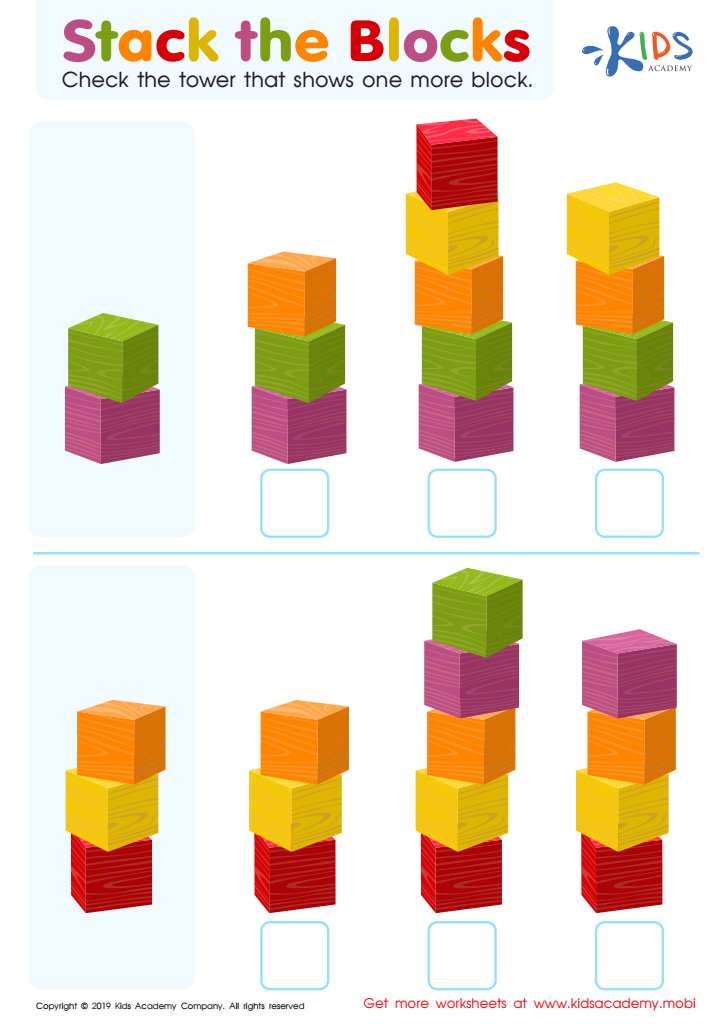
Stack the Blocks Worksheet
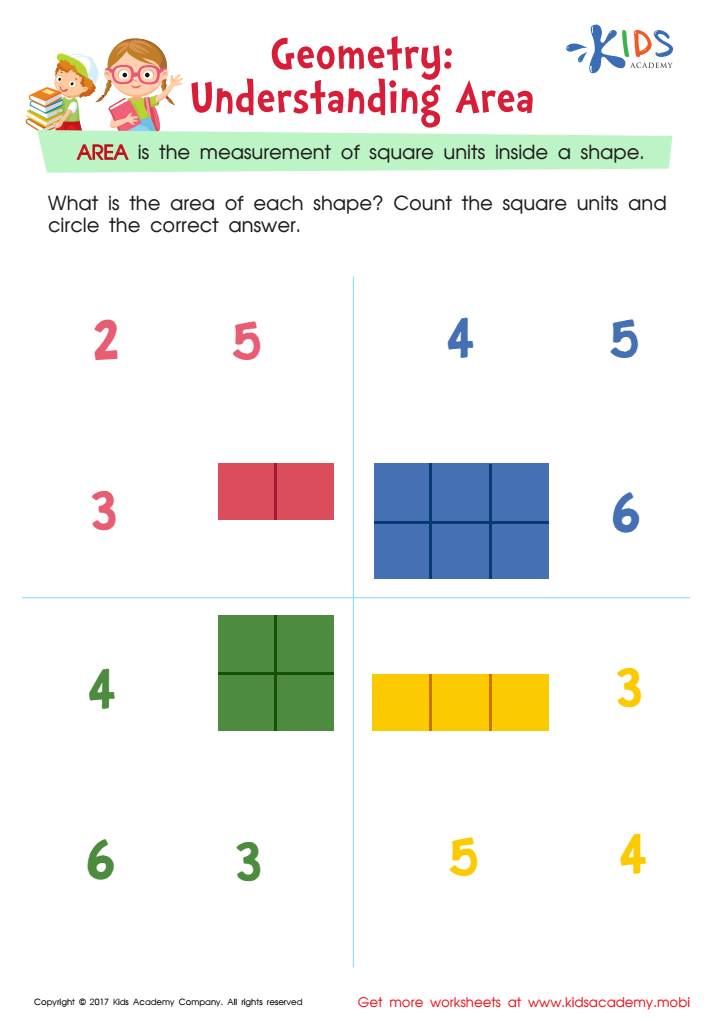
Understanding Area Worksheet





Spatial reasoning is the ability to understand and manipulate objects and shapes in a spatial context, and it is foundational for children aged 4-8. Parents and teachers should care about nurturing this skill because it plays a pivotal role in early math development. Research shows that strong spatial skills are linked to better performance in STEM (Science, Technology, Engineering, and Math) subjects later in life.
For young children, improving spatial reasoning can lead to enhanced problem-solving capabilities, as they learn to visualize and manipulate different scenarios in their minds. Activities that develop skills like shape recognition, understanding geometric relationships, and grasping the properties of objects contribute not just to math proficiency, but also to reading comprehension and writing by aiding in the recognition of letters and numbers, which are essentially shapes.
Additionally, spatial reasoning helps children overcome real-world challenges—they can better assess space while playing, organizing toys, or even in understanding geography through maps. It fosters creativity by enabling them to build and invent objects while playing.
In conclusion, parents and teachers should emphasize spatial reasoning as it not only lays a critical mathematical foundation but also enhances overall cognitive development, setting children up for success in various academic and life pursuits.








