
Time reading skills Easy Math Worksheets for Ages 5-9
4 filtered results
Difficulty Level
Grade
Age
-
From - To
Subject
Activity
Standards
Boost your child's confidence in telling time with our "Time Reading Skills Easy Math Worksheets for Ages 5-9." These engaging and educational worksheets are designed to help young learners master the basics of reading analog and digital clocks. Perfectly tailored for kids aged 5-9, our fun activities range from identifying hours and minutes to understanding concepts of AM and PM. Enhance your child's time-telling abilities while they enjoy solving puzzles and matching exercises. Created by experts at Kids Academy, our worksheets are the ideal resource for parents and teachers seeking to ensure foundational math skills. Download and start learning today!
Favorites
With answer key
Interactive
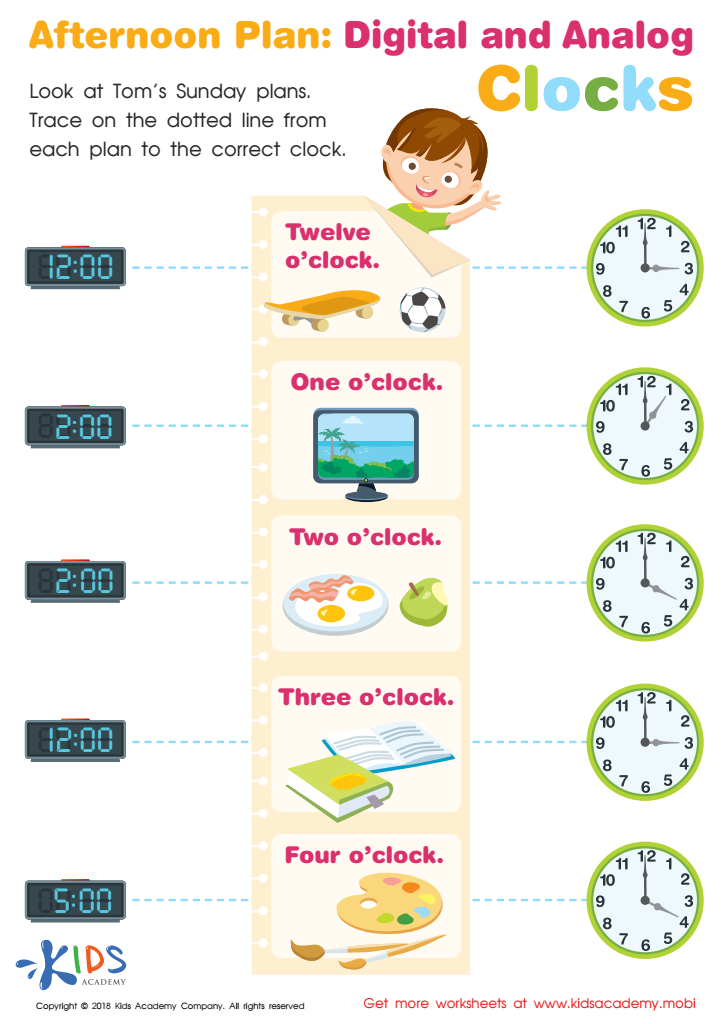
Afternoon Plan: Digital and Analog Clocks Worksheet
Tom's got Sunday plans and your kids can use this worksheet to help them learn how to tell the time. With tracing dotted lines from plans to the correct clock, they'll gain the skills to accurately convert digital time to analog. It'll be a great way to get them better at telling the time.
 Assign to My Students
Afternoon Plan: Digital and Analog Clocks Worksheet
Worksheet
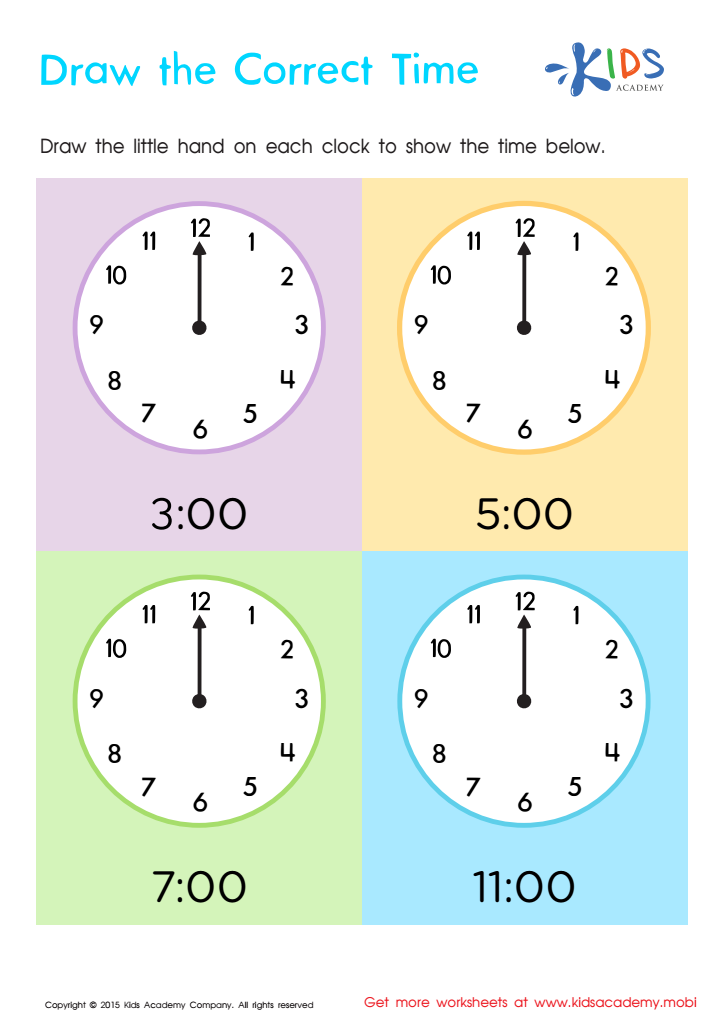
Telling The Time Worksheet: Part 1
Practice telling the time with Kids Academy. Our worksheets make it fun for kindergarteners to learn about clocks and reading the time. Find our free math worksheets on telling the time and draw the little hand on the clock faces to show the time. Let's learn together!
Telling The Time Worksheet: Part 1
Worksheet
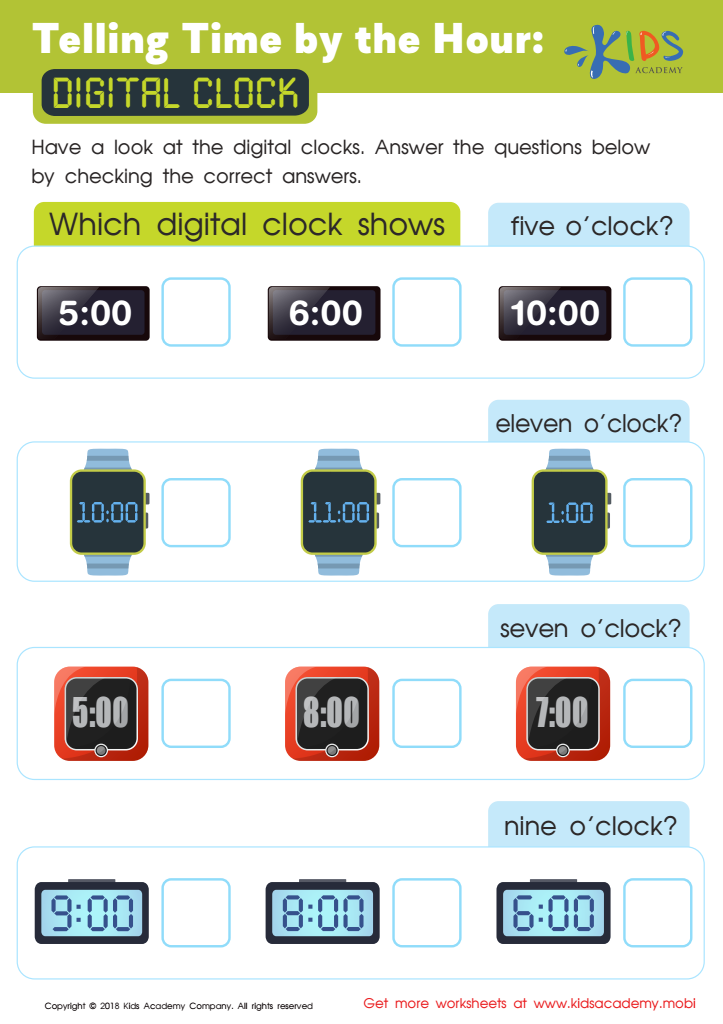
Telling Time by the Hour: Digital Clock Worksheet
Introduce your students to digital clocks. This worksheet will help them become familiar with them. Guide them through answering the questions - they're simple and stimulating. Encourage their young minds to explore the digital clocks in the exercise.
Telling Time by the Hour: Digital Clock Worksheet
Worksheet
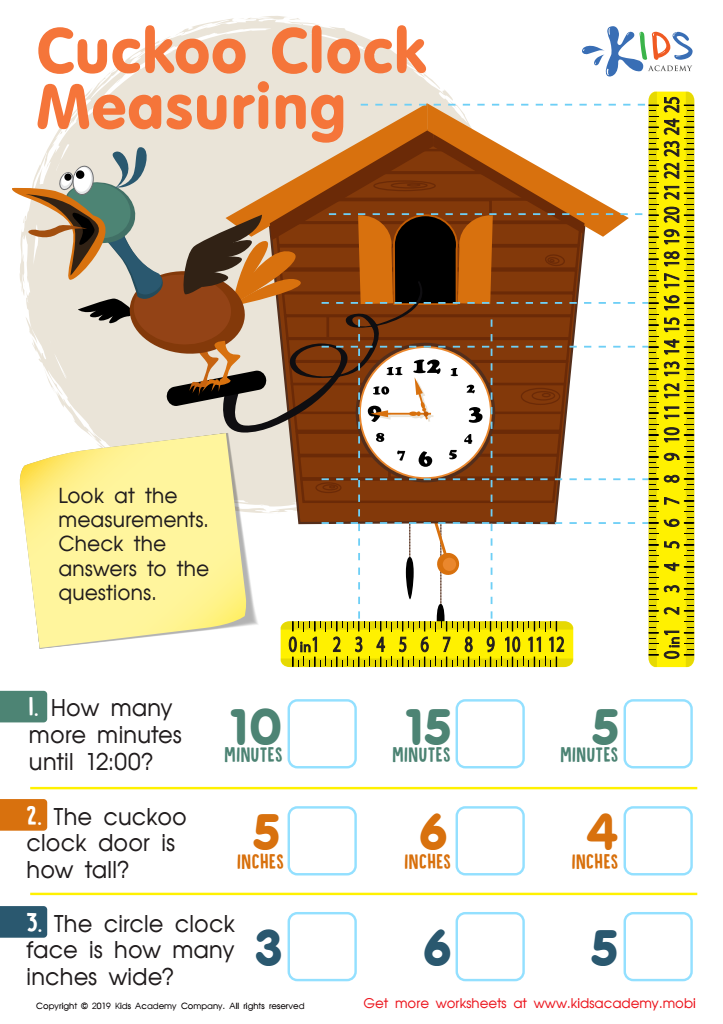
Cuckoo Clock Measuring Worksheet
Check out the fun picture in this worksheet. Ask your kids to identify the object. It's a cuckoo clock - the bird pops out every hour to announce the time. See if your child knows how to measure the clock. Help them answer the 3 questions and test their knowledge of time!
Cuckoo Clock Measuring Worksheet
Worksheet
Join Kids Academy for Free
Who is primarily going to use this learning content?






Parents and teachers should prioritize time reading skills and easy math for children ages 5-9 for several impactful reasons. Firstly, learning to read an analog clock strengthens children's understanding of the passage of time, fostering essential life management skills. Knowing what time it is helps children build a strong sense of routine and structure, serving as a foundation for daily activities and punctuality.
Simultaneously, easy math skills lay the groundwork for more advanced mathematical concepts. Developing confidence in basic operations like addition, subtraction, multiplication, and division within this age range is crucial. Early proficiency in math equips children with problem-solving skills and logical reasoning abilities that benefit them across all academic subjects and in real-life situations.
Moreover, fostering time reading and math skills enhances cognitive development. It improves memory, attention, and spatial-temporal skills, contributing to better overall brain function. Effective monitoring and support from parents and teachers can also identify and address early learning difficulties, ensuring that children do not fall behind their peers.
Encouraging time reading and math at an early age not only boosts academic achievement but also enables children to understand and interact with the world around them more effectively, setting them up for long-term success and independence.








