
Identifying shapes Easy Worksheets for Ages 6-9
3 filtered results
Difficulty Level
Grade
Age
-
From - To
Subject
Activity
Standards
Discover our engaging “Identifying Shapes Easy Worksheets” designed specifically for children aged 6-9! Our printable resources help young learners explore the world of shapes through fun and interactive exercises. From circles to triangles, these worksheets align with early education standards, promoting foundational geometry skills. Each activity is crafted to enhance recognition and differentiation of shapes, encouraging creativity and critical thinking. Ideal for classroom use or home learning, our worksheets provide clear instructions and colorful illustrations that captivate children's attention. Boost your child's confidence in math while making learning enjoyable! Download now and watch them master shapes with ease.
Favorites
With answer key
Interactive
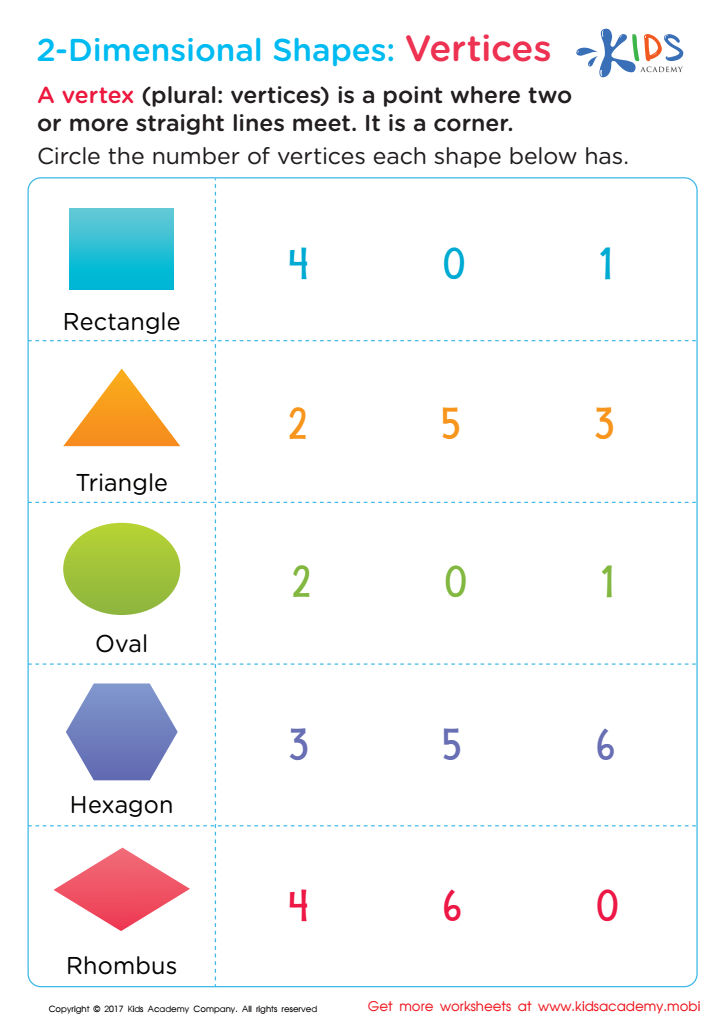
Two–Dimensional Shapes: Vertices Printable
This colorful worksheet teaches kids geometry by introducing them to two-dimensional shapes and vertices. Kids can practice counting vertices and learn an important new math term in an easy to understand way. Boost your child's knowledge of geometry today!
Two–Dimensional Shapes: Vertices Printable
Worksheet
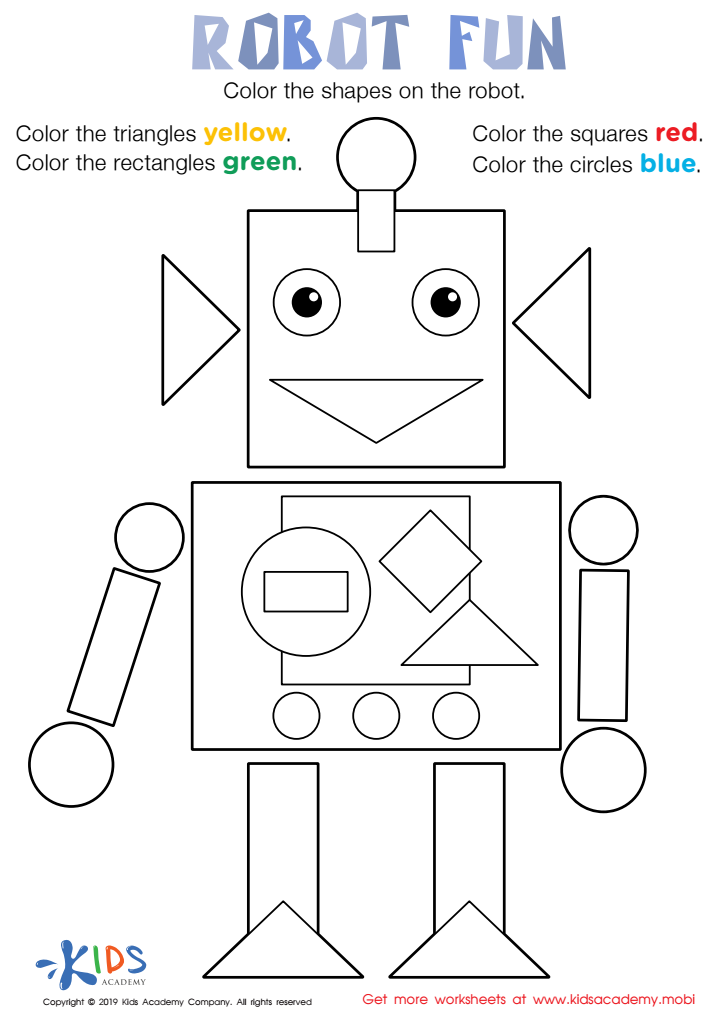
Robot Fun Worksheet
Help your child learn about basic shapes with this fun robot worksheet! Kids practice identifying circles, squares, rectangles and triangles, then color each shape according to directions. Make math practice enjoyable with this coloring page that teaches all four basic shapes - it's an important math skill!
Download (PDF)
 Assign to My Students
Assign to My Students
Robot Fun Worksheet
Worksheet
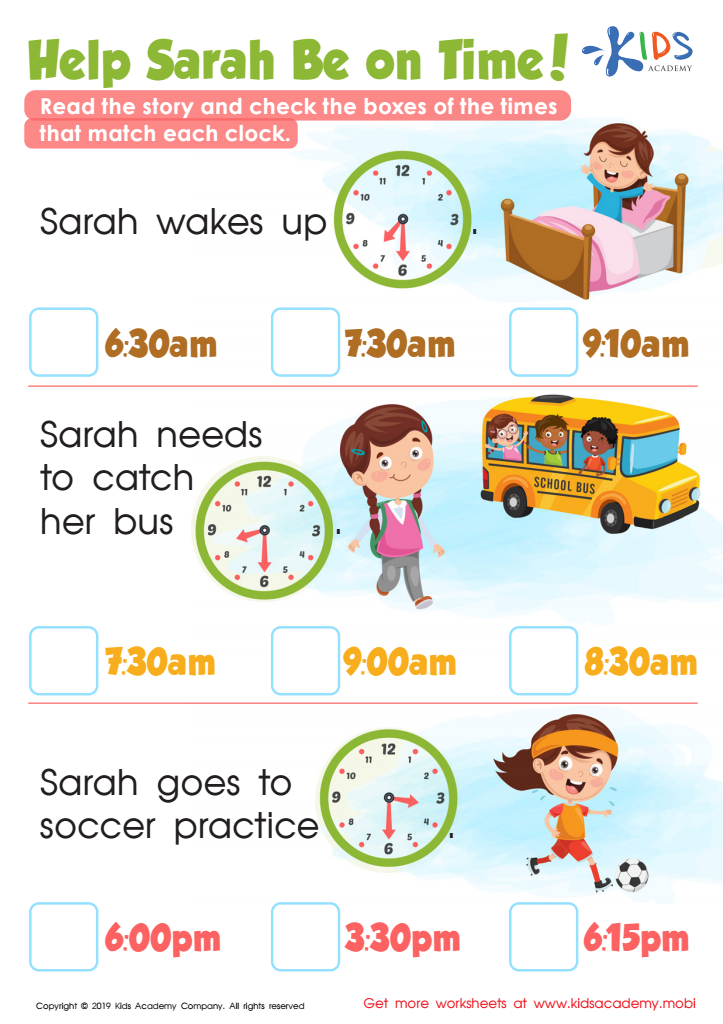
Help Sarah Be on Time! Worksheet
Humans are social creatures and need to be punctual for things to run smoothly. For instance, a meeting with a friend requires a time to be agreed upon. Ask your kids what else needs to be punctual. Then, show them the worksheet and read the accompanying story. Get them to match clocks with the correct times.
Help Sarah Be on Time! Worksheet
Worksheet
Join Kids Academy for Free
Who is primarily going to use this learning content?







Identifying shapes is a fundamental skill for children ages 6-9, serving as a crucial building block for their overall development. For parents and teachers, understanding the importance of this skill can greatly enhance a child’s learning experience. First, shape recognition helps promote spatial awareness, which is essential in math, art, and everyday problem-solving. When children can identify and differentiate shapes, they develop the ability to visualize and understand their environment better.
Additionally, recognizing shapes fosters critical thinking and analytical skills. As children categorize and compare shapes, they learn to observe similarities and differences, which encourages curiosity and exploration. This process also lays the groundwork for more complex mathematical concepts, such as geometry, which will be essential in their educational journey.
Moreover, engaging in shape identification can be a fun, hands-on activity that promotes teamwork and communication among peers. It can enhance fine motor skills through activities like drawing, cutting, and assembling shapes.
Incorporating shape identification into daily activities—whether at home through games or in school through projects—can nurture these skills and make learning enjoyable. Ultimately, by supporting this early learning stage, parents and teachers contribute to a child's confidence and interest in learning.








