Number Recognition Easy Numbers Worksheets for Ages 6-9 - Page 4
75 filtered results
-
From - To

Counting on the City Skyline: Dot-to-Dot Worksheet
 Assign to My Students
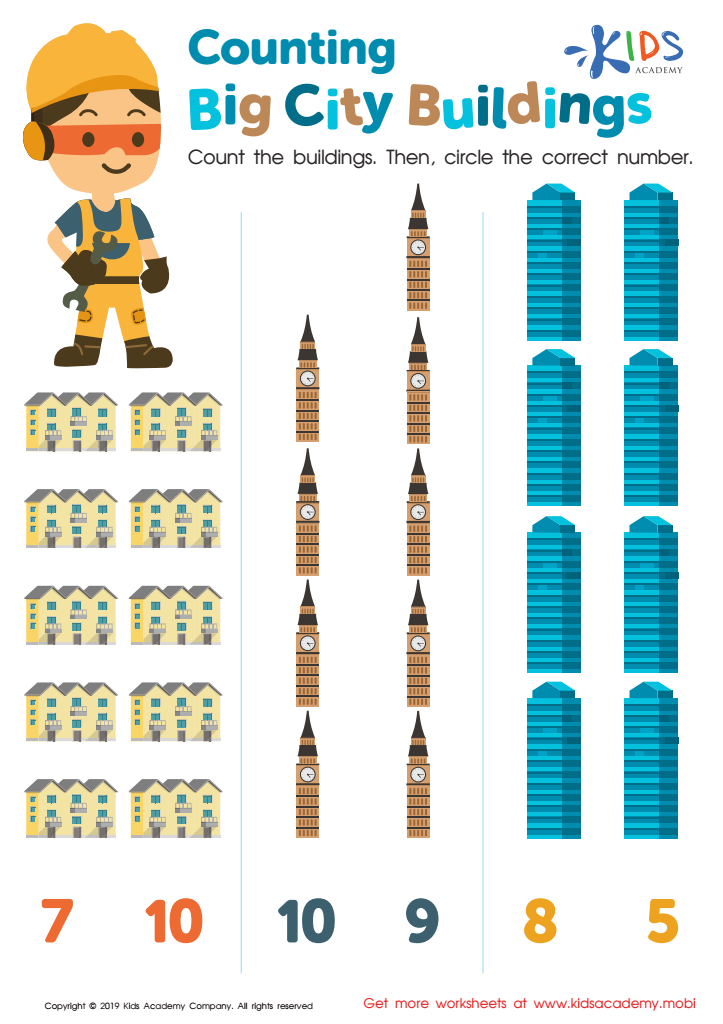
Counting Big City Buildings Worksheet

Night Sky Numbers Worksheet








Number recognition is a foundational skill essential for children aged 6-9 as it significantly influences their mathematical development. During this key stage, students transition from basic numeral identification to more complex mathematical concepts. Understanding easy numbers helps children build confidence in their calculation abilities, which is vital for future success in subjects like arithmetic, geometry, and even higher-organizational tasks like budgeting or data interpretation.
Parents and teachers should care about number recognition because it reinforces cognitive skills, critical thinking, and problem-solving capabilities. It also lays the groundwork for understanding larger mathematical concepts, such as addition and subtraction, by helping children recognize quantities distinctly. Moreover, number fluency aids in day-to-day activities, from counting change to telling time.
When parents and teachers actively engage with children in number recognition activities, they also nourish a positive attitude towards math. Fun games, visual aids, and consistent practice can make learning enjoyable, promoting a love for mathematics that lasts a lifetime. Ultimately, focusing on easy number recognition during these formative years can create a solid foundation, enabling children to excel academically and in practical life scenarios, and set them up for a successful future.








