
Understanding fractions Easy Worksheets for 6-Year-Olds
8 filtered results
Difficulty Level
Grade
Age
-
From - To
Subject
Activity
Standards
Understanding fractions can be challenging for young learners, but with our "Understanding Fractions Easy Worksheets for 6-Year-Olds," the concept becomes a breeze! Designed to cater to the curious minds of 6-year-olds, these worksheets offer engaging and visually appealing activities to introduce fractions in a fun and simple way. With clear illustrations and step-by-step exercises, kids quickly grasp how to divide shapes and objects into equal parts. Perfect for parents and teachers, these resources ensure a stress-free learning experience, allowing children to master fractions effortlessly. Let Kids Academy guide your child to fraction success today!
Favorites
With answer key
Interactive
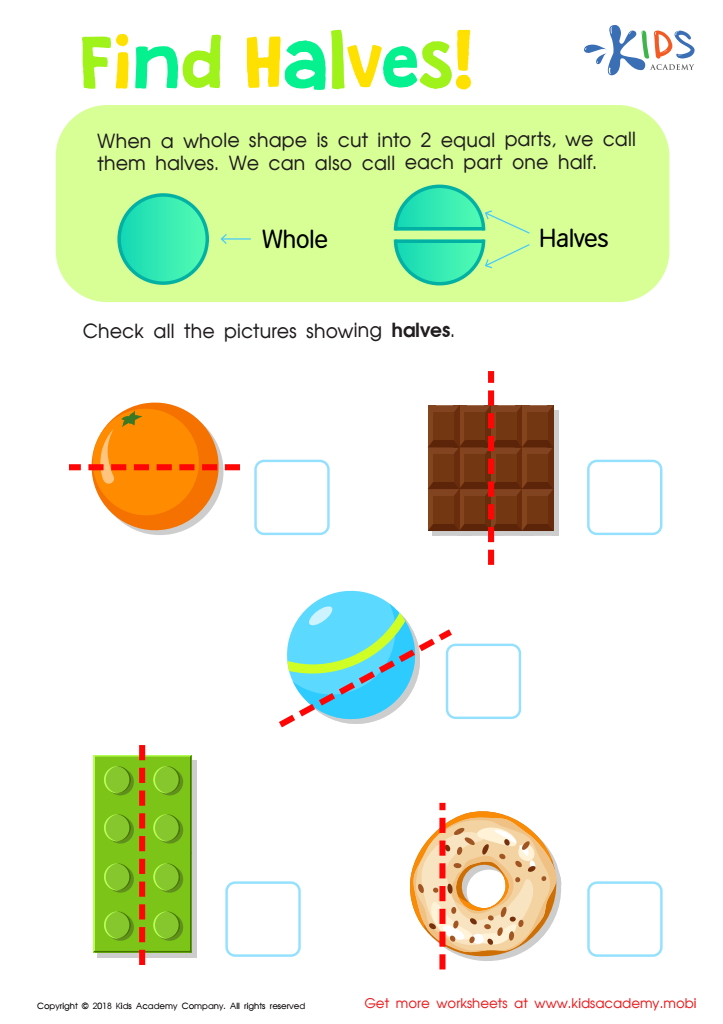
Find Halves Worksheet
If your child can tell you what two, three and four equal parts are called, give yourself a pat on the back! If not, this worksheet can help. Halves are two equal parts of a whole shape. Check the pictures in this printable pdf to help your child understand.
 Assign to My Students
Find Halves Worksheet
Worksheet
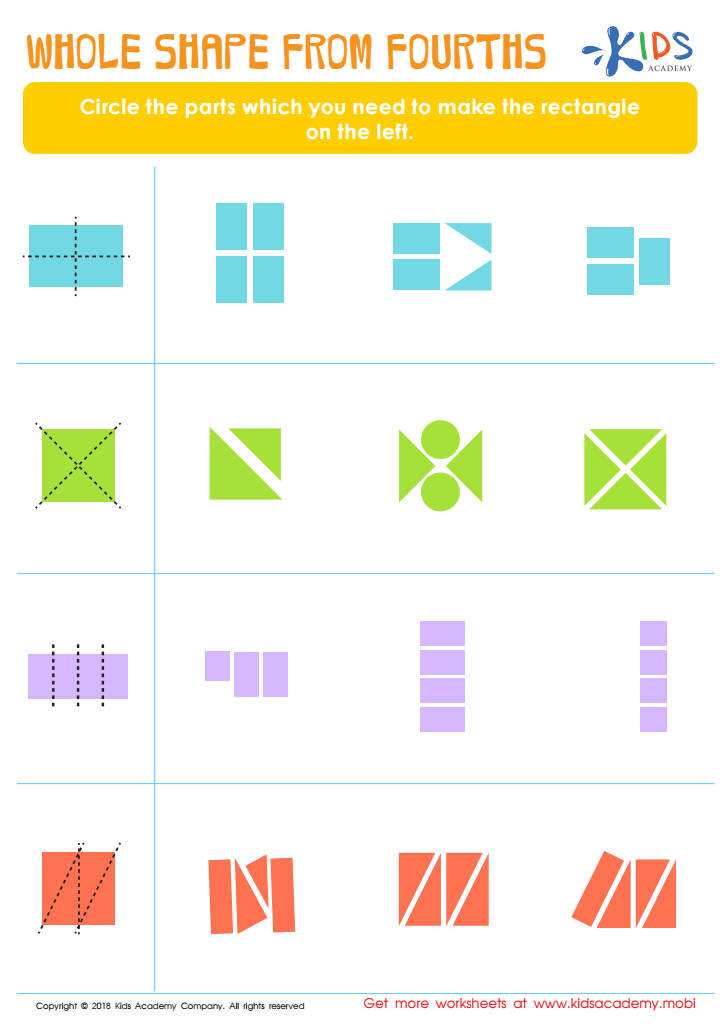
Whole Shape from Fourths Worksheet
Have your kids circle the shapes that'll form the rectangle on the left. It'll test their knowledge of shapes and ability to put them together to make a new one. Ask them to look at the parts on the right and circle the ones that'll form the rectangle.
Whole Shape from Fourths Worksheet
Worksheet
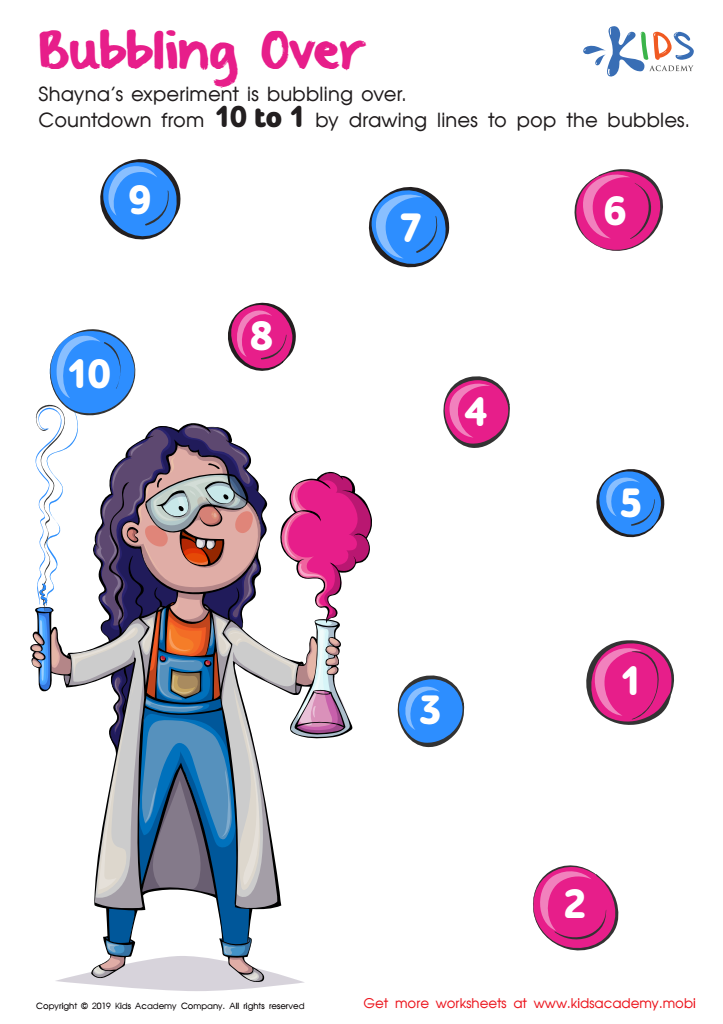
Bubbling Over Worksheet
Students love science experiments at the lab! They get to practice their counting skills while creating a masterpiece or an unexpected catastrophe! Ask them to count down from 10 to 1 by drawing lines to 'pop' the bubbles coming out of Shayna's experiment in the worksheet.
Bubbling Over Worksheet
Worksheet
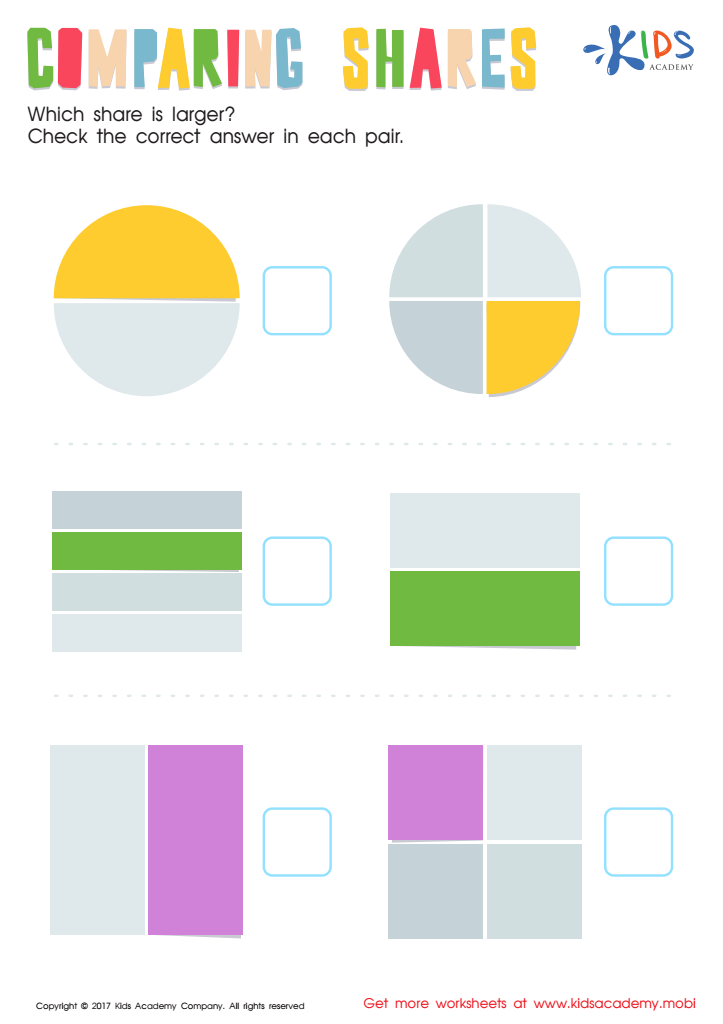
Comparing Shares Worksheet
Can your students identify and draw shapes correctly? If so, this exercise may be too easy. For those who are still learning, extra help may be needed. The worksheet requires students to select which shape is larger in each pair; circles and squares are included.
Comparing Shares Worksheet
Worksheet
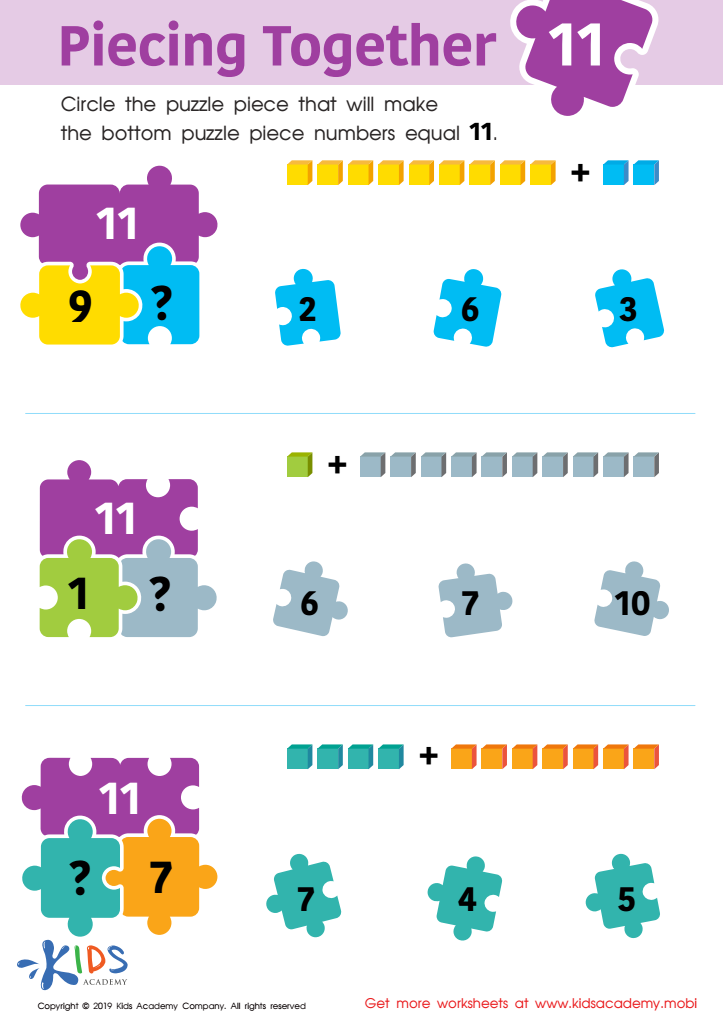
Piecing Together 11 Worksheet
Engage your preschoolers with learning-filled fun! Show them this colorful worksheet, and ask them to identify the figures. Each puzzle piece features an equation, except one which is missing. Help the kids solve the problems and circle the piece that'll make the numbers equal 11. It's a surefire way to make learning enjoyable!
Piecing Together 11 Worksheet
Worksheet
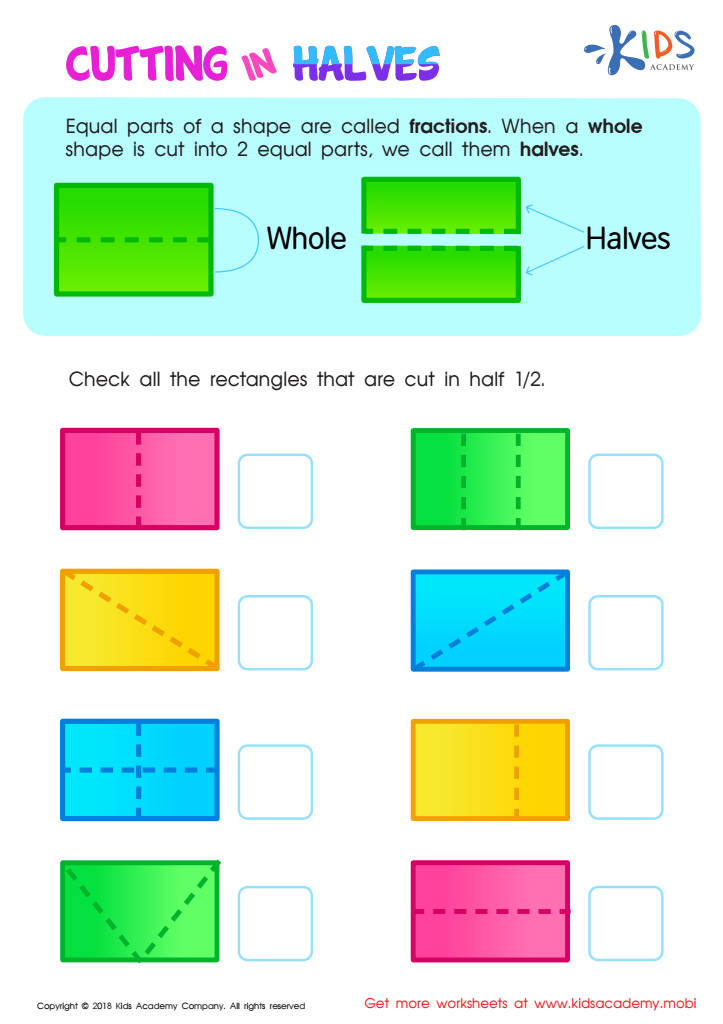
Cutting in Halves Worksheet
Show your child how to divide a whole shape, like a square, into smaller pieces to become fractions. Point out when a shape is divided into two equal parts, it's called a half. Look at the worksheet together, and identify all rectangles that are cut in half (½).
Cutting in Halves Worksheet
Worksheet
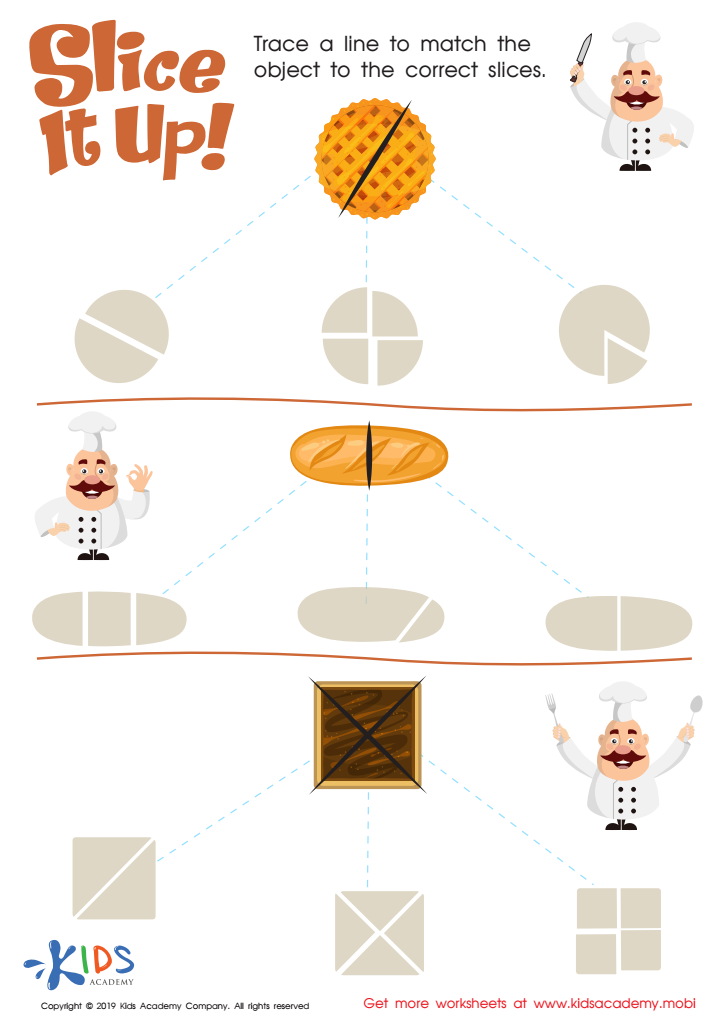
Slice It Up Worksheet
Try this fun math, reading and writing worksheet with your kids! They will love the colorful activities that perfect coordination and tracing. Engaging learning exercises help keep young minds sharp and boost skills. With these worksheets, your kids will be academically ahead of the curve!
Slice It Up Worksheet
Worksheet
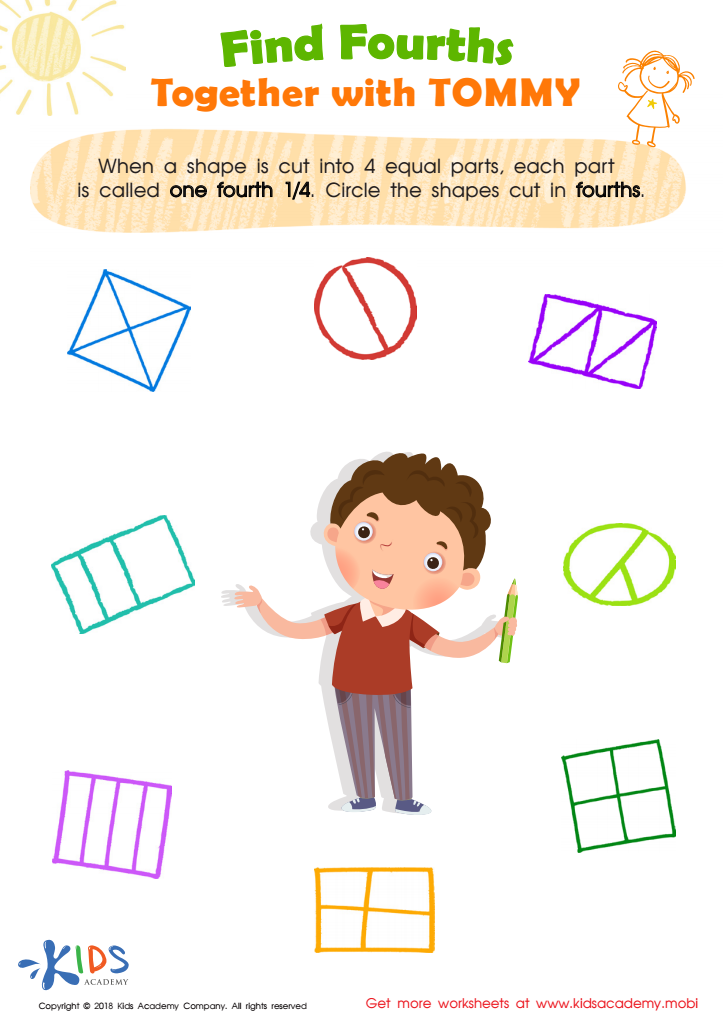
Find Fourths Together with Tommy Worksheet
Teach your kids fractions with this easy and fun worksheet! They should already know that two equal parts is a half, and three is a third. Now, help them understand one fourth (¼) by asking them to circle shapes that are divided into four parts. Make fractions learning stress-free for you and your children!
Find Fourths Together with Tommy Worksheet
Worksheet
Join Kids Academy for Free
Who is primarily going to use this learning content?








Helping 6-year-olds to easily understand fractions is crucial for several reasons. Firstly, fractions are foundational building blocks in mathematics. Grasping them at a young age enhances a child's numerical proficiency, simplifying more complex topics in later years like ratios, percentages, and algebra.
Early comprehension of fractions fosters logical thinking and problem-solving skills. Children learn to break down problems into smaller, manageable parts—analogous to dividing a whole into fractions—which is a valuable skill across many subjects and real-life scenarios.
Additionally, fractions play a significant role in everyday activities. When kids understand fractions, they can better relate to everyday experiences such as sharing pizza slices, dividing a group of toys, or understanding time. This practical relevance helps to demystify numbers, making math more relatable and less intimidating.
Encouraging a positive relationship with fractions early also boosts a child’s confidence and diminishes math anxiety. As students master fractions, they gain a sense of achievement that motivates them to tackle more challenging math concepts.
For both parents and teachers, investing the extra effort to make fractions simple and engaging sets children up for academic success and a lifelong appreciation for math. It's about building a robust scaffold for future learning while nurturing a child's innate curiosity and confidence.








