
Vocabulary enhancement Easy Addition & Subtraction Worksheets for Ages 7-8
3 filtered results
Difficulty Level
Grade
Age
-
From - To
Subject
Activity
Standards
Boost your child's vocabulary and math skills with our "Easy Addition & Subtraction Worksheets" specifically designed for ages 7-8. These engaging worksheets provide a fun and interactive way for young learners to enhance their understanding of mathematical terms and concepts while practicing basic arithmetic. Each worksheet reinforces vocabulary associated with addition and subtraction, fostering better communication and comprehension in math. Perfect for at-home learning or classroom activities, our resources support children’s educational journey with clear instructions and vibrant illustrations. Unlock your child's potential in both math and language with these invaluable learning tools focused on skill development and exploration.
Favorites
With answer key
Interactive
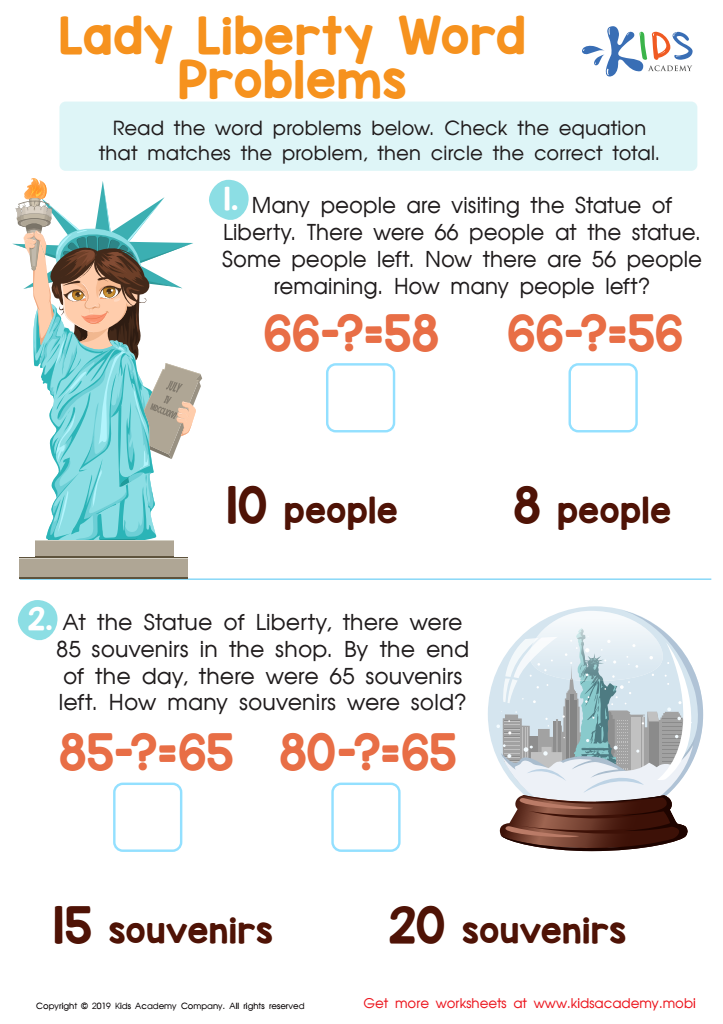
Lady Liberty Worksheet
Have your students ever been to the Statue of Liberty? Ask them to tell you where it is and what it looks like. Every day, the statue draws a crowd admiring its beauty, taking pics and learning more about it. Pose a word problem and help them check the answer. Circle the correct total. (80 words)
 Assign to My Students
Lady Liberty Worksheet
Worksheet
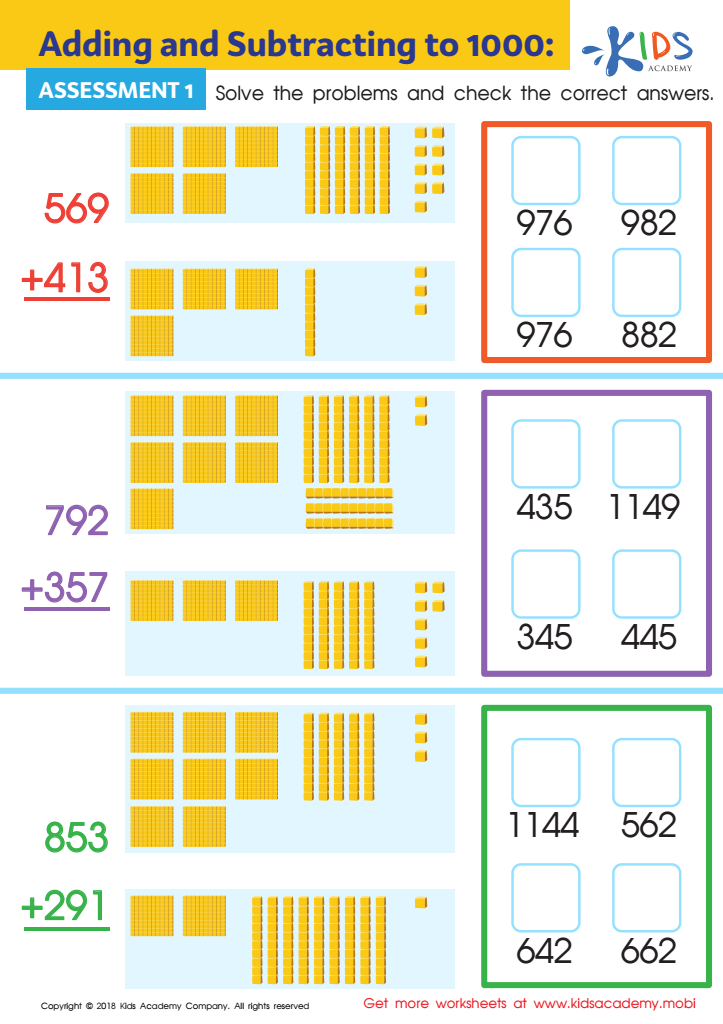
Adding and Subtracting to 1 Worksheet: Assessment 1
This assessment worksheet tests your child's addition skills. It has 3 3-digit problems with base ten blocks for visual aid. Encourage learners to use these visuals for better understanding. When they have solved the problems, they can check the box with the right answer. It's a quick and easy way to gauge numeracy development.
Adding and Subtracting to 1 Worksheet: Assessment 1
Worksheet
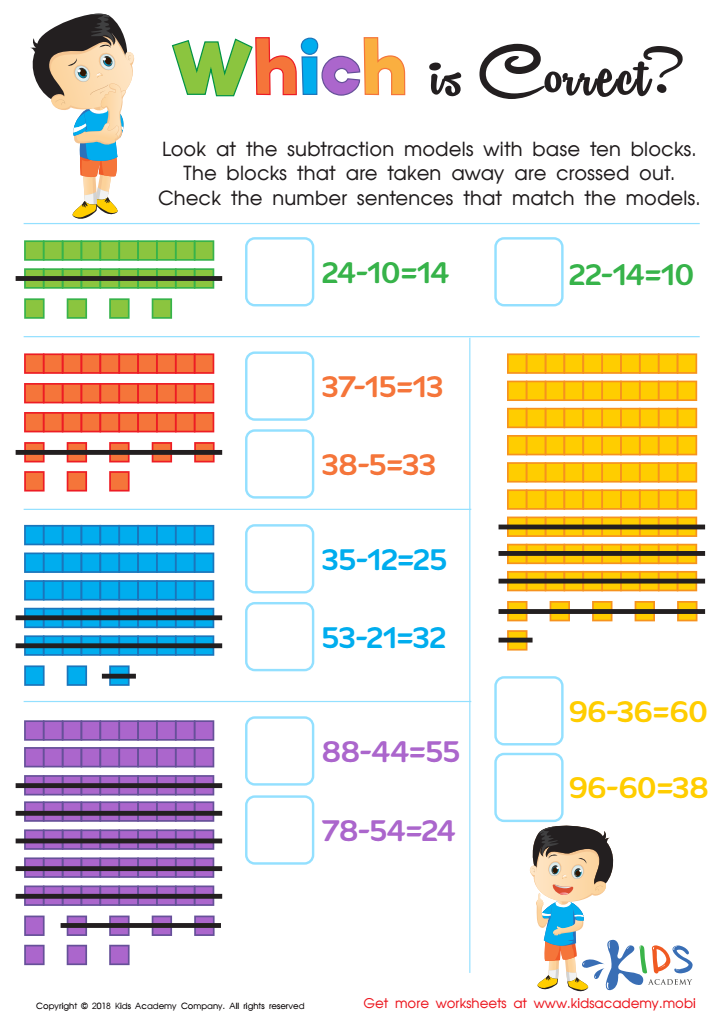
Which Is Correct? Math Worksheet
Young mathematicians will gain confidence solving subtraction problems with this bright, colorful worksheet. They'll use base ten blocks representations, then pick the right number sentence to match. It's great practice for developing number sense, helping them excel in higher-level math.
Which Is Correct? Math Worksheet
Worksheet
Join Kids Academy for Free
Who is primarily going to use this learning content?








Vocabulary enhancement in the context of mathematics, especially for addition and subtraction, is crucial for children aged 7-8 as it strengthens not only their mathematical skills but also their overall language abilities. At this age, children are cementing their foundational understanding of math concepts and beginning to encounter more complex word problems. A rich vocabulary helps them comprehend math language, making it easier for them to interpret problems correctly and verbalize their mathematical thinking.
Moreover, when parents and teachers prioritize vocabulary development in mathematics, they equip children with the tools needed to articulate their problem-solving processes. This not only boosts their confidence but also enhances collaboration and communication skills, which are valuable in group settings or classroom discussions.
Furthermore, a strong vocabulary in math can improve performance on standardized tests, where word problems often assess both comprehension and computation skills. Overall, investing time in vocabulary enhancement related to easy addition and subtraction can foster a more effective learning environment, creating curious, confident learners who appreciate the beauty of mathematics. By integrating vocabulary practice into daily routines, adults can support children's academic success and lifelong learning.








