Comparing objects Extra Challenge Math Worksheets for Ages 3-8
3 filtered results
-
From - To
Unlock your child's potential with our "Comparing Objects Extra Challenge Math Worksheets" designed for ages 3-8. These engaging activities encourage young learners to develop essential math skills through hands-on comparing and contrasting of different objects. Our worksheets promote critical thinking and enhance understanding of concepts like size, quantity, and comparisons, all while making learning fun! With colorful illustrations and age-appropriate challenges, children will be motivated to explore their mathematical abilities. Perfect for educators and parents alike, these worksheets provide the ideal way to support early learning and boost confidence in young mathematicians. Get your child started on their math journey today!
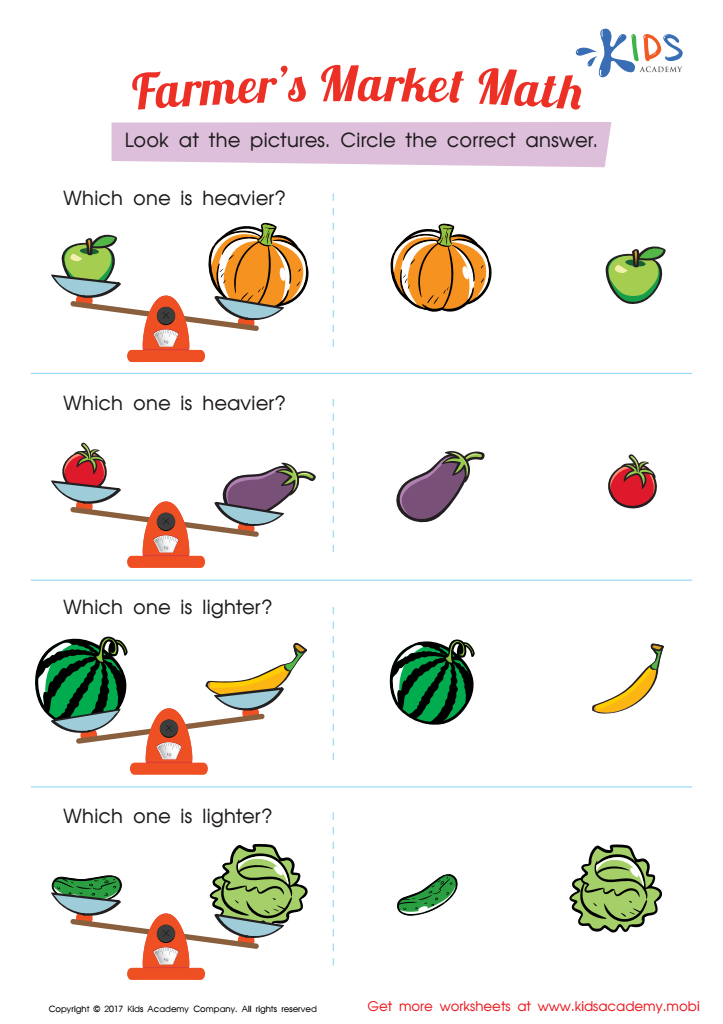
Which One Is Heavier Worksheet
 Assign to My Students
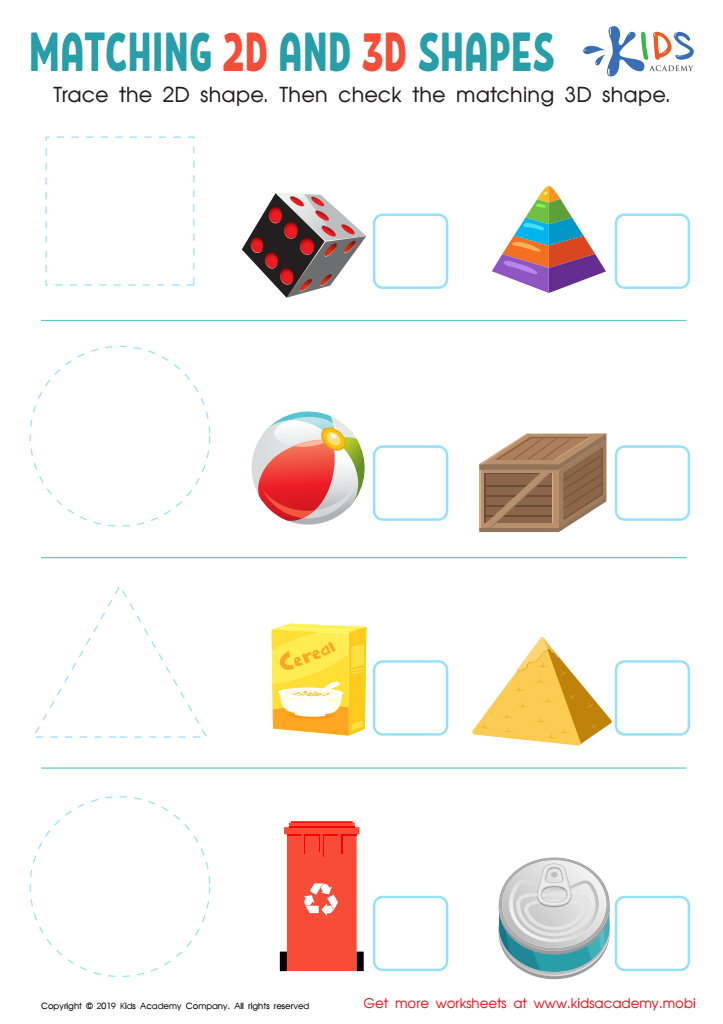
Matching 2D and 3D Shapes Worksheet
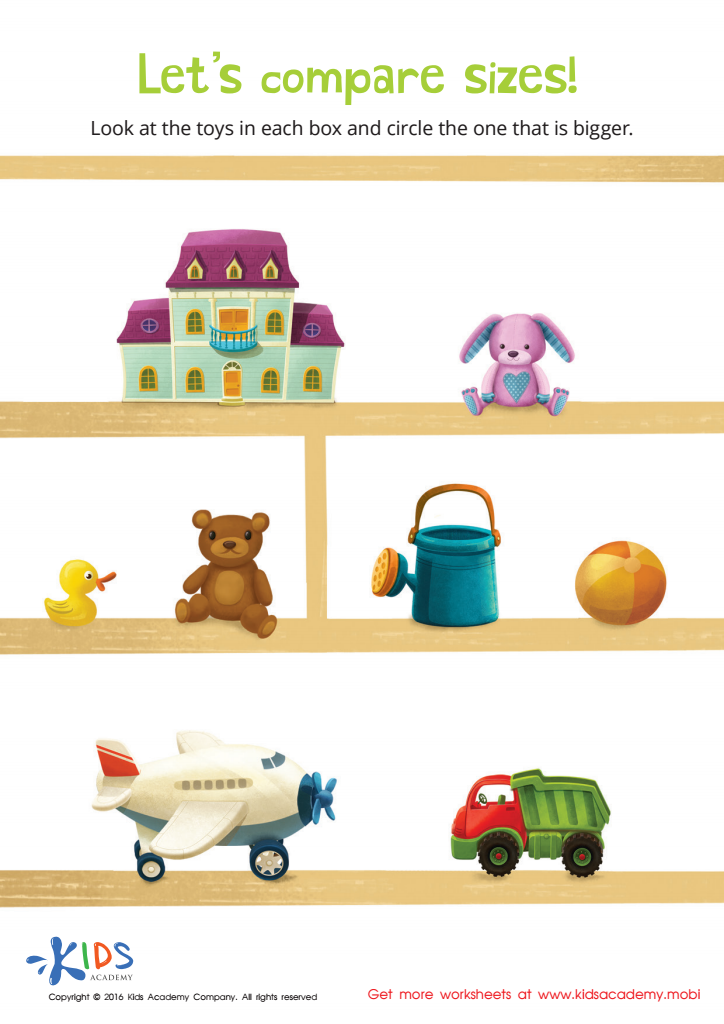
Classifying by Size Sorting Worksheet







Comparing objects is a fundamental mathematical skill that plays a crucial role in early childhood development, especially for children aged 3-8. Parents and teachers should care about promoting these skills as they lay the groundwork for more advanced mathematical concepts and problem-solving abilities.
Firstly, comparing objects enhances children's ability to recognize differences and similarities, fostering critical thinking and analytical skills. For instance, children learn to assess attributes such as size, shape, color, and quantity, which aids in their ability to categorize and organize information.
Moreover, engaging children in comparing objects helps build their language and communication skills. As they describe what they see, they develop vocabulary and learn how to express their thoughts clearly. This not only supports their mathematical understanding but also enhances their overall linguistic abilities.
Additionally, this foundational skill supports a concept called number sense, which is crucial for later arithmetic learning. Through hands-on activities, children develop an intuitive grasp of numbers, measurement, and spatial awareness, positioning them for success in future mathematical endeavors.
By fostering these skills early on, parents and teachers encourage active learners who are better equipped to navigate the complexities of mathematics and beyond, nurturing lifelong problem-solvers.