Filters

7 filtered results

Clear all filters
Favorites
With answer key
Interactive

7 filtered results

Difficulty Level

Grade


Discover our engaging Cognitive Development Extra Challenge Geometry Worksheets designed specifically for children ages 4-7! These interactive worksheets foster critical thinking and spatial awareness while introducing young learners to fundamental geometric concepts. Your child will enjoy a variety of stimulating activities, from identifying shapes to solving intriguing puzzles that enhance their cognitive skills. Perfect for home schooling or supplementing classroom learning, our worksheets offer an enjoyable way to challenge and inspire budding mathematicians. Watch your child's confidence and understanding grow as they navigate through colorful, fun exercises tailored to develop their early geometry knowledge. Empower your child’s learning journey today!

Check out this FREE Trial Lesson on Geometry for age 4-7!

Lesson 3- Classify and Sort Shapes

Favorites
With answer key
Interactive
  • 4-7
  • Cognitive Development
  • Geometry
  • Extra Challenge
Birthday 3D Shapes Worksheet

Birthday 3D Shapes Worksheet

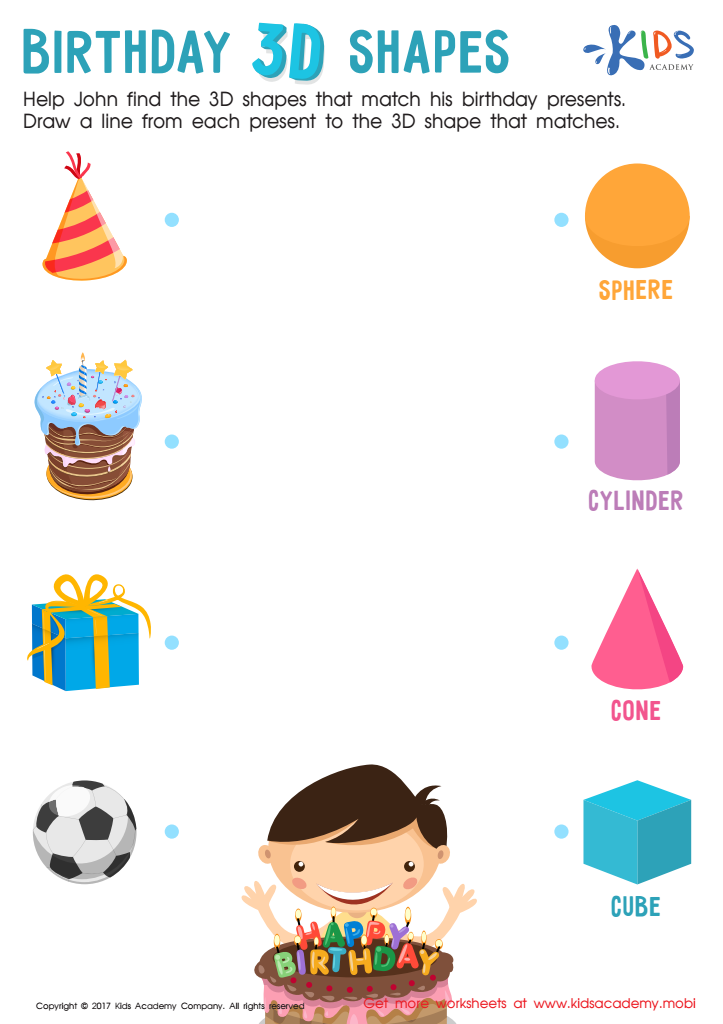
It's John's birthday and he needs your help. Ask your kids to draw a line from each present to the matching 3D shape. First, check they understand the difference between 2D and 3D shapes. Then, they can help John figure out which 3D shape matches each present.
Birthday 3D Shapes Worksheet
Worksheet
Match It up Worksheet

Match It up Worksheet

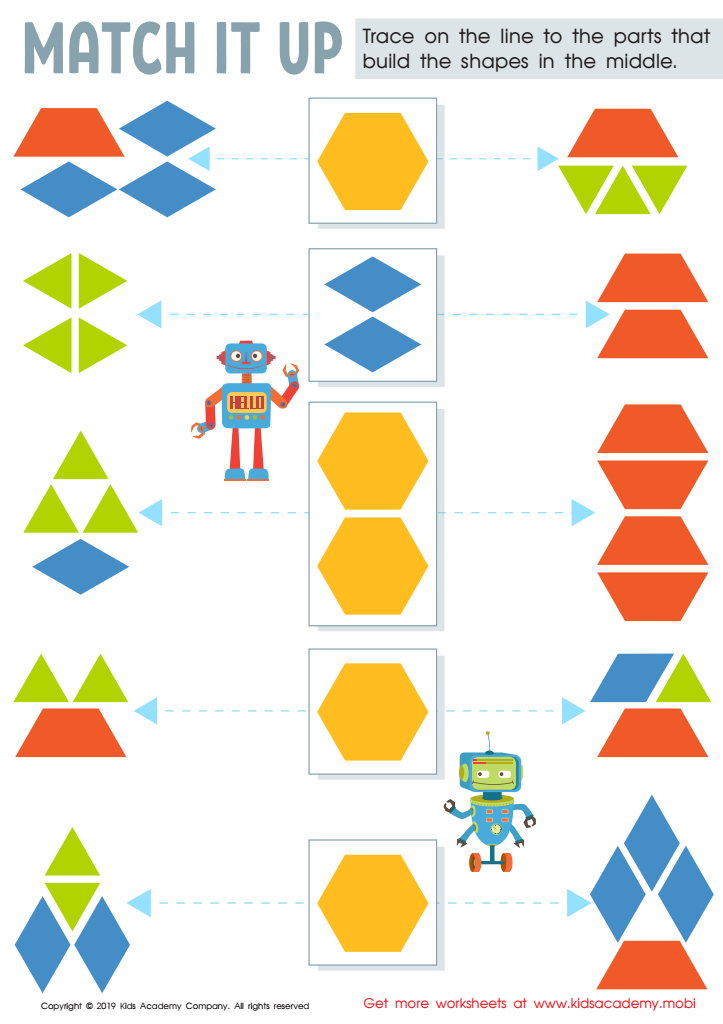
If your kids are into robots, they'll be thrilled to work on this worksheet. Ask them to name shapes they know, and help them draw and identify these shapes. Look at the shapes in the middle, and the sides. Finally, help your kids trace the lines to build the shapes in the middle.
Match It up Worksheet
Worksheet
Matching Colors Worksheet

Matching: Shapes and Colors Worksheet
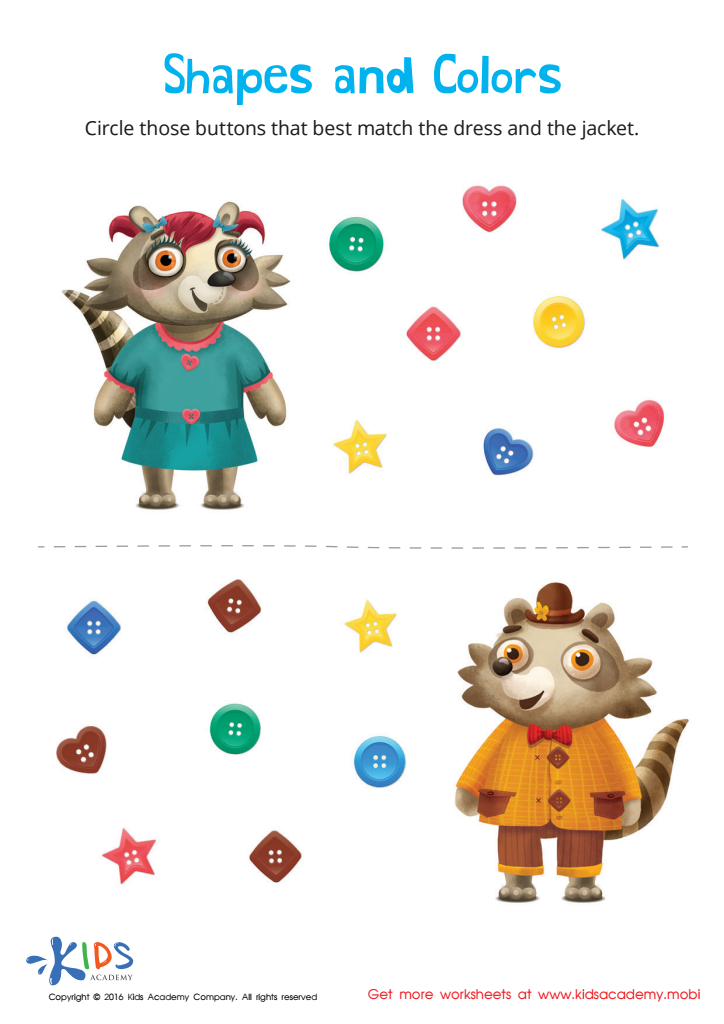
Help Mr. and Mrs. Raccoon find the right buttons to match their shirts! Kids will identify shapes and colors and learn to match them correctly.
Matching: Shapes and Colors Worksheet
Worksheet
2D and 3D Shapes Worksheet
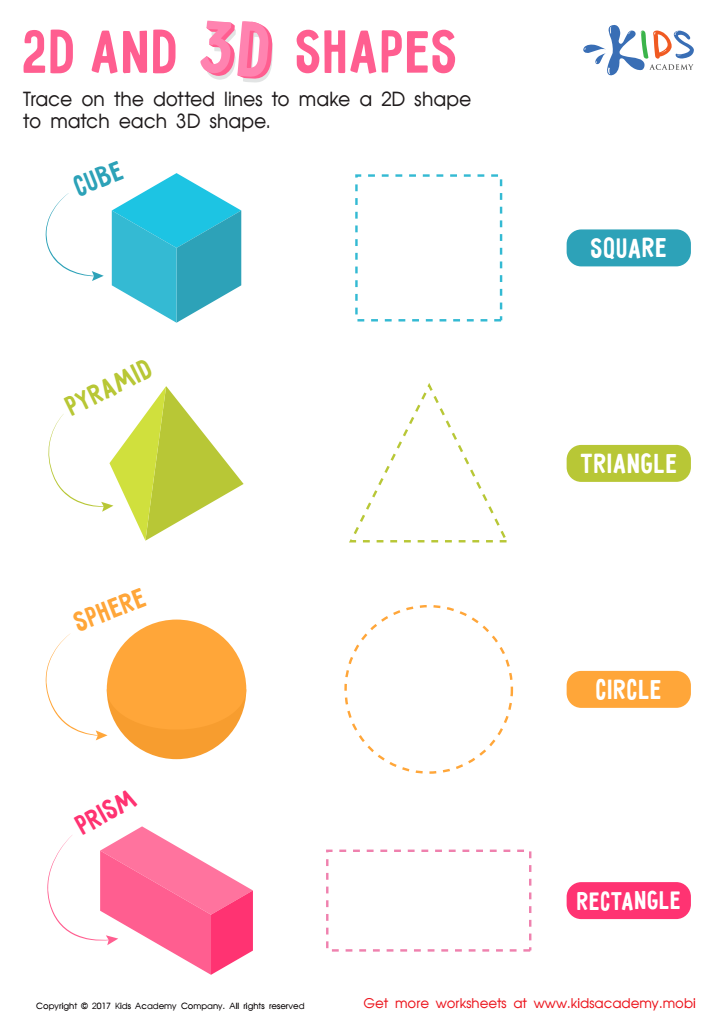
2D and 3D Shapes Worksheet

Introduce your child to 3D and 2D with this traceable worksheet. With dotted lines, help them trace and make a 2D shape for each 3D shape: square, triangle, rectangle, and circle. Show them there's more than one way to draw! You may have taken them to a 3D movie, or they've seen some fantastic 3D art. Now they can wonder no more.
2D and 3D Shapes Worksheet
Worksheet
The Circle Maze Worksheet

The Circle Maze Worksheet

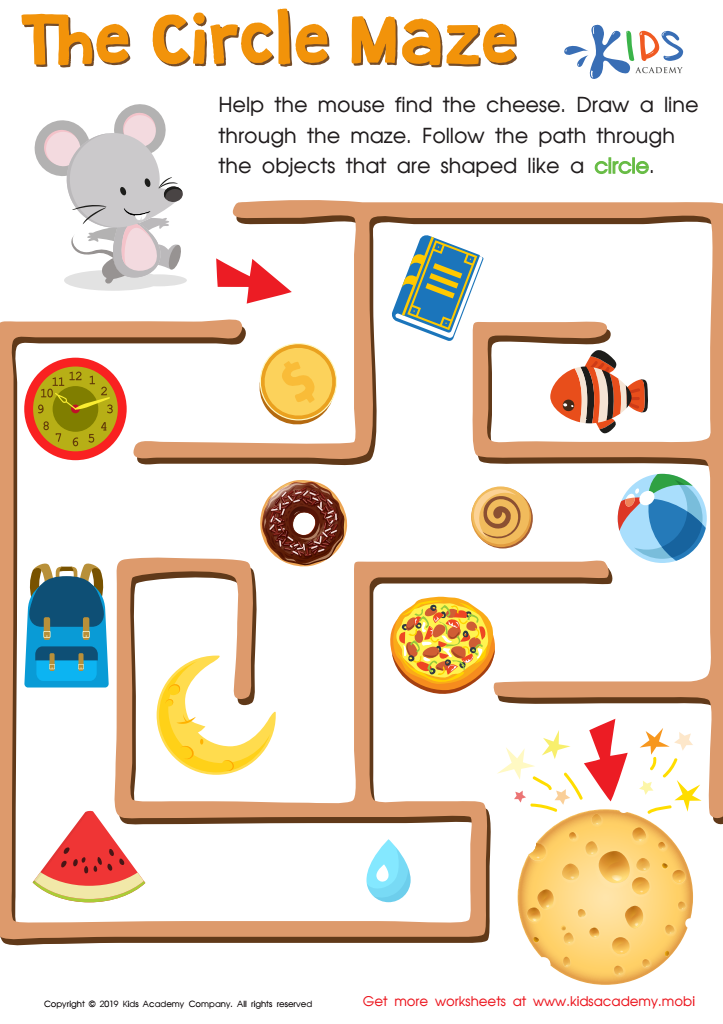
Kids can have fun learning shapes with this maze worksheet. They can help the mouse find its cheese by tracing the path of a circle through the maze. This printable is great for classroom learning or as an activity at home.
The Circle Maze Worksheet
Worksheet
Matching 2D and 3D Shapes Worksheet

Matching 2D and 3D Shapes Worksheet

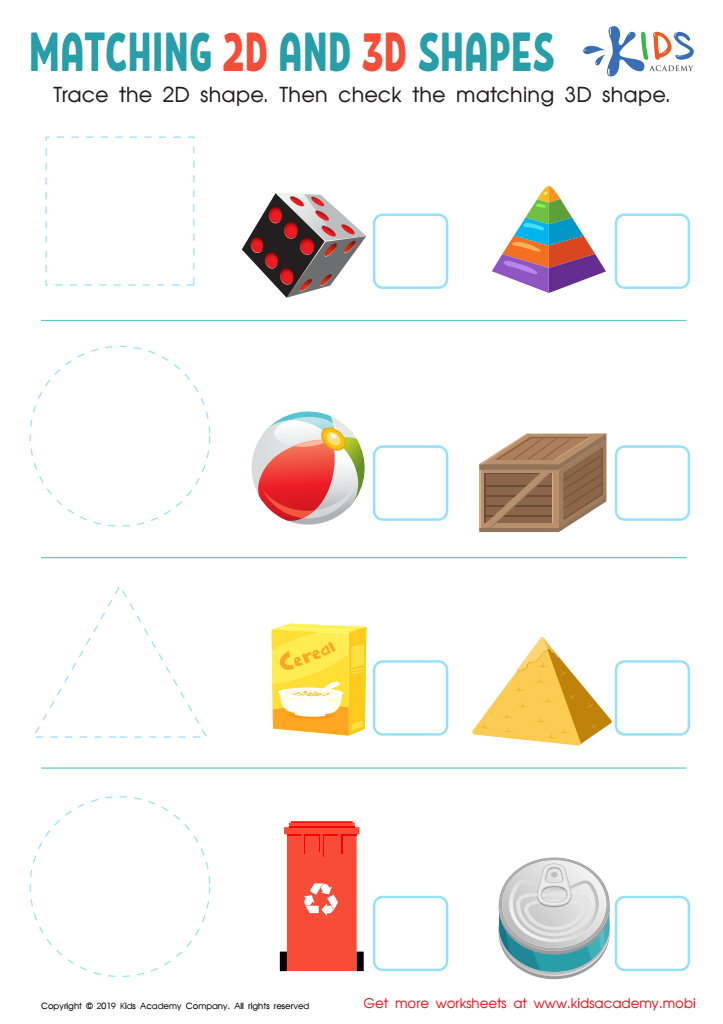
Before starting this worksheet, ask your kids what shapes they know and point out the 2D and 3D shapes on it. Help your kids trace the 2D shapes and then match them to the 3D versions. It'll be a fun new world for your kids to explore!
Matching 2D and 3D Shapes Worksheet
Worksheet
Preschool Matching Worksheet

Shapes Worksheet

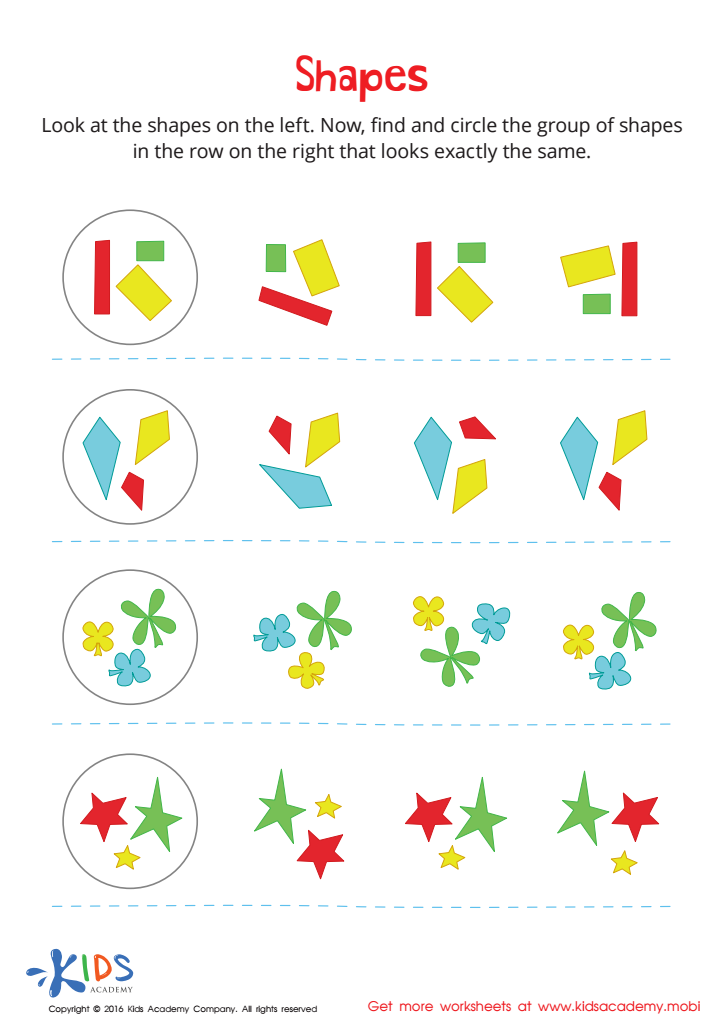
This fun worksheet will challenge your child to recognize tricky patterns, sort through similar ones, and create strategies to get the right answer. It'll also help them to strengthen problem-solving skills and build confidence. With more challenging tasks, your child will be ready to tackle higher level math and sequencing skills.
Shapes Worksheet
Worksheet


Cognitive Development Extra Challenge Geometry for ages 4-7 is essential for young learners as it fosters critical thinking and problem-solving skills at an early age. During this pivotal time in a child's development, engaging with geometric concepts can significantly enhance their spatial awareness and reasoning abilities. Understanding shapes, symmetry, and spatial relationships provides a foundation for more complex mathematical concepts in later years.

By incorporating extra challenges in geometry, parents and teachers can stimulate curiosity and promote a love for learning. Such activities encourage children to think creatively, explore different solutions, and refine their analytical skills, all of which are crucial not just in math but across various disciplines.

Furthermore, early geometry exposure helps children make connections between mathematical concepts and their everyday experiences, boosting their confidence as learners. The interplay of tactile experiences through shape exploration promotes fine motor skills and can enhance overall cognitive development.

Moreover, these skills are increasingly important in a world that heavily relies on technology and logical problem solving. By investing time and resources in challenging geometric activities, parents and teachers can set a solid foundation for children, ensuring they thrive academically and develop a lifelong passion for learning.