Spatial awareness Extra Challenge 2D Shapes Worksheets for Ages 4-8
3 filtered results
Difficulty Level
Grade
Age
-
From - To
Subject
Activity
Standards
Enhance your child's spatial awareness with our Extra Challenge 2D Shapes Worksheets, specifically designed for ages 4-8! These engaging worksheets focus on helping young learners recognize, differentiate, and manipulate various 2D shapes, fostering critical thinking and problem-solving skills. Through fun activities, children will develop their understanding of spatial relationships while enjoying colorful illustrations and engaging exercises. Ideal for home or classroom use, these worksheets provide an effective way to supplement your child's math learning journey. Encourage your child's creativity and cognitive growth with our carefully crafted resources designed to make learning about shapes enjoyable and interactive! Explore and download now!
Favorites
With answer key
Interactive
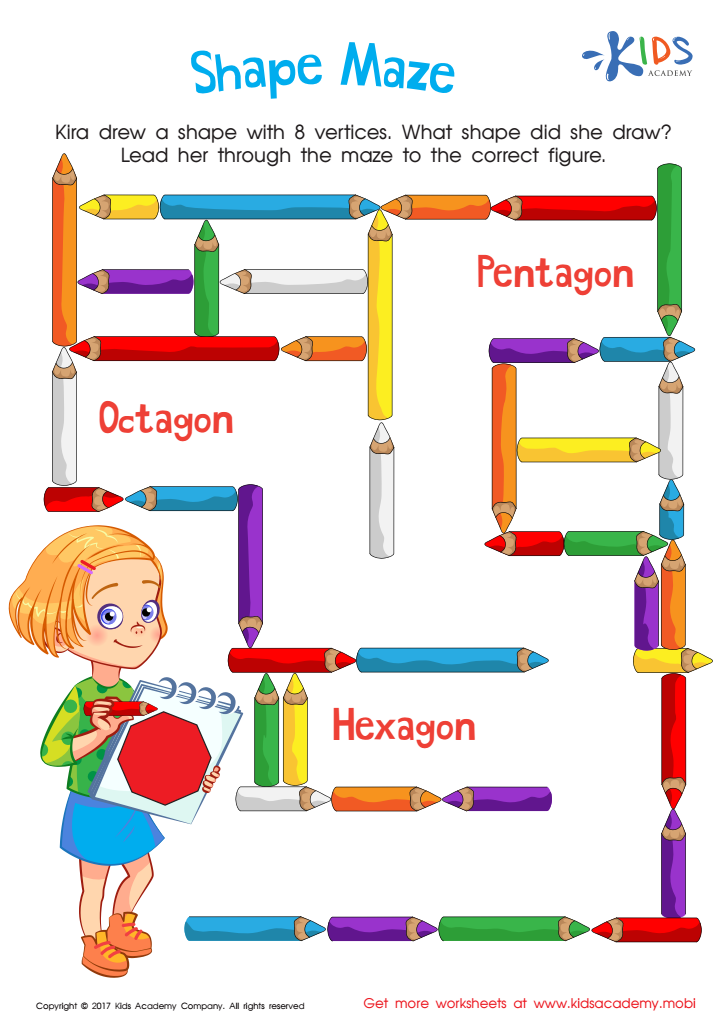
Shape Maze Worksheet
Test your child's geometry knowledge with this fun printable maze! They'll need to identify shapes with 8 vertices to find their way through the maze and get the correct answer.
 Assign to My Students
Shape Maze Worksheet
Worksheet











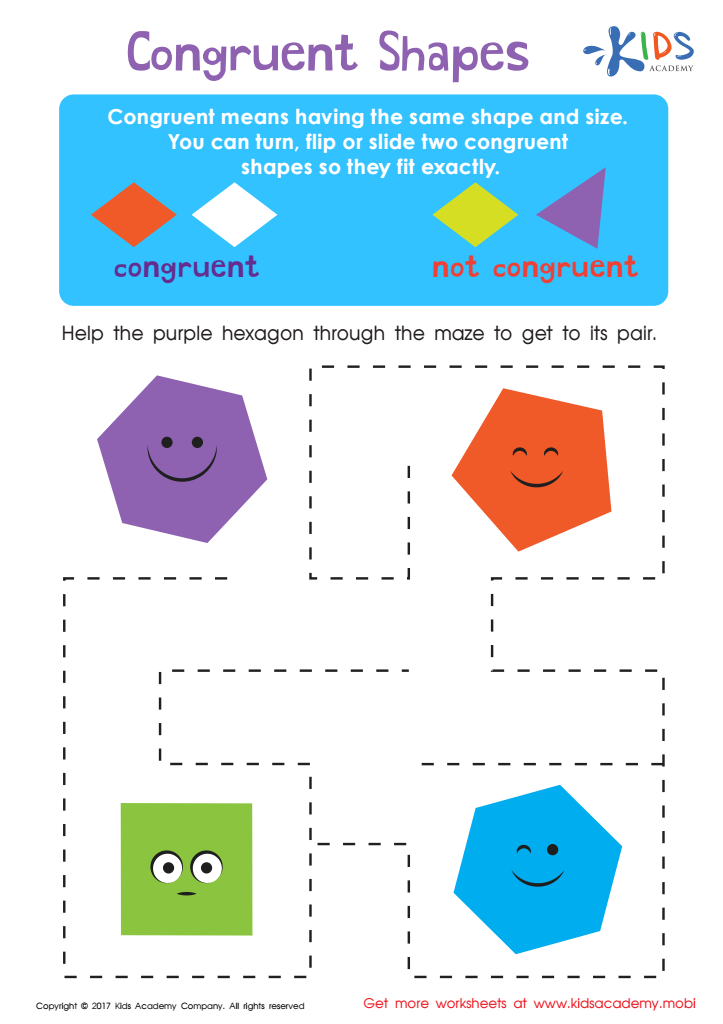
Congruent Shapes Worksheet
Help your child find the twin of the purple hexagon! This congruent shapes worksheet is great for increasing vocabulary while challenging mental rotation skills.
Congruent Shapes Worksheet
Worksheet
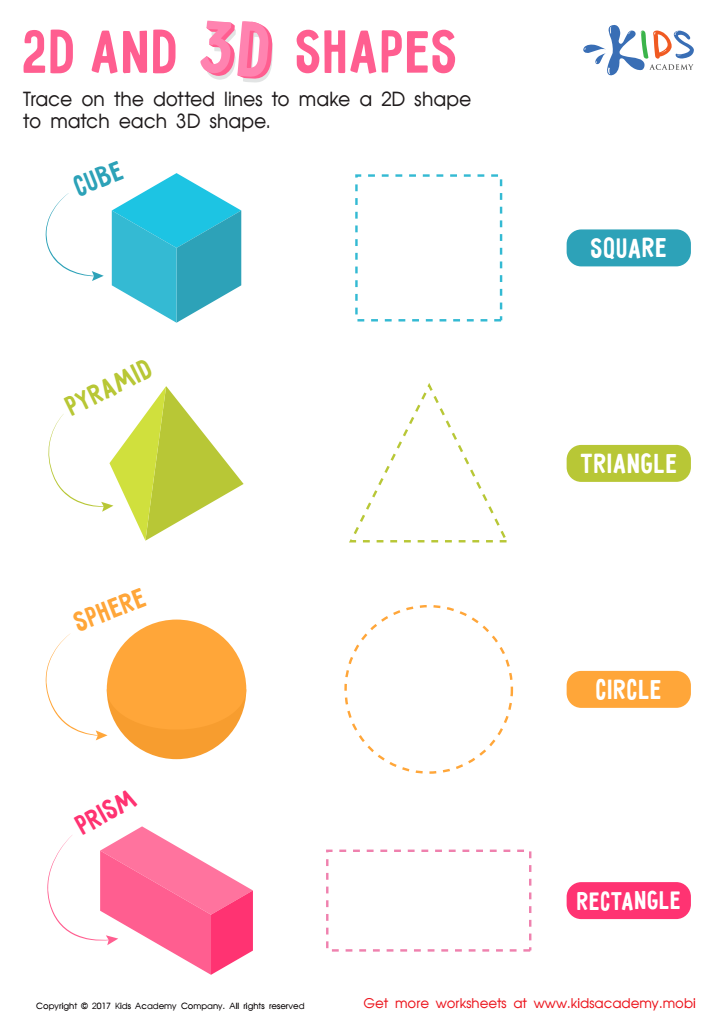
2D and 3D Shapes Worksheet
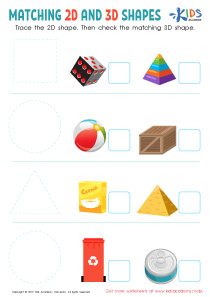
Introduce your child to 3D and 2D with this traceable worksheet. With dotted lines, help them trace and make a 2D shape for each 3D shape: square, triangle, rectangle, and circle. Show them there's more than one way to draw! You may have taken them to a 3D movie, or they've seen some fantastic 3D art. Now they can wonder no more.
2D and 3D Shapes Worksheet
Worksheet
Join Kids Academy for Free
Who is primarily going to use this learning content?








Spatial awareness and understanding 2D shapes are crucial skills for children ages 4-8, forming the foundation for their academic and everyday life. Parents and teachers should prioritize these skills as they play a significant role in critical thinking, problem-solving, and even creativity. Developing spatial awareness helps children perceive and interact with their environments, essential for activities like navigating spaces, playing sports, or understanding maps.
Moreover, 2D shapes are prevalent in various subjects, including math, science, and art. Recognizing and understanding these shapes foster mathematical comprehension, essential for geometry, measurement, and even basic arithmetic. Engaging with shapes also sparks curiosity, stimulating children's exploration and learning, which are foundational aspects of their cognitive development.
Furthermore, nurturing these skills promotes fine motor skills through activities like drawing, building, or manipulating objects. Engaging with 2D shapes can be integrated into fun, interactive games or arts and crafts exercises, making learning enjoyable and effective.
Ultimately, strengthening spatial awareness and shape recognition sets the stage for future academic success and enhances children's confidence, encouraging them to explore the world around them creatively and effectively. By focusing on these skills, parents and teachers contribute significantly to holistic childhood development.