
Practical math application Extra Challenge Worksheets for Ages 5-7
3 filtered results
Difficulty Level
Grade
Age
-
From - To
Subject
Activity
Standards
Discover our "Practical Math Application Extra Challenge Worksheets" designed for ages 5-7! These engaging worksheets help young learners apply their math skills to real-life scenarios, promoting critical thinking and problem-solving. Featuring fun activities that incorporate addition, subtraction, and comparison, children will enhance their understanding of math concepts while developing confidence. Each worksheet encourages hands-on learning through relatable examples, ensuring that math becomes an enjoyable experience. Perfect for classroom use or home practice, our printable resources support early math development and pave the way for future success. Encourage your child's passion for learning with these innovative and challenging math tasks!
Favorites
With answer key
Interactive
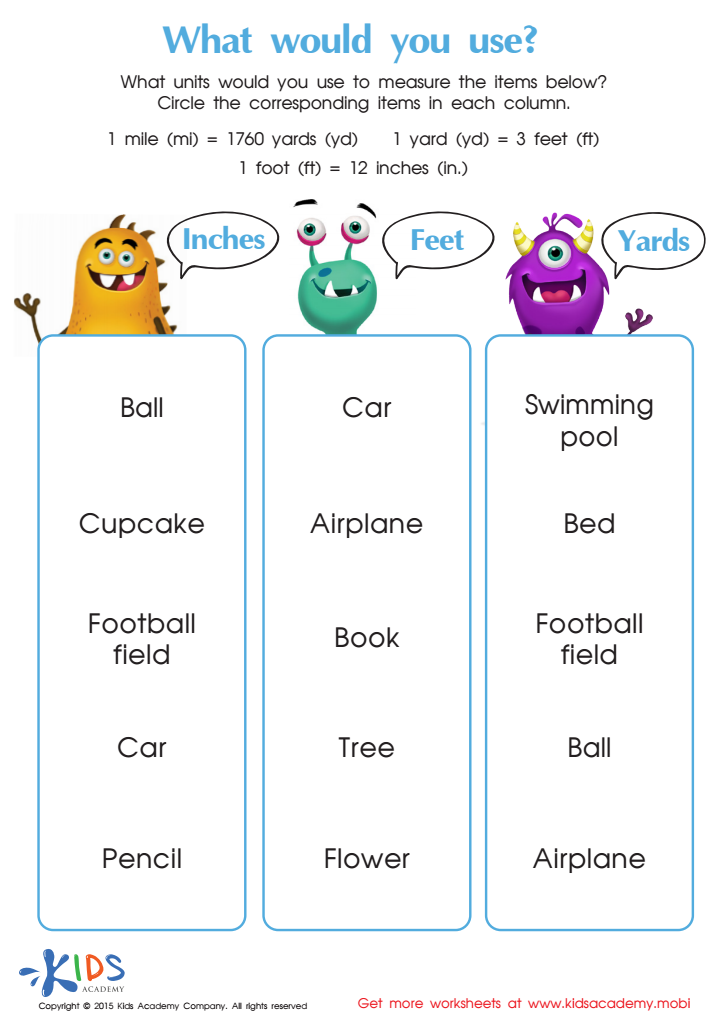
Learning about measuring objects in inches, feet and yards Worksheet
Download, cut and let your preschoolers learn and have fun estimating objects like pencils, airplanes and swimming pools in inches, feet and yards!
 Assign to My Students
Learning about measuring objects in inches, feet and yards Worksheet
Worksheet
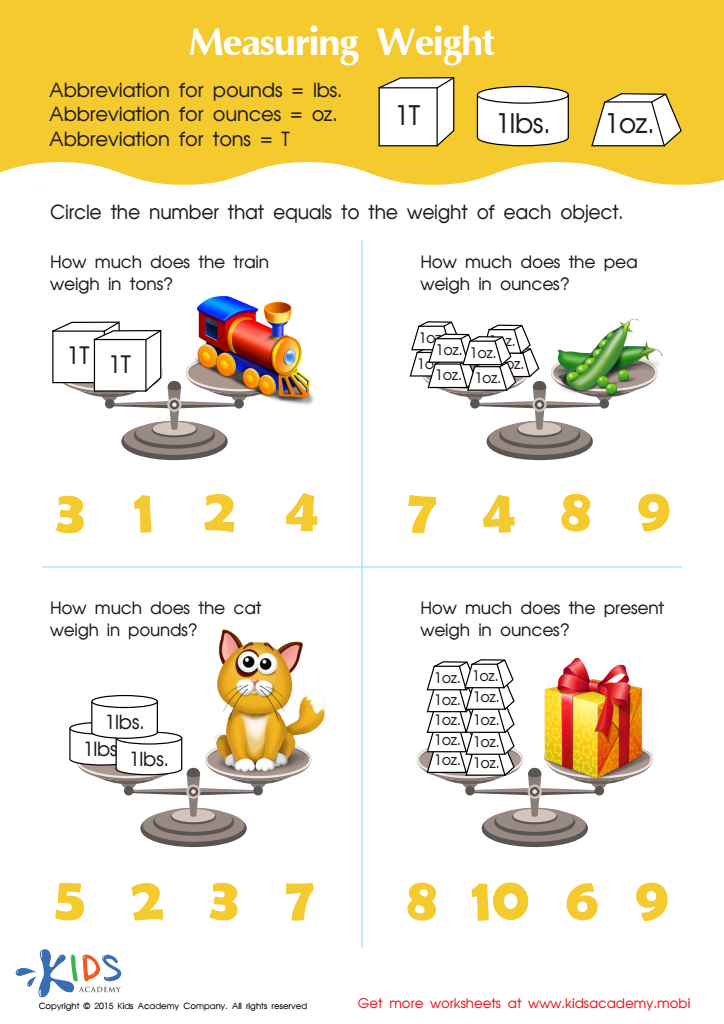
Measuring Weight in Ounces, Pounds and Tons Worksheet
Do you know how much a chicken, a bumble bee, a bike or a train weighs? Circle the most reasonable weight for each object. It's fun and easy with our math worksheets from Kids Academy! Download them for free from our website and get more practice in math with your little learners.
Measuring Weight in Ounces, Pounds and Tons Worksheet
Worksheet
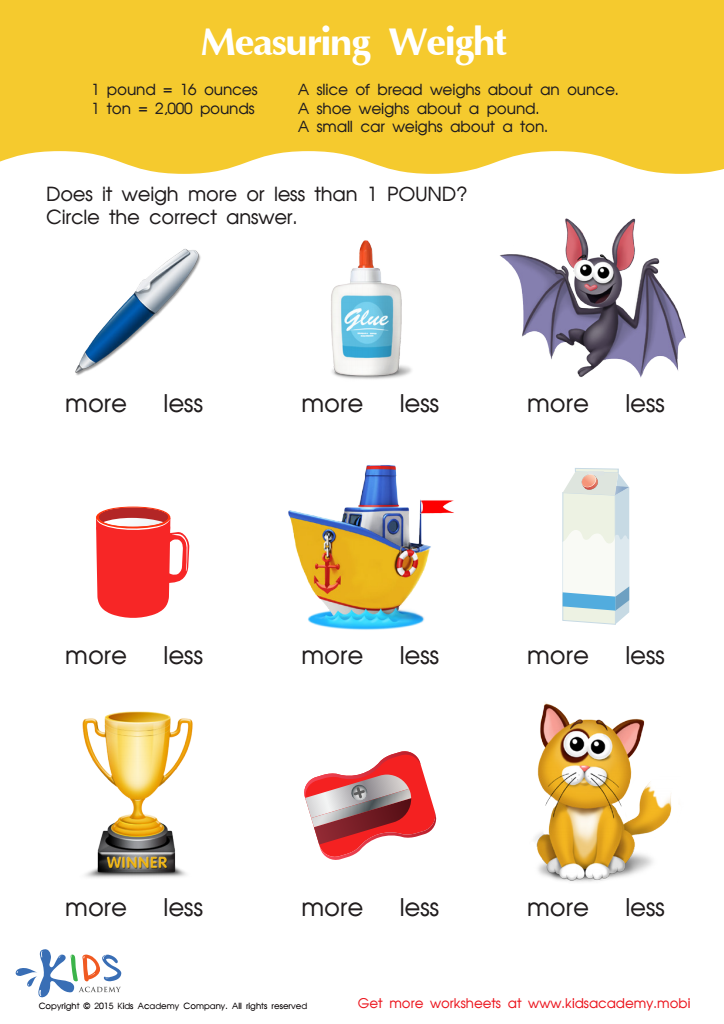
Measuring weight in pounds Worksheet
Help your kids comprehend pounds with our free worksheet. Everyday objects are compared to one pound, helping them understand this weight unit. Find the whole collection of free math worksheets by Kids Academy on our website. Make studying fun for your kids with our free printable worksheets!
Measuring weight in pounds Worksheet
Worksheet
Join Kids Academy for Free
Who is primarily going to use this learning content?






.jpg)
Practical math application in early education, especially for ages 5-7, is vital for several reasons. Firstly, children at this age are naturally curious and eager to learn through hands-on experiences. By integrating math into everyday activities, such as cooking, shopping, or gardening, we help them make real-world connections, fostering a deeper understanding of mathematical concepts.
Furthermore, practical math applications promote critical thinking and problem-solving skills. When children engage in activities like measuring ingredients or counting change, they not only apply theoretical knowledge but also learn to approach challenges independently. This experiential learning builds confidence and sets a strong foundation for future mathematical studies.
Additionally, involving parents and teachers in these practical challenges nurtures a collaborative learning environment. It encourages open communication about math, allowing children to express their thoughts and ask questions in a supportive setting. Engaging with math this way helps demystify the subject, alleviating any anxiety children may feel about math.
Ultimately, incorporating practical math applications enhances motivation, engagement, and comprehension, preparing children for more complex mathematical concepts in the future while equipping them with necessary life skills. Therefore, parents and teachers should actively prioritize these experiences in the learning process.








