Sequencing numbers Extra Challenge Math Worksheets for Ages 6-7
3 filtered results
Difficulty Level
Grade
Age
-
From - To
Subject
Activity
Standards
Welcome to our "Sequencing Numbers Extra Challenge Math Worksheets" designed specifically for ages 6-7! These worksheets offer engaging and thought-provoking exercises that help young learners master the essential skill of sequencing numbers. Perfect for enhancing their mathematical understanding, these challenges go beyond basics, encouraging critical thinking and problem-solving skills. Each worksheet features fun themes and vibrant illustrations to captivate your child's attention. As they complete the activities, learners will build confidence and develop a strong foundation in math. Perfect for home or classroom use, these extra challenges are sure to enrich your child’s learning journey. Join us for an exciting math adventure today!
Favorites
With answer key
Interactive
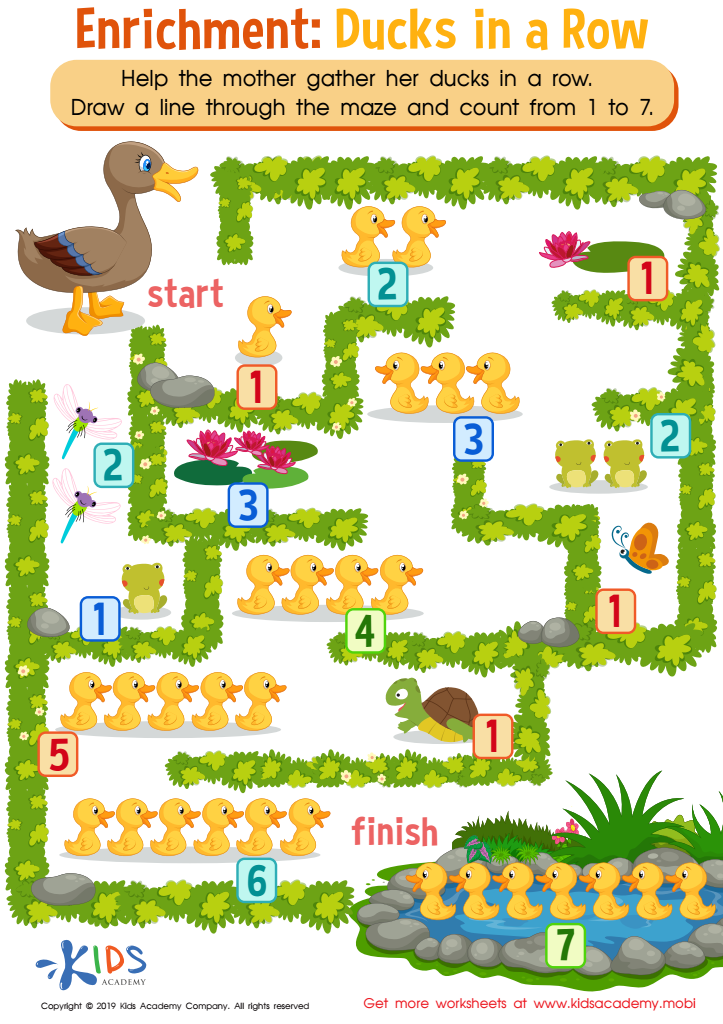
Ducks in a Row Worksheet
Are you looking for a fun and free math enrichment activity for your young one? Get Sweet Mama Duck and her ducks to the pond by helping your child navigate through this colorful maze! They'll use their fine motor skills and hone their number sense as they count ducks, turtles and frogs. Plus, they'll learn one-to-one representation. A great educational way to have fun!
 Assign to My Students
Ducks in a Row Worksheet
Worksheet
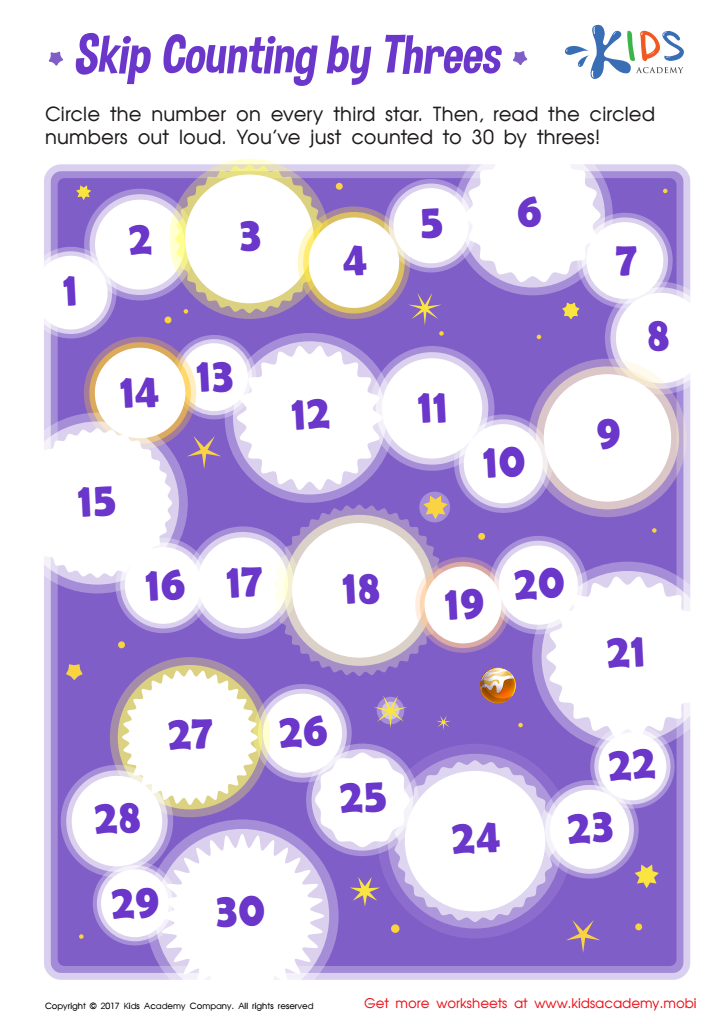
Skip Counting By Three Printable
Inspire your child with this star-themed skip counting worksheet! It offers a fun way to learn while providing a foundation for more advanced math skills, like adding, subtracting, and multiplication. It will help your child gain a sense of numeracy, practice problem solving, and stay ahead in math.
Skip Counting By Three Printable
Worksheet
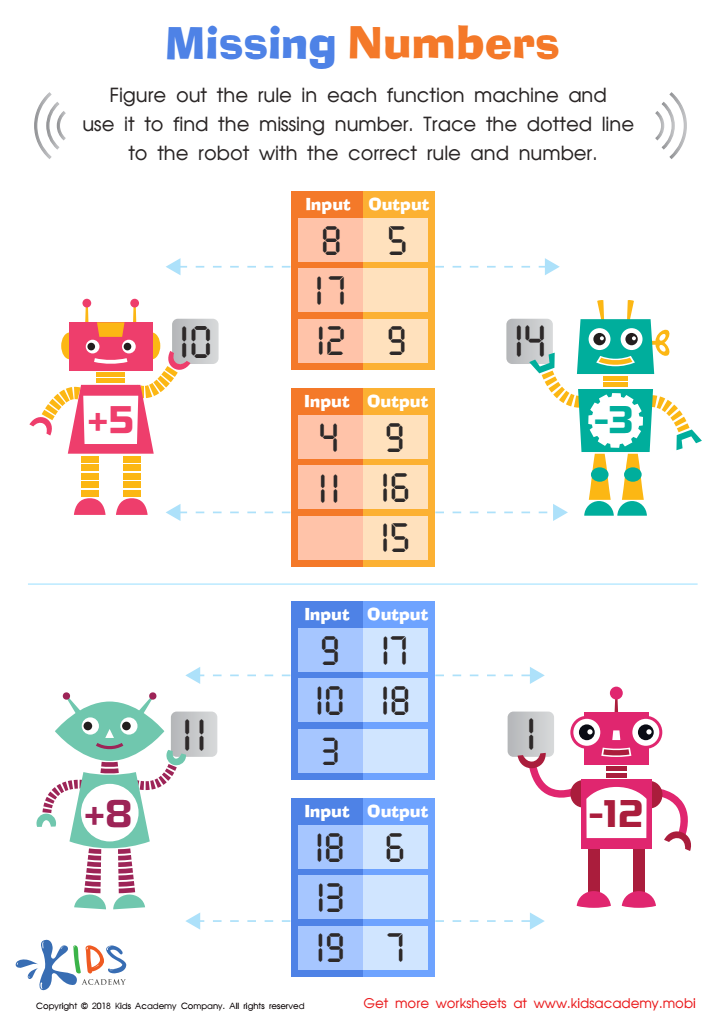
Missing Numbers Worksheet
Elementary students can learn the important pre-algebra skill of solving for missing numbers! Our robots guide them along with number-filled bellies and missing answers in their hands. Kids can examine the other numbers in each graph, use the rule to solve the missing number, and check their work with the missing number to ensure correctness.
Missing Numbers Worksheet
Worksheet
Join Kids Academy for Free
Who is primarily going to use this learning content?








Sequencing numbers is a fundamental mathematical skill that is crucial for children aged 6-7, forming the foundation of their numerical understanding. As parents and teachers, encouraging the practice of sequencing numbers—arranging numbers in order from smallest to largest or vice versa—helps improve critical thinking and problem-solving abilities. It enhances a child’s grasp of number relationships, essential for more advanced concepts like addition, subtraction, and basic multiplication.
Engaging in sequencing activities has developmental benefits as well. It promotes cognitive skills such as memory and pattern recognition, which are vital for future learning. Moreover, by mastering sequencing, children gain confidence in their math abilities, fostering a positive attitude towards learning. This skill becomes especially beneficial when children encounter real-life situations, from counting objects to organizing data—allowing them to navigate their world more effectively.
Finally, incorporating extra challenges can motivate students and encourage a sense of achievement. It engages their curiosity, instills perseverance, and can be a fun and enjoyable way to learn through games and activities. By emphasizing the importance of sequencing numbers, parents and teachers play a significant role in nurturing their child’s mathematical proficiency, providing a sturdy framework for future academic success.