
Understanding measurements Extra Challenge Worksheets for 6-Year-Olds
4 filtered results
Difficulty Level
Grade
Age
-
From - To
Subject
Activity
Standards
Explore our "Understanding Measurements Extra Challenge Worksheets for 6-Year-Olds," designed to enhance young learners' measurement skills through fun and engaging activities. These worksheets cover essential concepts such as length, weight, and volume, tailored specifically for six-year-olds. Each worksheet provides an extra challenge to foster critical thinking and problem-solving abilities while maintaining the excitement of learning. With colorful illustrations and clear instructions, children will enjoy mastering measurement concepts that are vital for their future math success. Perfect for classroom use or at-home practice, these extra challenge worksheets support foundational learning in a playful and interactive way. Boost confidence in measurements today!
Favorites
With answer key
Interactive
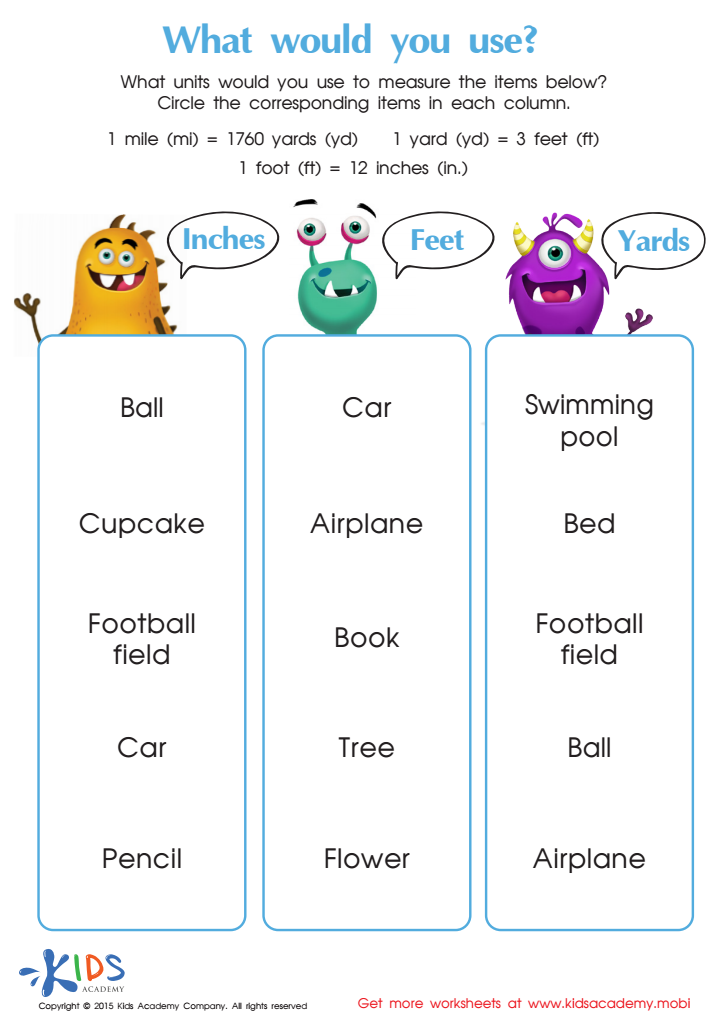
Learning about measuring objects in inches, feet and yards Worksheet
Download, cut and let your preschoolers learn and have fun estimating objects like pencils, airplanes and swimming pools in inches, feet and yards!
 Assign to My Students
Learning about measuring objects in inches, feet and yards Worksheet
Worksheet
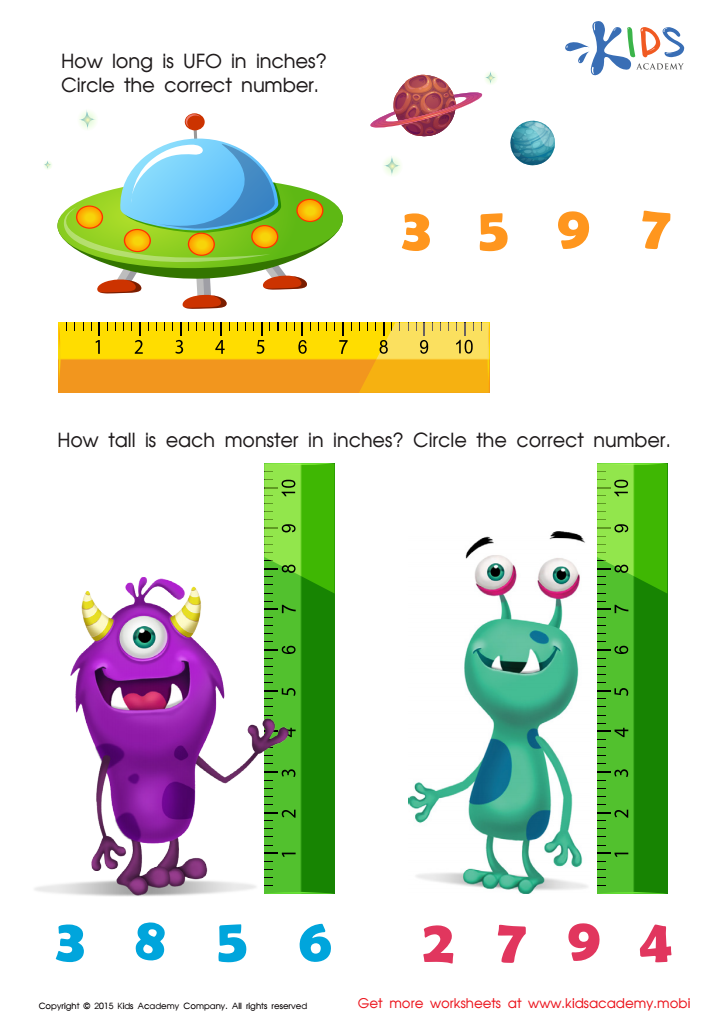
Measuring in Inches Worksheet
Look at the picture, can you measure the UFO & monsters? Write down how long each is. Which is tallest? Circle it. Get more free printable math worksheets for kindergarten at our website.
Measuring in Inches Worksheet
Worksheet
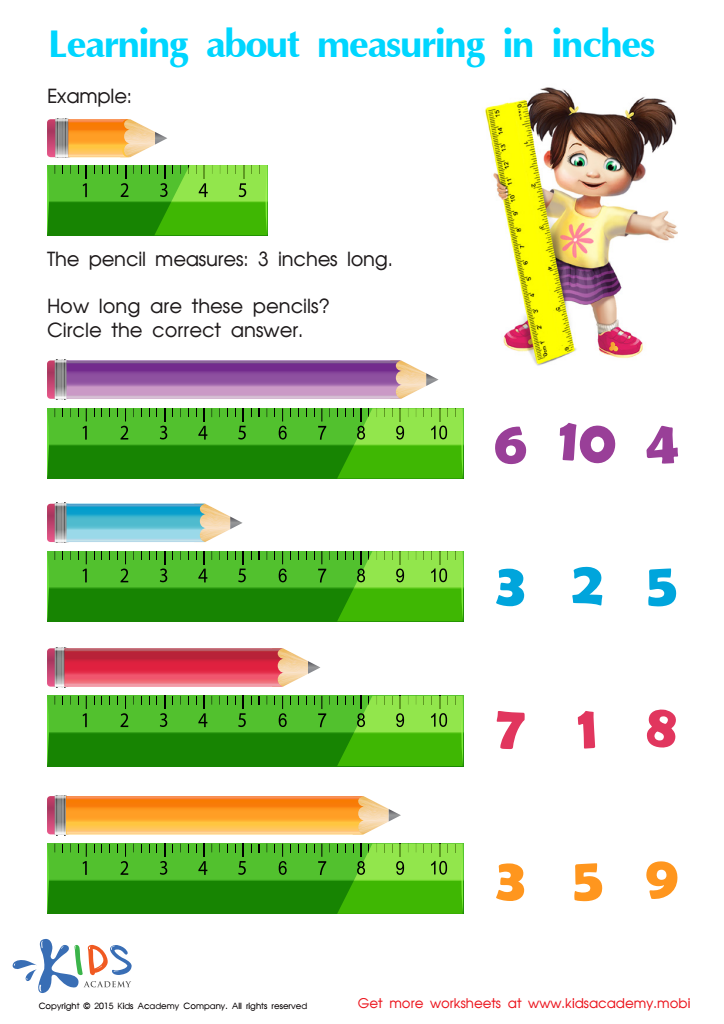
Learning About Measuring In Inches Printable
Print this free worksheet and measure pencils together with kids. See who finds the longest and the shortest! Enjoy learning math with your kids.
Learning About Measuring In Inches Printable
Worksheet
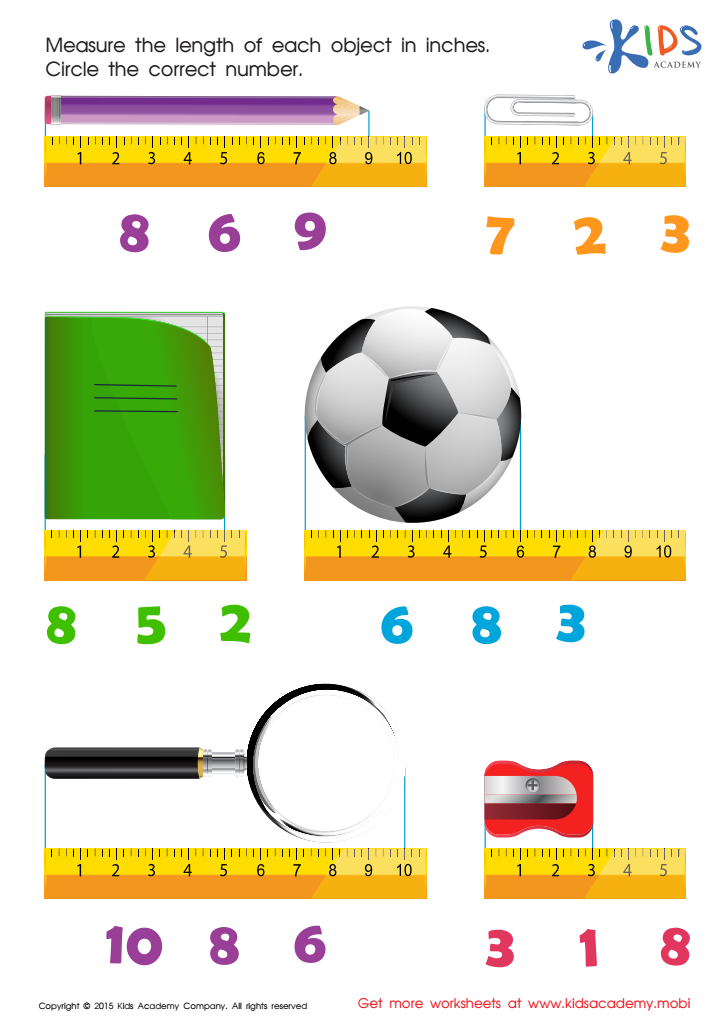
Learning measuring objects in inches Worksheet
Help your little learners gain confidence in using a ruler! Print out our free worksheet, cut out the inch ruler, and let them measure and record objects' width and length. Kids Academy has a variety of math worksheets to make learning math fun! Check out our website for more free printables!
Learning measuring objects in inches Worksheet
Worksheet
Join Kids Academy for Free
Who is primarily going to use this learning content?





Understanding measurements is crucial for six-year-olds as it lays the foundation for essential skills in math, science, and everyday problem-solving. At this age, children are naturally curious and eager to explore their environment, making it the perfect time for parents and teachers to introduce them to concepts of size, length, weight, and volume.
When kids engage with measurement through hands-on activities—such as comparing the lengths of pencils or estimating how many cups of water fill a container—they develop critical thinking skills and enhance their ability to make comparisons. These early experiences foster a sense of confidence as they start to quantify their observations about the world around them.
Moreover, measurement is interwoven with various subjects. Understanding it not only boosts mathematical proficiency but also enhances skills like reading comprehension when interpreting data from graphs or following recipe instructions.
Additionally, measuring can be fun! It transforms learning into an interactive experience, whether through crafts, cooking, or outdoor activities, making it more likely for young children to retain information. By encouraging this understanding, parents and teachers create a strong foundation for lifelong learning and subtract any barriers that children might face as they progress in their education.








