Fraction visualization Extra Challenge Geometry Worksheets for Ages 7-9
3 filtered results
Difficulty Level
Grade
Age
-
From - To
Subject
Activity
Standards
Enhance your child's understanding of fractions with our Fraction Visualization Extra Challenge Geometry Worksheets designed for ages 7-9. These engaging worksheets offer an innovative approach to learning fractions through geometric shapes and real-life applications. Your child will master concepts like equivalent fractions, part-whole relationships, and fraction comparisons while enjoying fun and visually stimulating exercises. Ideal for extra practice or enrichment, these worksheets foster critical thinking and problem-solving skills. Perfect for classroom use or at-home learning, our fraction visualization challenges ensure kids build confidence and competence in math. Explore our printable resources today and support your young learner's journey to mathematical success!
Favorites
With answer key
Interactive
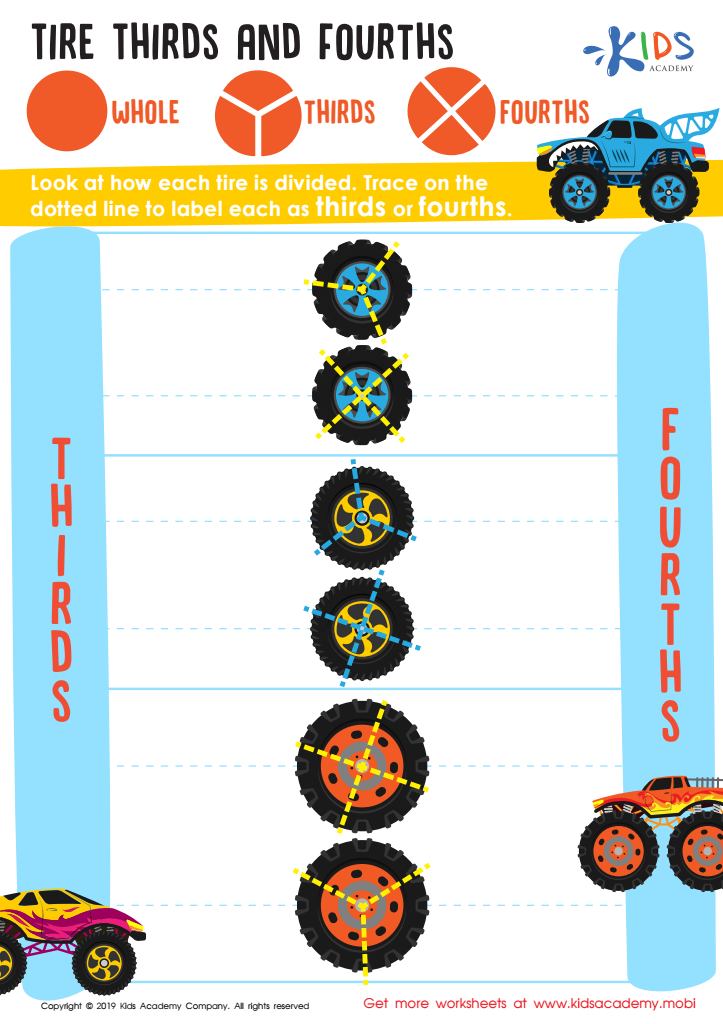
Tire Thirds and Fourths Worksheet
Learning geometry is key in your child's education. Have them identify and name shapes cut into 2, 3 and 4 parts. Test their knowledge with this worksheet - trace the dotted line to label each as third or fourth. Encourage them to keep learning!
 Assign to My Students
Tire Thirds and Fourths Worksheet
Worksheet











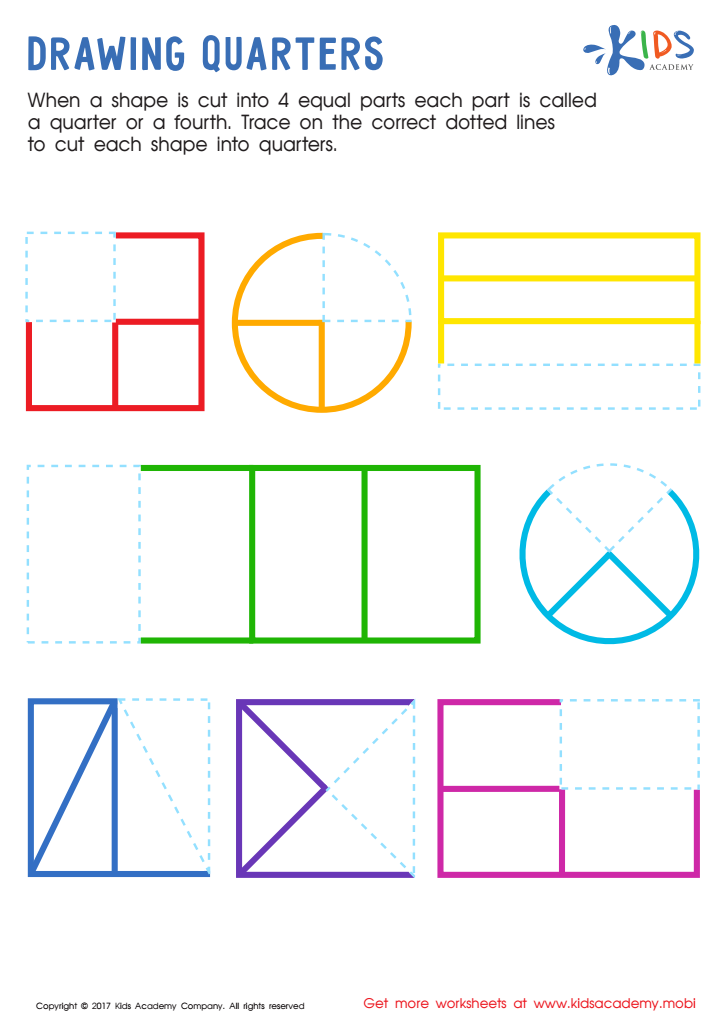
Drawing Quarters Worksheet
Help your kids divide shapes into quarters! Have them trace dotted lines to cut each shape into 4 equal parts. Each of the 4 parts is called a quarter or a fourth. This worksheet will help kids learn more about dividing shapes into four equal parts.
Drawing Quarters Worksheet
Worksheet
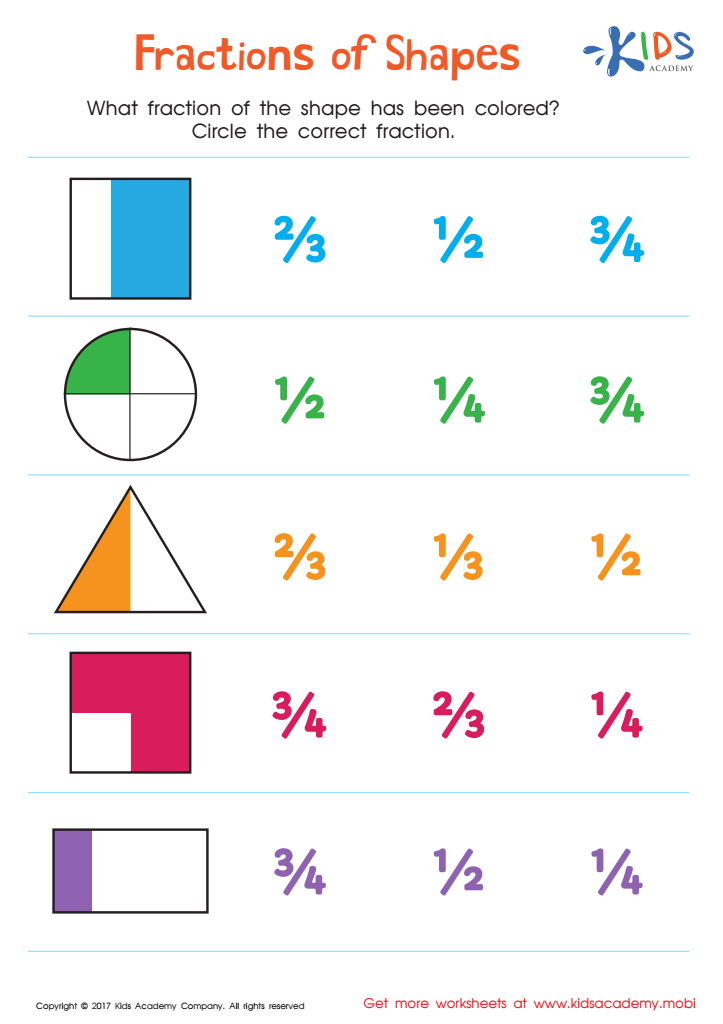
Fractions of Shapes: Math Concept Worksheet
Fractions can be tricky, but with pictures to illustrate them, they become much easier to understand. Our fractions of shapes worksheet is a great way to help children visualize fractions and gain a better understanding of them.
Fractions of Shapes: Math Concept Worksheet
Worksheet
Join Kids Academy for Free
Who is primarily going to use this learning content?








Fraction visualization is a critical skill for children ages 7-9, as it lays the foundation for their understanding of more complex mathematical concepts. For parents and teachers, emphasizing this extra challenge in geometry can significantly enhance students' comprehension of fractions by connecting them to visual representations. When children visually interact with fractions, such as through pie charts, number lines, or area models, it helps them grasp proportional relationships and part-whole concepts more concretely.
This age group is particularly receptive to visual learning, making it an ideal time to engage with geometric shapes and fractional parts. By consistently exposing children to fraction visualization using geometric concepts, educators promote spatial reasoning, which is integral to problem-solving in math. Furthermore, this skill fosters mathematical discussions, encouraging students to articulate their thinking and develop reasoning abilities.
Incorporating fraction visualization into learning not only solidifies foundational math skills but also builds confidence in young learners. It prepares them for more advanced topics like algebra and ratios in higher grades. Overall, focusing on this area equips children with critical thinking skills, making learning enjoyable and meaningful, and thereby promoting a lifelong interest in mathematics.