Capacity understanding Worksheets for Kids
1 filtered results
Difficulty Level
Grade
Age
-
From - To
Subject
Activity
Standards
Capacity understanding worksheets are an invaluable tool for students to develop their mastery over the concept of capacity. These worksheets enable children to comprehend and apply the principles of measurement, estimation, and comparison of volume. By engaging in various capacity-related exercises, students enhance their analytical thinking, mathematical skills, and problem-solving abilities. Moreover, worksheets encourage a hands-on learning experience, allowing students to visualize and manipulate different containers, such as cups, jugs, and bottles. With the help of worksheets, students can expand their understanding of capacity while fostered spatial awareness and critical thinking. Start utilizing capacity understanding worksheets today and witness your students grow into confident and skilled mathematicians.
Favorites
With answer key
Interactive
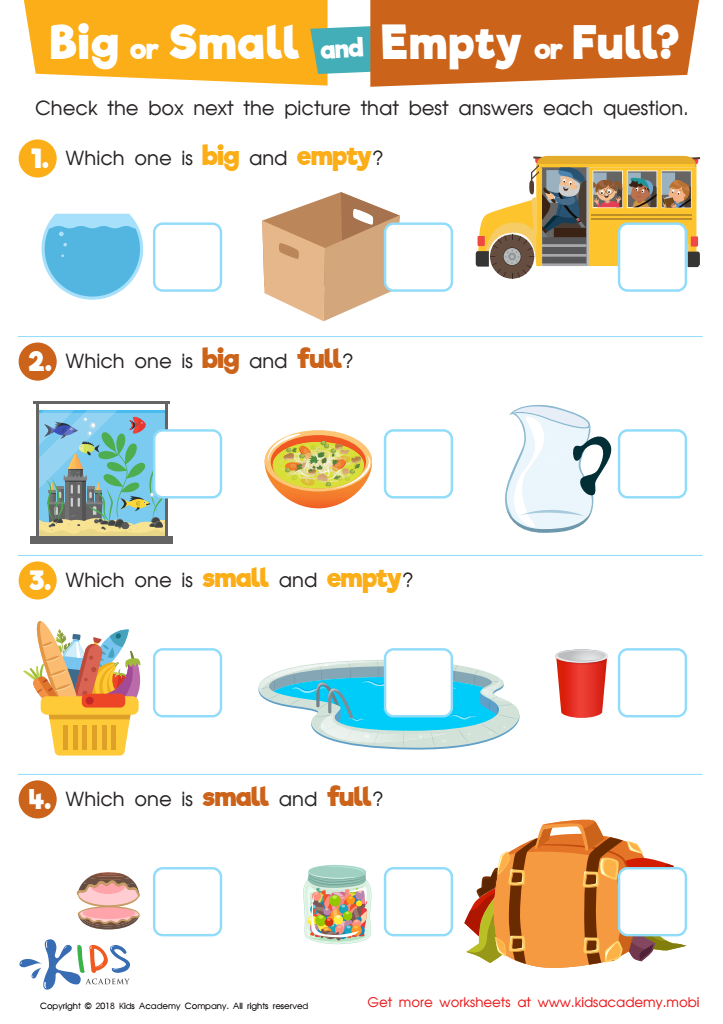
Big or Small and Empty or Full? Worksheet
Early learners can develop their math skills by using this Worksheet with fun, familiar pictures. It reinforces concepts like big/small and empty/full, helping them to differentiate and identify objects that meet those definitions.
 Assign to My Students
Big or Small and Empty or Full? Worksheet
Worksheet
Question/Answer

What are some effective activities to train students’ Capacity understanding skill when teaching them about Measurement?
Effective activities for training students' capacity understanding in measurement include hands-on experiments like measuring and comparing the capacity of different containers using water or sand, creating and using estimation jars to guess and verify volumes, and engaging in real-life problem-solving scenarios involving capacity, such as planning a party and determining the amount of drinks needed for guests.
How does the mastery of the Capacity understanding skill affect a student's performance at an early age?
The mastery of the Capacity understanding skill at an early age significantly enhances a student's performance by improving their ability to grasp concepts of volume and quantity, crucial for problem-solving in mathematics and science. It fosters logical thinking, helps in the development of spatial awareness, and lays a strong foundation for learning more complex mathematical concepts in the future.
How to test a Kindergarten student’s Capacity understanding skills?
To test a Kindergarten student’s capacity understanding skills, use hands-on activities involving physical objects. Provide a variety of containers in different shapes and sizes. Ask the student to predict which container holds more or less, then allow them to fill and compare containers with water, sand, or small objects.
Join Kids Academy for Free
Who is primarily going to use this learning content?