Egyptian history knowledge Worksheets for Kids
1 filtered results
-
From - To
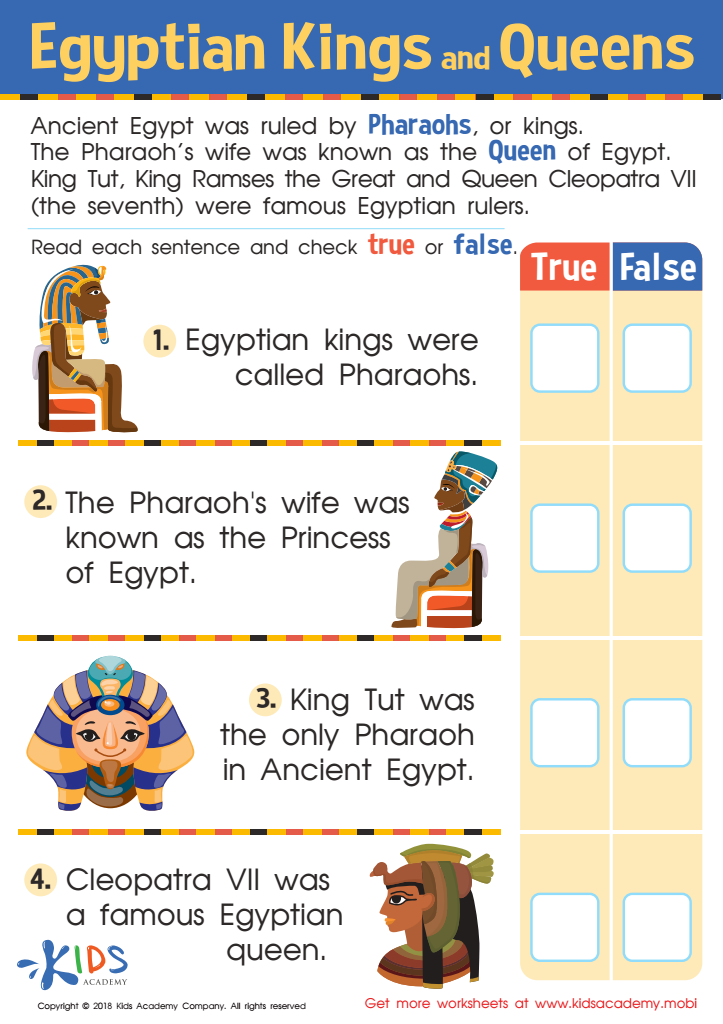
Egyptian Kings and Queens Worksheet
 Assign to My Students
Question/Answer

Why is the Egyptian history knowledge skill important for Grade 3 students?
Learning about Egyptian history in Grade 3 is important because it introduces students to ancient civilizations, teaching them about the origins of some of our modern-day customs and institutions. It helps develop their understanding of cultural diversity and historical timelines, encouraging curiosity and respect for past societies. This foundational knowledge also supports critical thinking and connects to broader historical narratives.
How to test a Grade 3 student’s Egyptian history knowledge skills?
To test a Grade 3 student's Egyptian history knowledge, use a mix of multiple-choice questions, true/false statements, and short answer questions focused on key topics like the Nile River, pyramids, pharaohs, mummies, and hieroglyphics. Include visual aids for identification and comprehension. This approach assesses both factual knowledge and understanding of concepts.
How does the mastery of the Egyptian history knowledge skill affect a student's performance at an early age?
Mastering Egyptian history at an early age enhances students' understanding of world history, contributes to cultural awareness, and improves critical thinking skills. It fosters curiosity, encourages historical empathy, and helps develop a sense of temporal perspective. This knowledge notably supports cross-curricular learning, enriching vocabulary and comprehension in reading, and providing context for art, mathematics, and science studies.