Learning food chains Worksheets for Kids
1 filtered results
Difficulty Level
Grade
Age
-
From - To
Subject
Activity
Standards
Understanding food chains is vital to grasp ecosystem balances. Worksheets help students learn about food chains and their elements, such as organism identification, energy flow, and species interdependence. They also foster critical thinking by examining food chain dynamics and potential ecosystem impacts. These worksheets offer a practical learning method, boosting retention and comprehension, making them a powerful educational resource that enhances knowledge of food chains, hones critical thinking, and deepens respect for organism interconnectedness within ecosystems.
[Character count: 700 characters without spaces]
Favorites
With answer key
Interactive
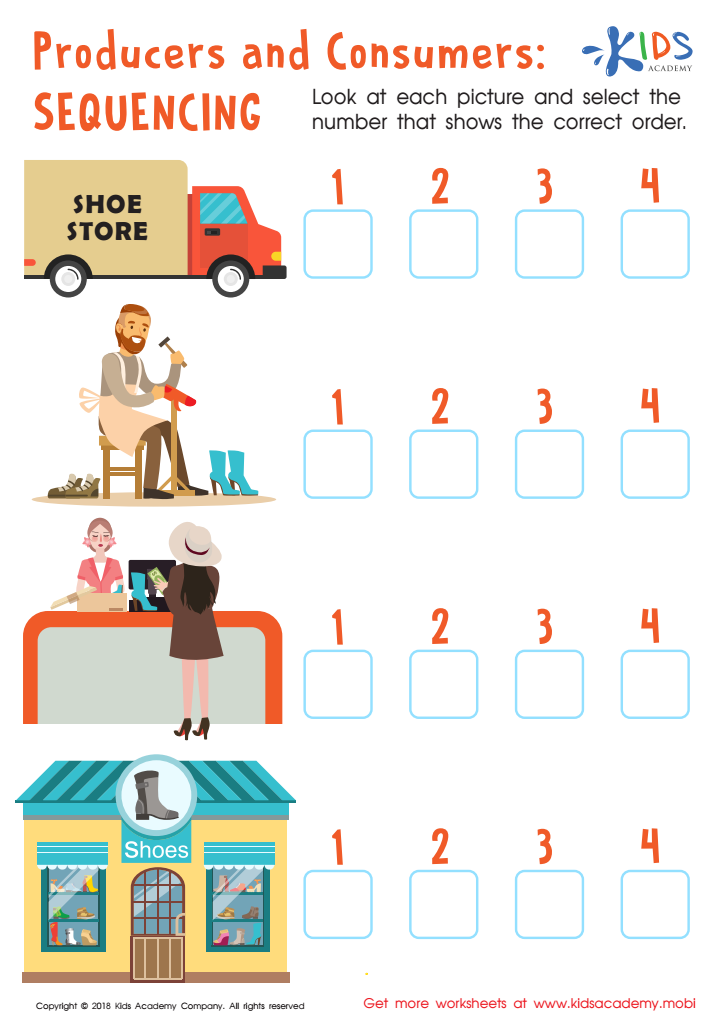
Producers and Consumers: Sequencing Worksheet
Ask your child: Who are producers? Can you give an example? Here's one: a shoe maker. What's happening in each picture? Can you arrange them in the right order? Select the number that shows the correct answer.
 Assign to My Students
Producers and Consumers: Sequencing Worksheet
Worksheet
Question/Answer

Why is the Learning food chains skill important for Grade 1 students?
Learning food chains is important for Grade 1 students as it introduces them to basic ecological relationships and the interdependence of organisms. This foundational knowledge helps children understand the natural world around them, fostering respect for living things and awareness of environmental conservation. It also builds critical thinking skills by exploring cause and effect within natural systems.
How does the mastery of the Learning food chains skill affect a student's performance at an early age?
Mastery of the Learning food chains skill at an early age positively impacts a student's performance by enhancing understanding of ecological relationships, improving critical thinking, and fostering an appreciation for biodiversity. This knowledge lays a foundation for advanced scientific concepts, encourages curiosity about the natural world, and contributes to a holistic understanding of environmental stewardship.
How to test a Grade 1 student’s Learning food chains skills?
To test a Grade 1 student's understanding of food chains, you can use simple and interactive methods like picture card sorting, where they categorize plants, herbivores, and carnivores. Alternatively, drawing simple food chains or matching exercises, where they connect different organisms according to who eats whom, can be effective.
Join Kids Academy for Free
Who is primarily going to use this learning content?