
Promoting diversity understanding Worksheets for Kids
1 filtered results
Difficulty Level
Grade
Age
-
From - To
Subject
Activity
Standards
Promoting diversity through worksheets is key for understanding different cultures and perspectives. These educational tools engage learners in activities exploring diversity's richness. They offer self-reflection on biases, foster empathy for marginalized groups, and enhance critical thinking about race, religion, gender, and socioeconomic issues. The worksheets also help in developing inclusive language and behaviors, improving communication. Active learning is encouraged through questions and discussions, leading to more harmonious, inclusive communities. By challenging biases and promoting inclusivity, we prepare individuals to better navigate a diverse world.
Favorites
With answer key
Interactive
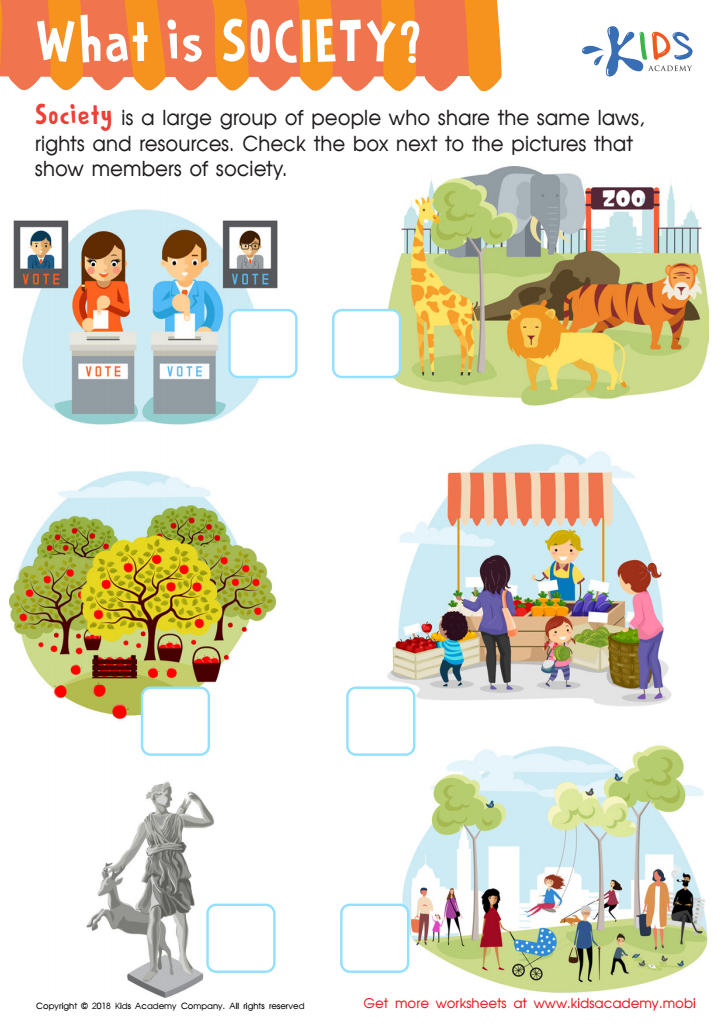
What Is Society? Worksheet
Ask your students to define 'society'. Then, have them name some of the people and buildings that make up a society. To clarify, explain that societies are made of large groups of people who share laws, rights and resources. Finally, have them check the box next to the pictures that depict members of society.
 Assign to My Students
What Is Society? Worksheet
Worksheet
Question/Answer

What are some effective activities to train students’ Promoting diversity understanding skill when teaching them about Governance and Civics?
Integrate role-playing scenarios that depict diverse perspectives in governance issues, facilitate debates on civic policies affecting varied communities, organize multicultural group projects to solve civic problems collaboratively, and use case studies of diverse leaders and their impact on governance. These activities encourage empathy, understanding, and respect for different viewpoints, vital for fostering diversity understanding in governance and civics education.
Why is the Promoting diversity understanding skill important for Grade 2 students?
Promoting diversity understanding in Grade 2 students is crucial as it fosters empathy, respect, and appreciation for differences at an early age. This early foundation helps combat prejudice, encourages inclusivity, and prepares students to thrive in a diverse world. It also enhances social and emotional development by teaching children to value and respect others regardless of their backgrounds.
How to train the Promoting diversity understanding skill in Grade 2 students learning about Governance and Civics?
To train Grade 2 students in promoting diversity understanding within Governance and Civics, integrate multicultural stories and examples into lessons, emphasizing the value of different perspectives and backgrounds. Use role-playing and group activities to teach empathy and cooperation, highlighting how diverse viewpoints strengthen community decision-making. Incorporate interactive discussions about respect and inclusion, making abstract concepts tangible through relatable, age-appropriate content.
Join Kids Academy for Free
Who is primarily going to use this learning content?













