Understanding galaxies Worksheets for Kids
1 filtered results
Difficulty Level
Grade
Age
-
From - To
Subject
Activity
Standards
Understanding galaxies worksheets are designed to help students learn and comprehend the fascinating world of galaxies. These worksheets provide a structured and interactive way for students to explore topics such as galaxy formation, types of galaxies, and the life cycle of stars within galaxies. By using worksheets, students can take an active role in their learning process and engage in hands-on activities that promote critical thinking and problem-solving skills. These worksheets also offer an opportunity for students to reinforce their knowledge and test their understanding through various exercises and quizzes. With these benefits, understanding galaxies through worksheets becomes a dynamic and enjoyable learning experience for students of all levels.
Favorites
With answer key
Interactive
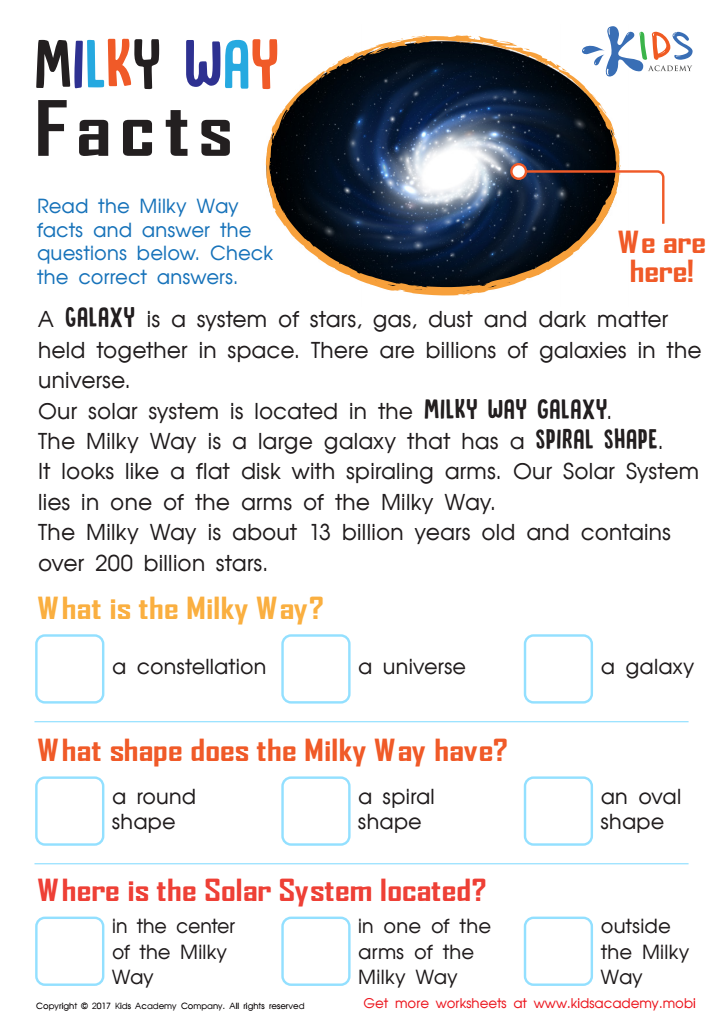
Milky Way Facts Worksheet
Blast off to explore the Milky Way! This fun-filled worksheet teaches kids facts about our galaxy, from its shape and composition, to its age and more! Get ready to discover what makes up a galaxy and enjoy learning all about it!
 Assign to My Students
Milky Way Facts Worksheet
Worksheet
Question/Answer

How to test a Grade 3 student’s Understanding galaxies skills?
To test a Grade 3 student's understanding of galaxies, you could ask them to identify and describe the basic characteristics of galaxies, such as their shapes (spiral, elliptical, irregular), size, and the fact that they contain stars, dust, and gas. Use simple multiple-choice questions, fill-in-the-blanks, or ask them to draw and label a simple galaxy diagram.
How to train the Understanding galaxies skill in Grade 3 students learning about Space?
To train the "Understanding galaxies" skill in Grade 3 students, use interactive activities like creating simple galaxy models with art supplies, engaging in storytelling about the Milky Way and other galaxies, employing educational videos and animations for visual learning, and conducting basic comparison exercises between our galaxy and others to highlight differences in size, shape, and composition.
Why is the Understanding galaxies skill important for Grade 3 students?
Understanding galaxies in Grade 3 fosters early curiosity about the universe, encouraging critical thinking and imagination. It lays the foundation for scientific literacy, helping students grasp basic astrophysical concepts and appreciate Earth's place in the cosmos. Moreover, it inspires awe and wonder about the vastness of space, promoting a lifelong interest in science and exploration.
Join Kids Academy for Free
Who is primarily going to use this learning content?