Understanding proportions Worksheets for Kids
1 filtered results
-
From - To
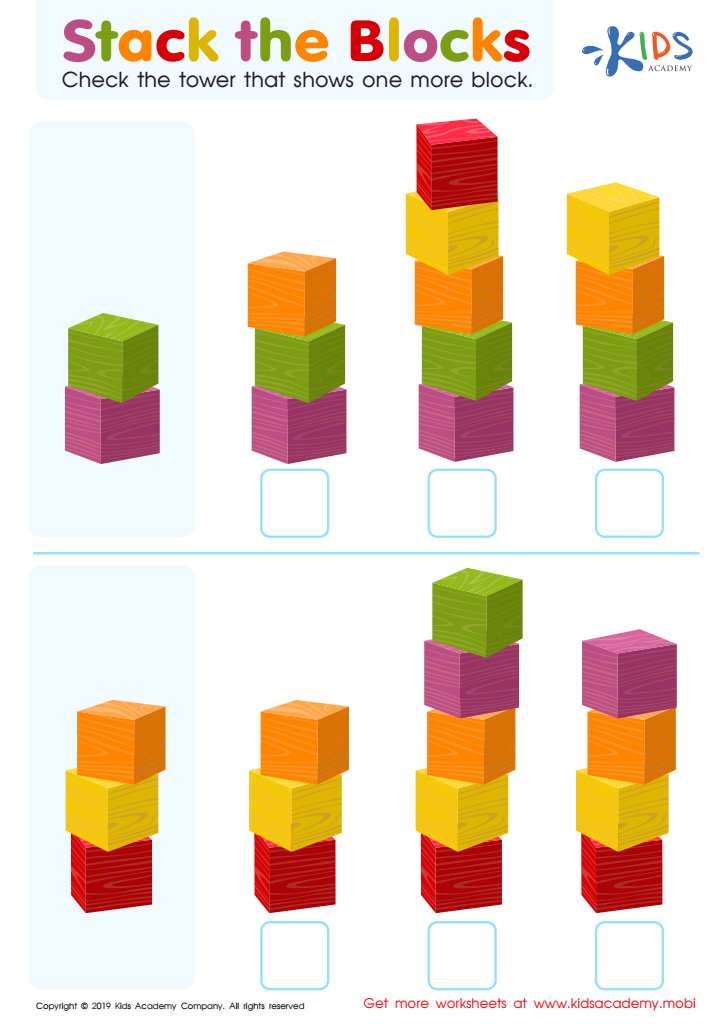
Stack the Blocks Worksheet
 Assign to My Students
Question/Answer

How does the mastery of the Understanding proportions skill affect a student's performance at an early age?
Mastery of the Understanding proportions skill at an early age significantly enhances a student's mathematical reasoning and problem-solving abilities. It lays a foundational understanding for algebra, geometry, and physics. This skill also improves their ability to analyze and interpret information in real-world contexts, leading to better academic performance across various subjects, not just mathematics.
How to train the Understanding proportions skill in Preschool students learning about Numbers?
To train the Understanding proportions skill in Preschool students, use concrete, relatable objects such as fruits, blocks, or toys. Start by comparing groups of items in terms of more, less, or equal amounts. Then, introduce simple ratios using these objects, like 1:1, 1:2, and show them visually.
How to test a Preschool student’s Understanding proportions skills?
To test a preschool student's understanding of proportions, present them with objects or pictures that vary in size and ask them to match or group them based on their size relationships. For instance, provide various sizes of the same animal pictures and guide them to order them from smallest to largest, testing their ability to recognize and categorize proportional differences.