Understanding division Addition Worksheets
5 filtered results
-
From - To
Discover our "Understanding Division Addition Worksheets," designed to help young learners grasp the concept of division as the opposite of addition. These engaging worksheets encourage students to explore division through addition problems, reinforcing their math skills in a fun and interactive way. With various exercises tailored to different levels, children can practice and build confidence in their understanding of both operations. Ideal for classroom use or at-home practice, our worksheets provide clear explanations and ample practice opportunities, ensuring that students master the foundation of division and addition. Dive into our resources today and support your child’s mathematical journey!
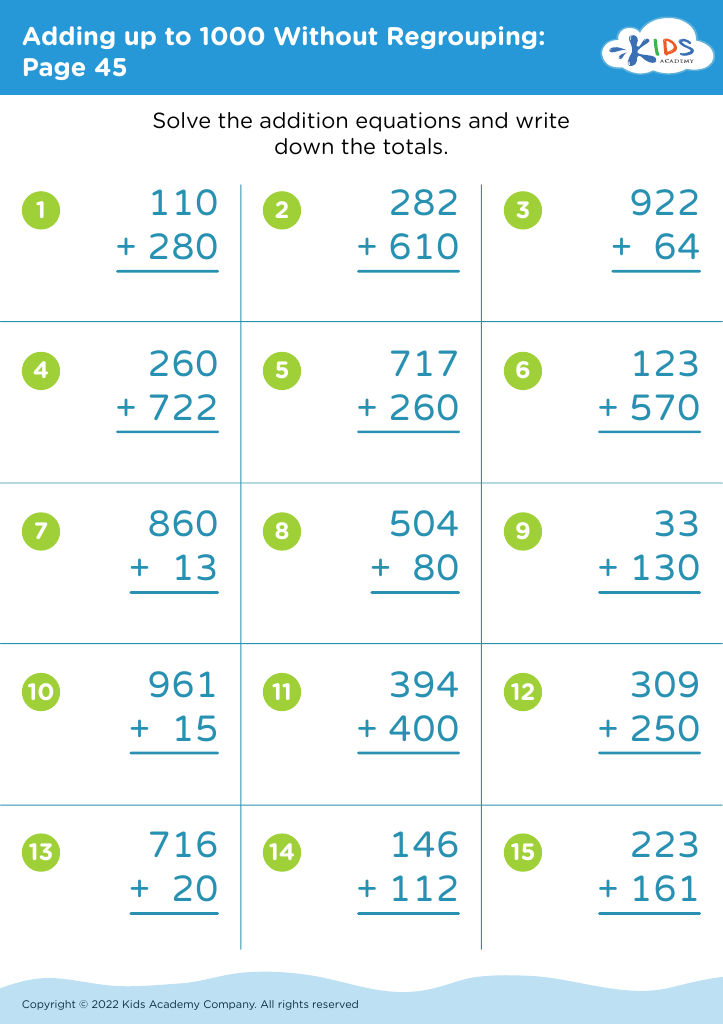








Understanding division in the context of addition is crucial for parents and teachers because it lays the foundation for a child's overall mathematical literacy. Division is not just about separating numbers; it is interconnected with addition, as multiplication can be seen as repeated addition.
When children grasp the concept of division as “how many groups can I make?” or “what size can my groups be?” it becomes easier for them to relate this idea to addition, facilitating a deeper understanding of number relationships. This comprehension aids in problem-solving skills in daily life, such as sharing items or allocating resources.
Moreover, proficient understanding of these concepts enhances children's confidence in math, reducing anxiety often associated with the subject. Students who perceive math as interconnected are more likely to engage and explore mathematical topics further.
For educators, teaching division alongside addition promotes a richer curriculum that reflects real-world applications. It helps teachers develop instructional strategies tailored to individual learning styles, ensuring all students grasp these fundamental concepts.
Ultimately, fostering an understanding of division through addition equips children with the skills they need for future mathematical concepts, supporting their academic success and building essential life skills.








