Logical reasoning skills Math Worksheets
3 filtered results
-
From - To
Unlock your child's potential with our Logical Reasoning Skills Math Worksheets at Kids Academy! Designed for young learners, these worksheets enhance critical thinking and problem-solving abilities. Each activity focuses on developing logical reasoning through fun, engaging exercises that incorporate patterns, sequencing, and comparisons. Ideal for reinforcing classroom learning, our worksheets cater to various skill levels and learning styles. Give your child the tools to succeed in math and beyond with our expertly crafted resources. Boost confidence, foster a love for learning, and watch them excel with Kids Academy Math Worksheets! Download now and start the journey to mathematical mastery.
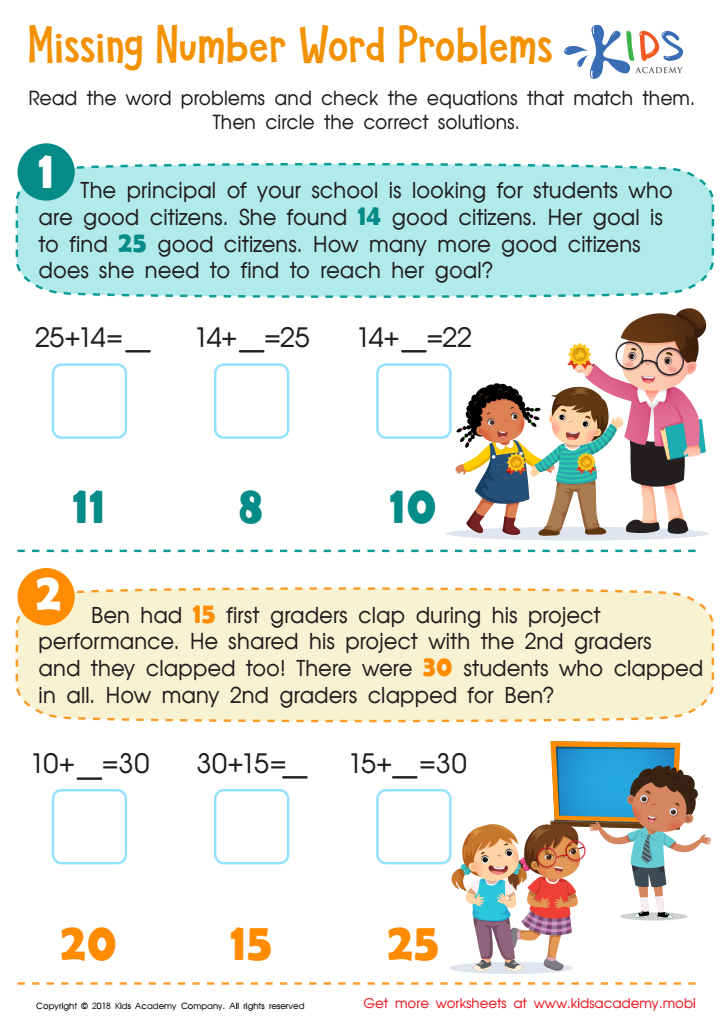
Missing Number Word Problems Worksheet
 Assign to My Students

Logic Game Sorting Worksheet

Sudoku Worksheet








Logical reasoning skills in math are critical for young learners as they form the foundation for problem-solving and analytical thinking, both in academic settings and in everyday life. Educators and parents should prioritize the development of these skills for several vital reasons. Firstly, logical reasoning promotes a deep understanding of mathematical concepts rather than rote memorization, which leads to greater retention and the ability to apply knowledge flexibly. It encourages children to approach problems methodically by breaking them down into smaller, manageable parts and analyzing the relationships between these parts.
Furthermore, strong logical reasoning skills are transferable to other subjects and real-world scenarios. For example, children learn to make sense of phenomena in science or understand cause-and-effect in social situations, thus fostering a well-rounded intellect. Logical reasoning also enhances critical thinking, enabling students to evaluate arguments, identify fallacies, and construct coherent conclusions.
By caring about the development of logical reasoning skills, parents and teachers support children's cognitive growth and prepare them for future academic and career success. Importantly, it contributes to their ability to navigate a complex world, make informed decisions, and solve problems independently. Cultivating these skills early on establishes a robust foundation for lifelong learning and adaptability.








