Understanding adjectives Math Worksheets
6 filtered results
-
From - To
Looking to boost your child's mathematical prowess while also enhancing their language skills? Our "Understanding Adjectives Math Worksheets" seamlessly blend math and English to build a strong learning foundation. Designed for young learners, these engaging worksheets simplify complex concepts by linking adjectives with math problems. Kids will practice identifying, describing, and analyzing objects, all while solving fun math challenges. Ideal for classroom use or at-home learning, these worksheets not only sharpen math abilities but also enrich vocabulary and comprehension skills. Unlock the path to academic success by integrating our unique approach to learning into your child’s routine today!
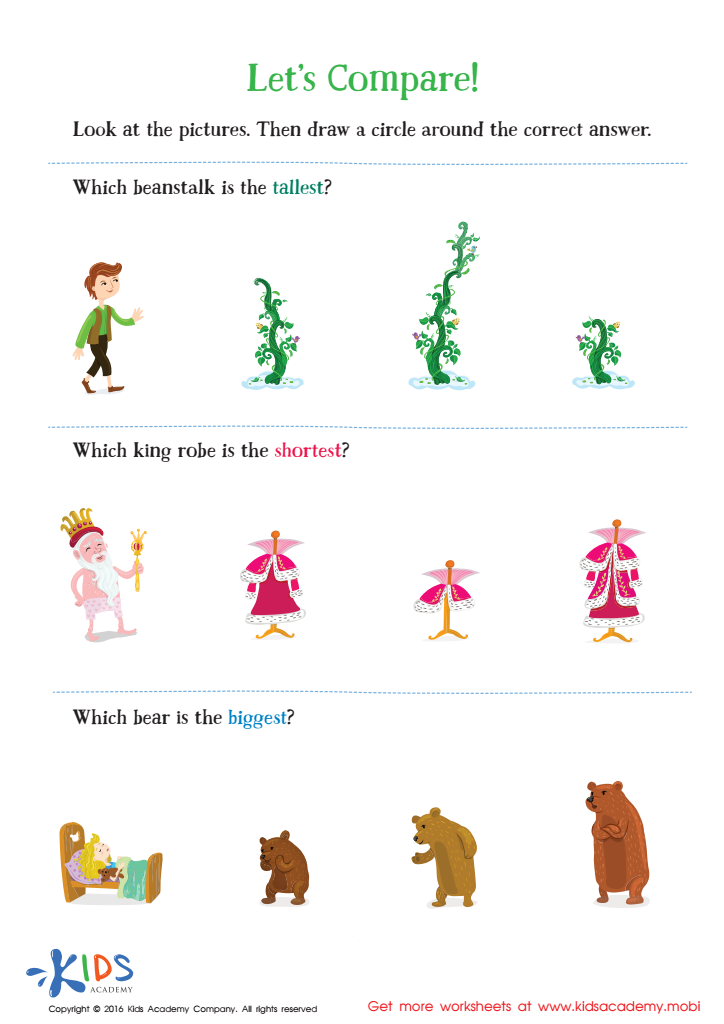
Fairy Tale Worksheet: Let's Compare
 Assign to My Students





.jpg)


Understanding adjectives is crucial for young learners, both in their literacy and numeracy education. For one, adjectives significantly enhance a child's ability to describe and interact with their environment. In literacy, adjectives enrich vocabulary and enable children to express themselves more vividly and precisely. This boosts their communication skills and makes reading and writing more engaging and enjoyable.
When it comes to math, understanding adjectives is equally vital. Adjectives help children grasp and articulate numerical concepts and the characteristics of shapes, sizes, and quantities. For example, when learning geometry, adjectives like "round," "tall," "short," "long," or "tiny" help students describe and compare the attributes of different shapes and objects. Adjectives are also essential when following instructions or solving word problems. They identify and differentiate aspects of a problem, aiding in comprehension and ensuring accurate problem-solving.
Moreover, integrating adjectives in math lessons can make abstract concepts more concrete and understandable. This cross-disciplinary approach not only fosters a deeper understanding of mathematical terms and concepts but also sustains interest and curiosity. Teachers and parents can thus support cognitive and linguistic development by giving children a solid grounding in the effective use of adjectives, creating a more holistic and interconnected learning experience.








