
Understanding clocks Math Worksheets
5 filtered results
Difficulty Level
Grade
Age
-
From - To
Subject
Activity
Standards
Enhance your child's time-telling skills with our "Understanding Clocks" Math Worksheets from Kids Academy. Our engaging and interactive printable worksheets help children grasp the concept of telling time through fun activities. Designed for young learners, they focus on reading both digital and analog clocks, learning about hours and minutes, and understanding the differences between AM and PM. Colorful illustrations and age-appropriate exercises ensure that kids stay interested while developing essential time-telling abilities. Perfect for classroom use or additional practice at home, these worksheets are a valuable resource for building foundational math skills. Empower your child with the gift of time through our expertly crafted materials.
Favorites
With answer key
Interactive
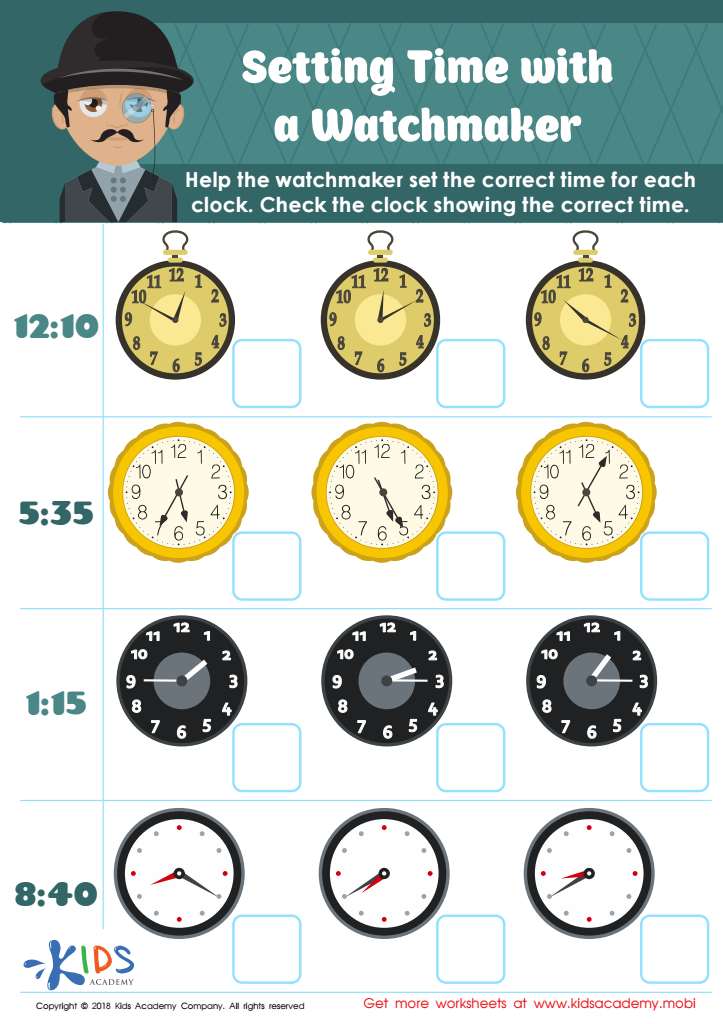
Setting Time with Watchmaker Worksheet
Can your kids tell the time? If so, this worksheet should be easy. Help them set the time for each clock: look at the time written on the left side and find the clock on the right side that matches.
 Assign to My Students
Setting Time with Watchmaker Worksheet
Worksheet
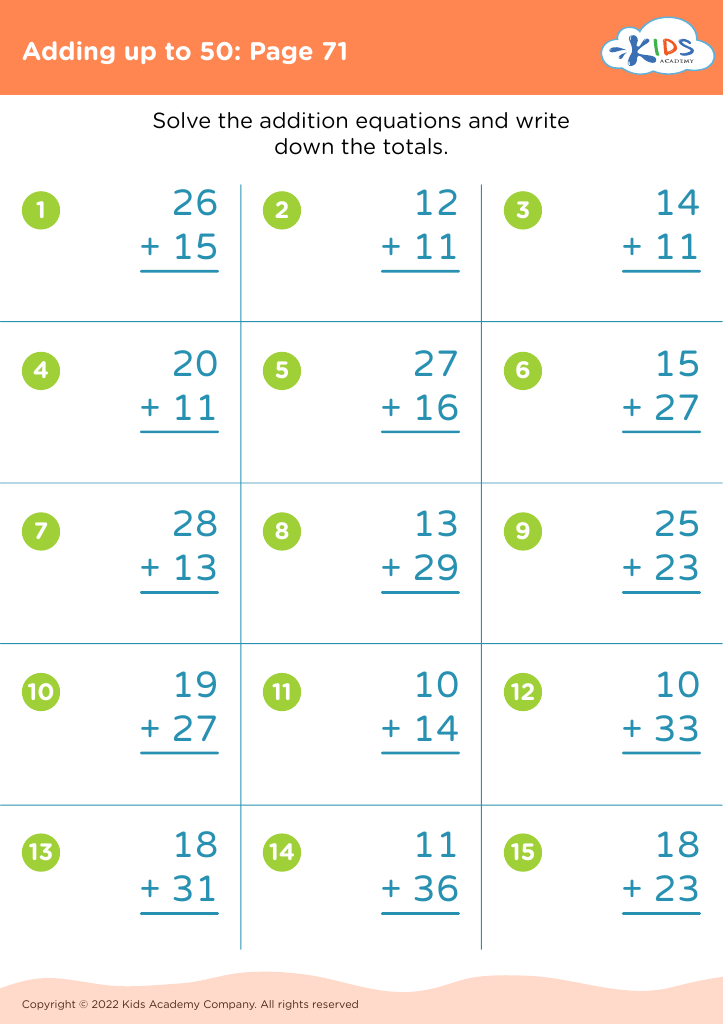
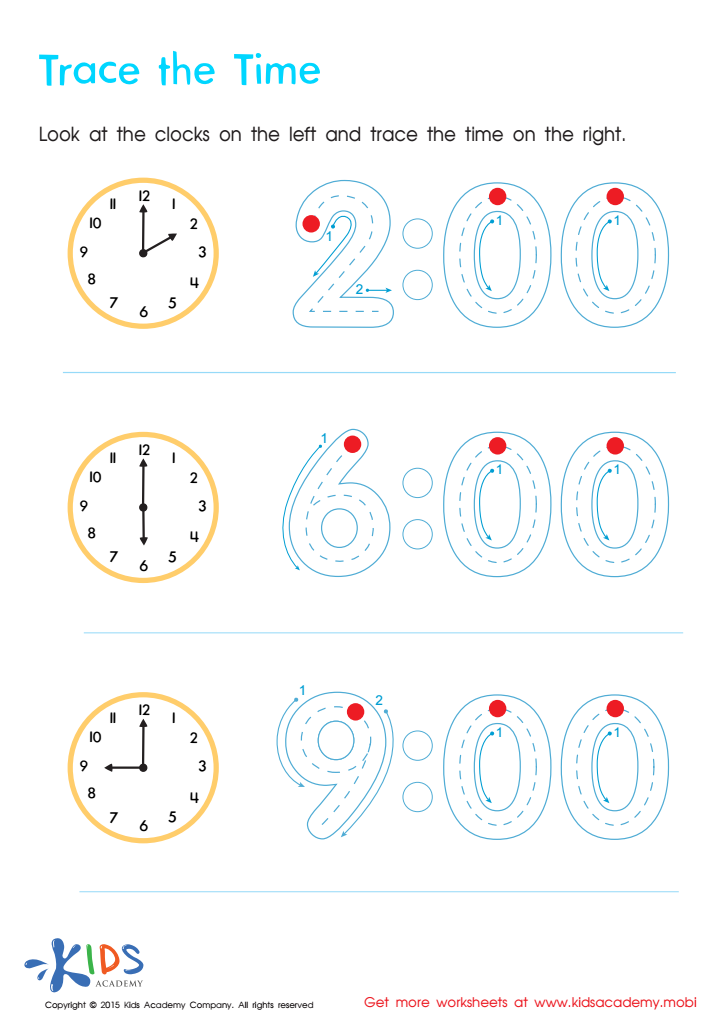
Telling The Time Worksheet: Part 2
Help your kids learn to tell the time with this free math worksheet from Kids Academy. Have them look at the clock faces and trace the time on the right - is it a full hour or half an hour? Get more practice with our wide selection of math worksheets for kindergarten.
Telling The Time Worksheet: Part 2
Worksheet
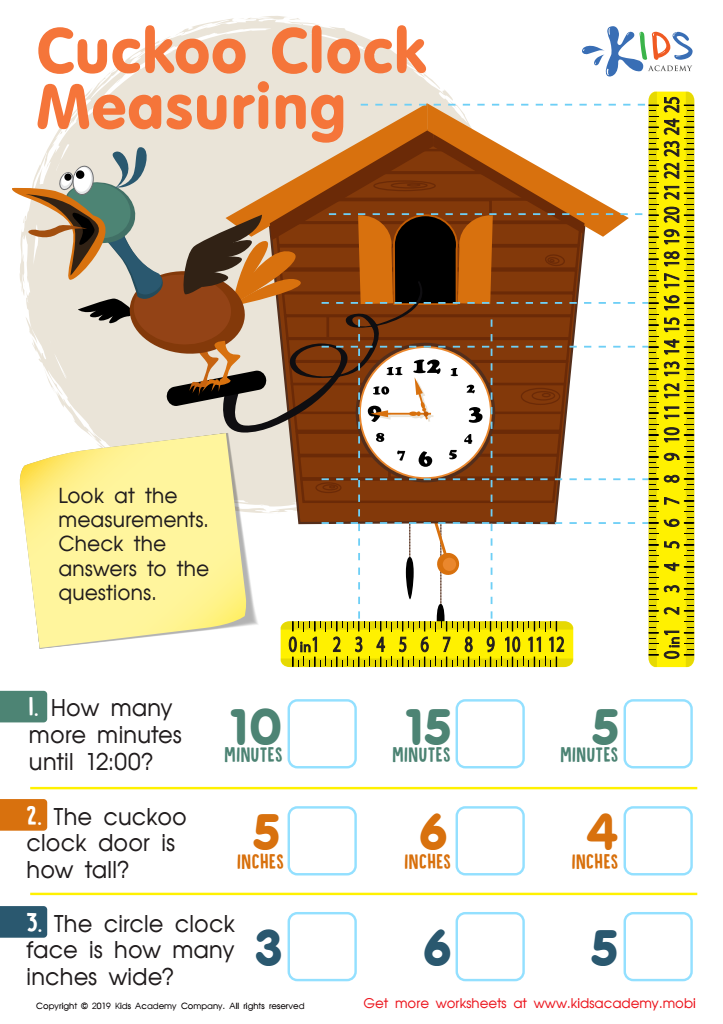
Cuckoo Clock Measuring Worksheet
Check out the fun picture in this worksheet. Ask your kids to identify the object. It's a cuckoo clock - the bird pops out every hour to announce the time. See if your child knows how to measure the clock. Help them answer the 3 questions and test their knowledge of time!
Cuckoo Clock Measuring Worksheet
Worksheet
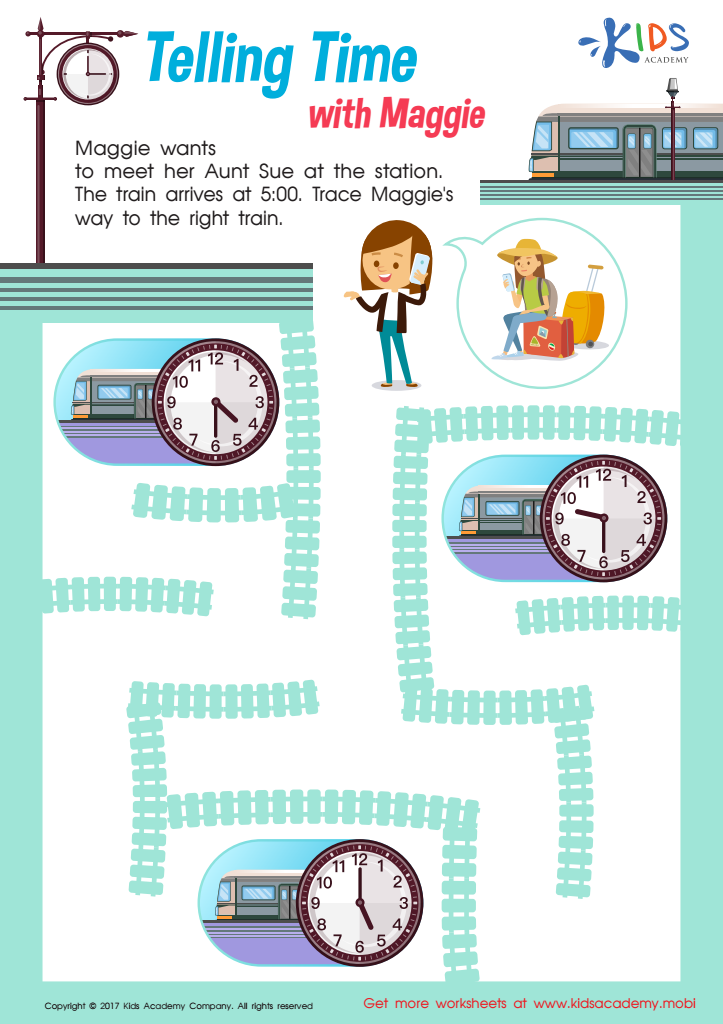
Telling Time With Maggie Time Worksheet
Help Maggie catch her train! Navigate the maze and read clocks to get her to her destination. Join her on a fun time-telling adventure with this puzzling worksheet. Your child will love it!
Telling Time With Maggie Time Worksheet
Worksheet
Join Kids Academy for Free
Who is primarily going to use this learning content?







Understanding clocks and telling time is a fundamental skill with numerous benefits, making it a critical area of focus for both parents and teachers. Firstly, it plays a crucial role in developing temporal awareness. Children need to grasp the concept of time and how it organizes daily activities. This foundational understanding aids in structuring their day, managing transitions between tasks, and fostering a sense of responsibility.
It also enhances mathematical abilities. Learning to read a clock involves recognizing numbers, understanding their sequence, and relating them to units of time. These activities improve counting, addition, subtraction, and sometimes even fractions, when dealing with minutes and seconds.
Additionally, telling time bolsters problem-solving and critical thinking skills. Interpreting the positioning of the clock's hands requires children to discern pieces of information and integrate them meaningfully. This process mirrors broader cognitive tasks, making time-telling a naturally preparatory exercise for more complex mental activities.
From a practical standpoint, proficiency in telling time is enormously useful. It helps children follow schedules, arrive punctually, and understand time management—all highly relevant skills for both academic success and everyday life.
Overall, the myriad benefits, ranging from cognitive development to practical application, make time-telling a vital component of a child's education. Parents and teachers who prioritize this skill are setting the stage for better-organized, more independent, and mathematically adept learners.








