Understanding quadrilaterals Math Worksheets
4 filtered results
-
From - To
Our "Understanding Quadrilaterals" math worksheets are designed to help young learners master the properties and classifications of quadrilaterals. These engaging activities feature colorful illustrations, clear instructions, and progressively challenging problems to aid comprehension and retention. Suitable for various grade levels, these printables cover key concepts such as identifying and differentiating between different types of quadrilaterals, understanding their angles and sides, and recognizing symmetrical properties. Perfect for classroom use or home study, our expertly crafted worksheets make learning math fun and effective, setting the foundation for future success in geometry and beyond.
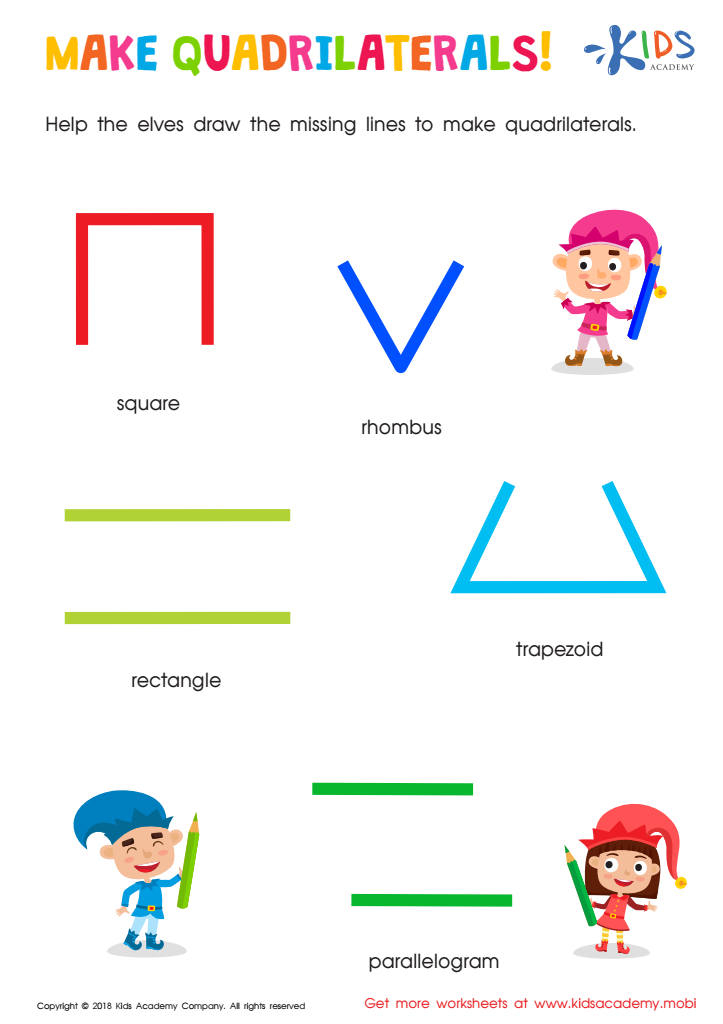
Make Quadrilaterals Worksheet
 Assign to My Students
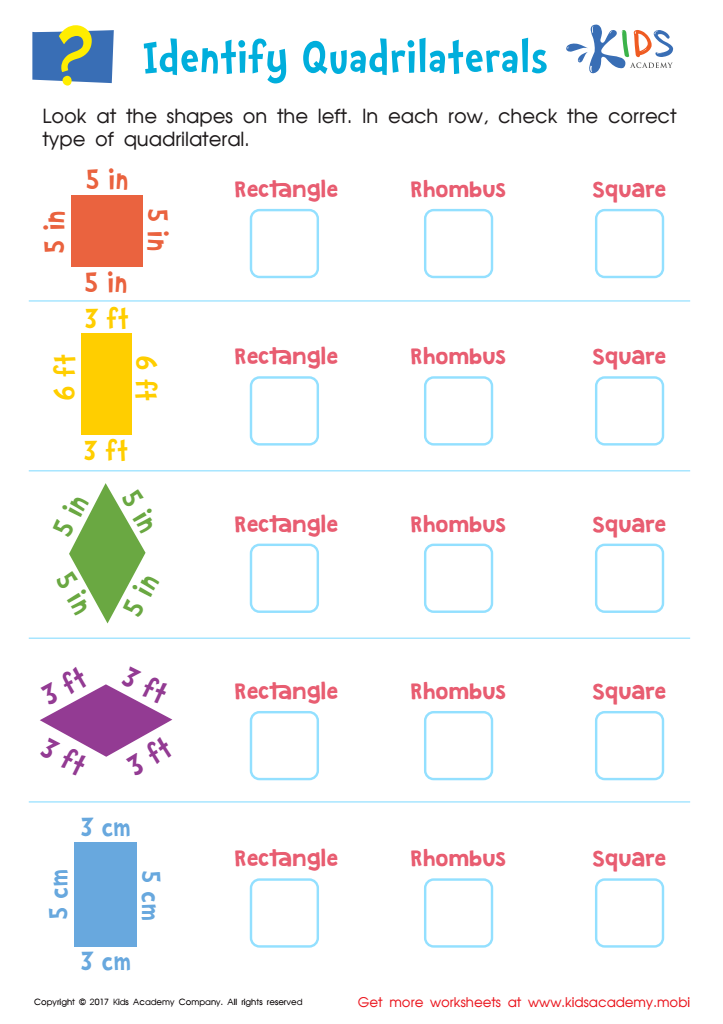
Identify Quadrilaterals Worksheet
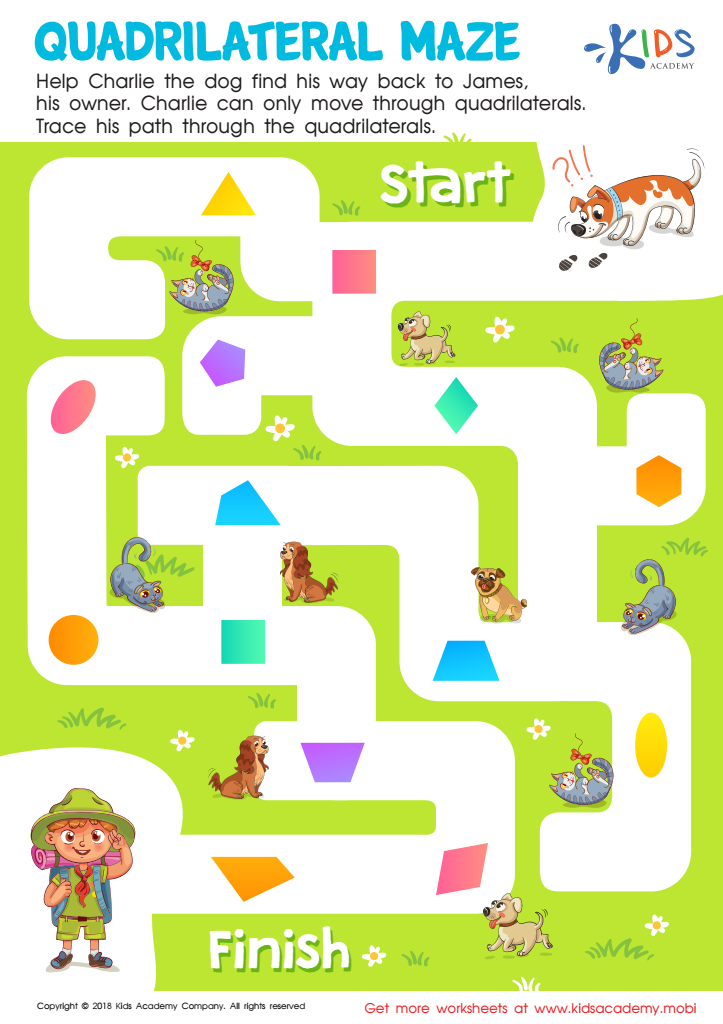
Quadrilateral Maze Worksheet
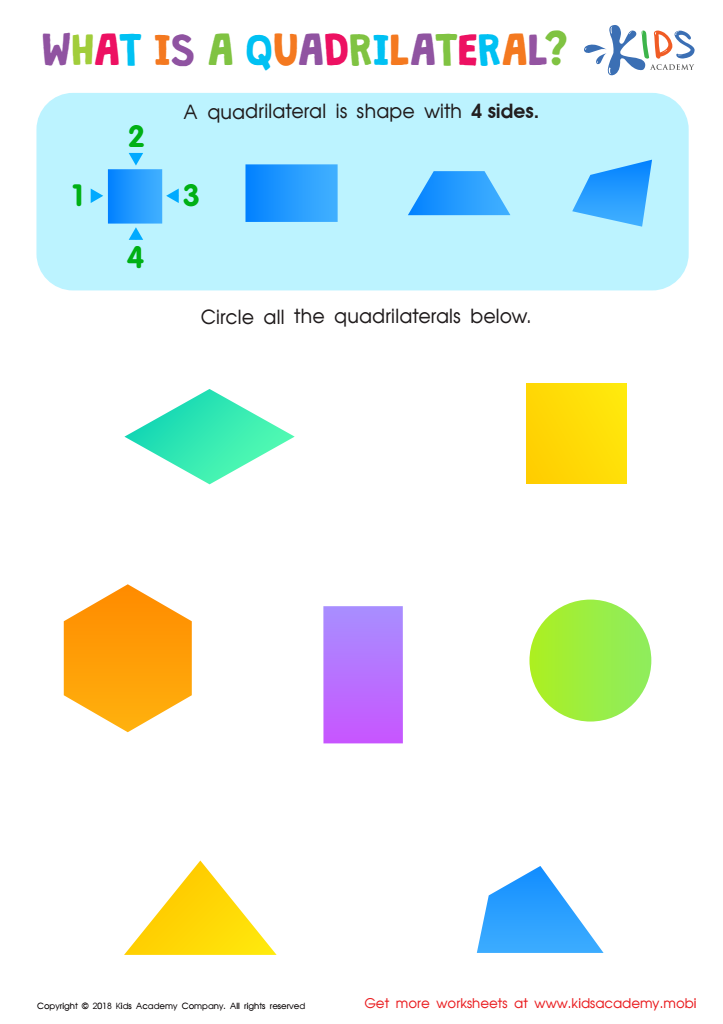
What Is a Quadrilateral? Worksheet







Understanding quadrilaterals is foundational for both parents and teachers to ensure a strong mathematical foundation for young learners. This comprehension is crucial because quadrilaterals form the building blocks of geometry, a major branch of mathematics. By grasping the properties of various quadrilaterals—such as squares, rectangles, trapezoids, and parallelograms—children acquire essential skills like recognizing shapes, understanding spatial relationships, and solving geometric problems. These abilities extend beyond math, influencing subjects like art, architecture, and even science.
For parents, engaging with their children in understanding quadrilaterals reinforces essential skills, promotes problem-solving abilities, and enhances critical thinking. It provides an opportunity to make learning a shared, enjoyable experience at home, creating positive attitudes towards mathematics.
For teachers, a solid grasp of quadrilaterals enables them to explain concepts clearly and effectively, using diverse teaching methods tailored to individual learning styles. This ensures that all students, regardless of their starting point, can achieve comprehension and master geometric principles. A well-structured understanding of quadrilaterals also establishes a foundation for more complex mathematics, such as algebra, calculus, and trigonometry, which students encounter in higher grades.
In essence, both parents and teachers who care about understanding quadrilaterals are investing in the child's overall academic success and lifelong problem-solving skills.








