Understanding prepositions Normal Geometry Worksheets for Ages 3-6
3 filtered results
-
From - To
"Understanding Prepositions Normal Geometry Worksheets for Ages 3-6" offer fun and engaging activities to help young learners master spatial relationships. Designed for preschoolers and kindergarteners, these worksheets enhance mathematical thinking by teaching kids about positional words such as 'above,' 'below,' 'next to,' and 'between.' Interactive and visually stimulating, each worksheet promotes hands-on learning, making complex prepositions easy to grasp. Perfect for use at home or in classroom settings, these resources lay a strong foundation for geometry skills by fostering critical thinking and language development. Make learning prepositions an adventure with these expertly crafted worksheets!
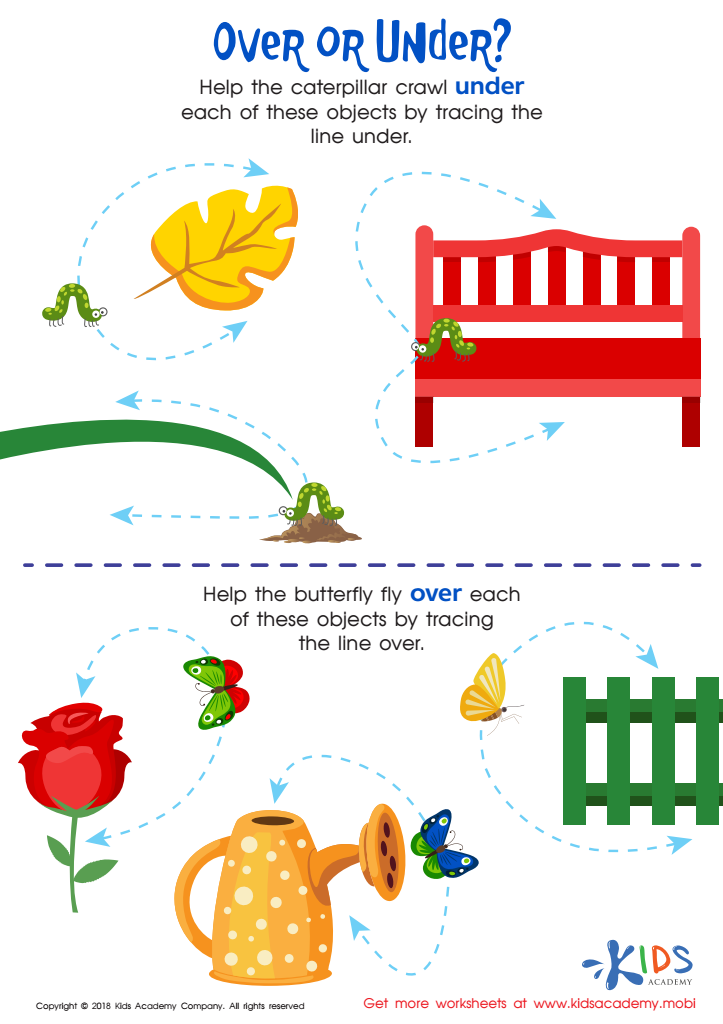
Over or Under? Worksheet
 Assign to My Students











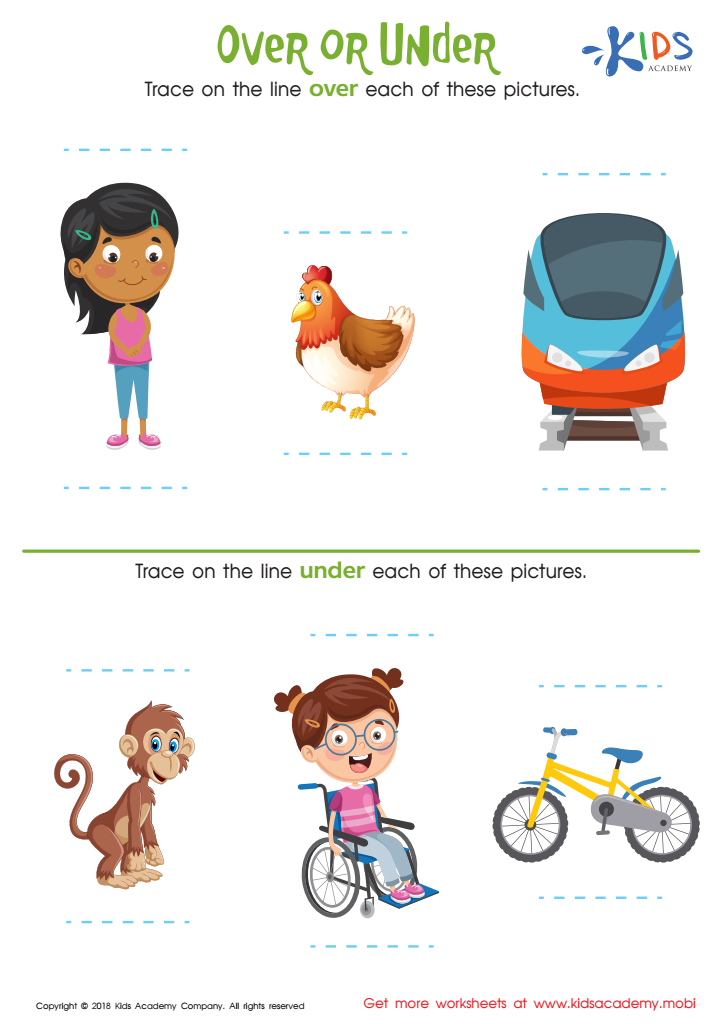
Over or Under Worksheet
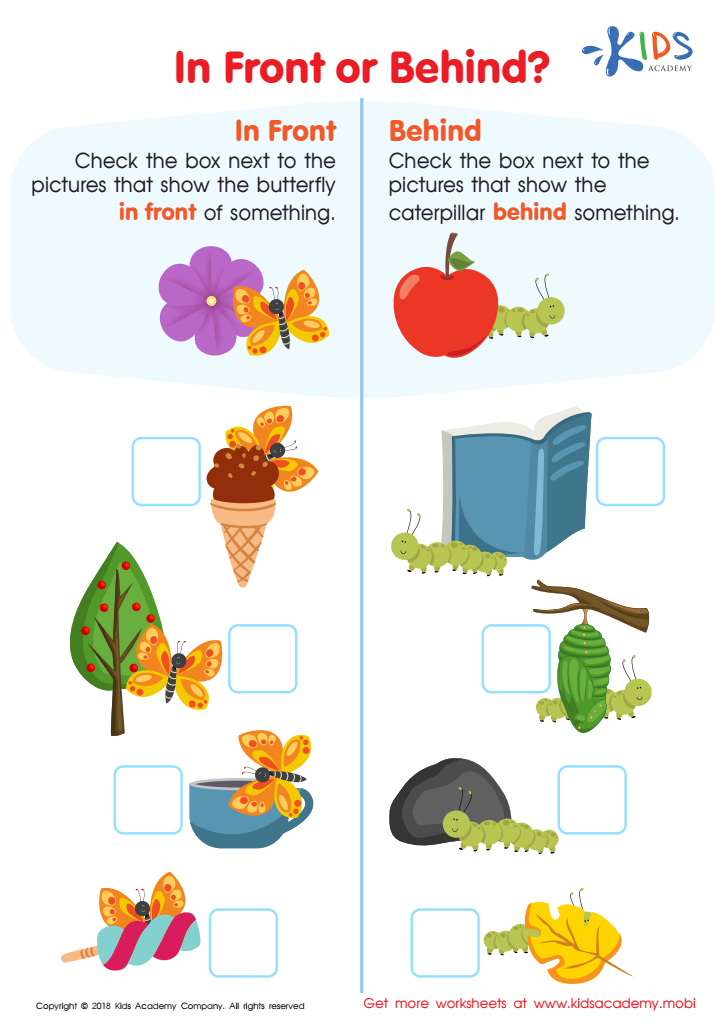
In Front or Behind Worksheet








Understanding prepositions and normal geometry for children ages 3-6 is crucial for early cognitive development. At this age, children are in the sensitive period for language and spatial awareness. Prepositions such as "on," "under," "behind," and "next to" help young children make sense of their surroundings and communicate effectively about spatial relationships. Early mastery of these concepts supports their ability to follow instructions, engage in creative play, and build foundational skills for later academic achievement.
Normal geometry, involving basic shapes and spatial recognition, is equally important and feeds directly into mathematical reasoning. Introducing children to geometric shapes like circles, squares, and triangles helps them learn to classify and categorize objects—skills essential for problem-solving in daily life. Hands-on activities using blocks or drawing shapes allow them to grasp these concepts in a concrete manner, strengthening their fine motor skills and hand-eye coordination.
When parents and teachers prioritize teaching these concepts through engaging, age-appropriate activities, children can develop a robust foundation for more complex mathematical and linguistic skills. This holistic approach sets them on a path of continuous learning, fostering curiosity and confidence as they advance into formal schooling years. Fundamental understanding in these areas significantly contributes to their overall intellectual and social growth.








