Basic geometry understanding Normal Math Worksheets for Ages 3-6
3 filtered results
-
From - To
Introduce your little learner to the world of shapes and spatial understanding with our basic geometry worksheets, specifically designed for ages 3-6. These engaging activities from Kids Academy encourage young minds to recognize and categorize basic geometric figures in a fun, interactive manner. Our expertly crafted sheets focus on essential skills like shape identification, symmetry, and spatial relationships, laying the foundation for advanced mathematical concepts. Perfect for home or classroom use, these printables provide a stimulating way to develop cognitive and visual-spatial abilities. Spark a joy for learning and give your children a head start in math with Kids Academy’s renowned resources.
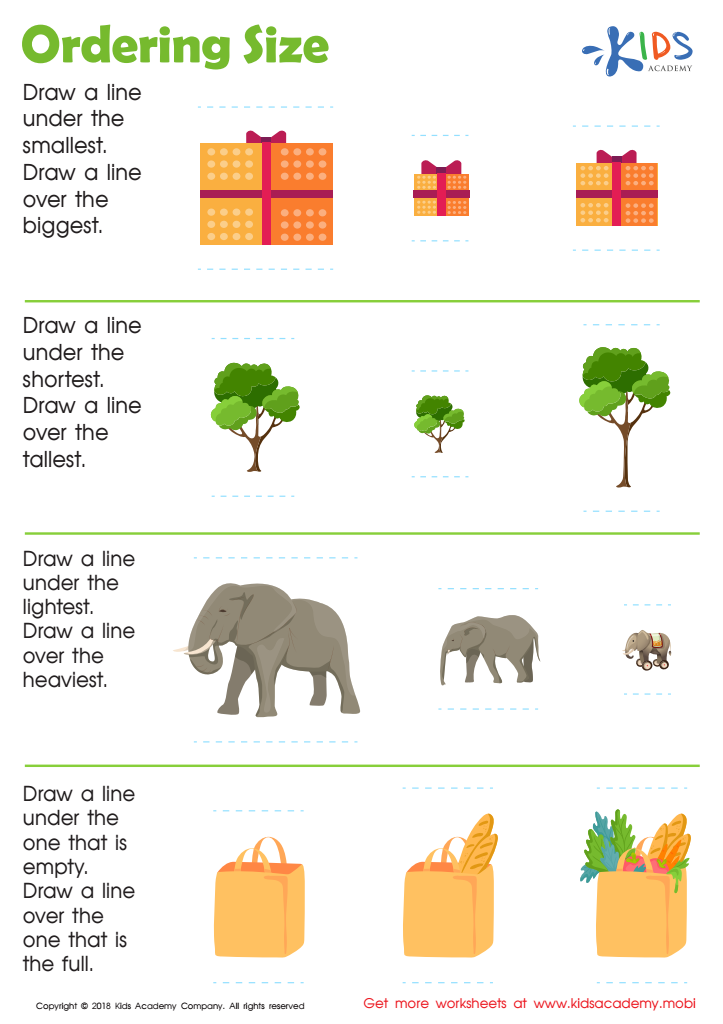
Ordering Size Worksheet
 Assign to My Students
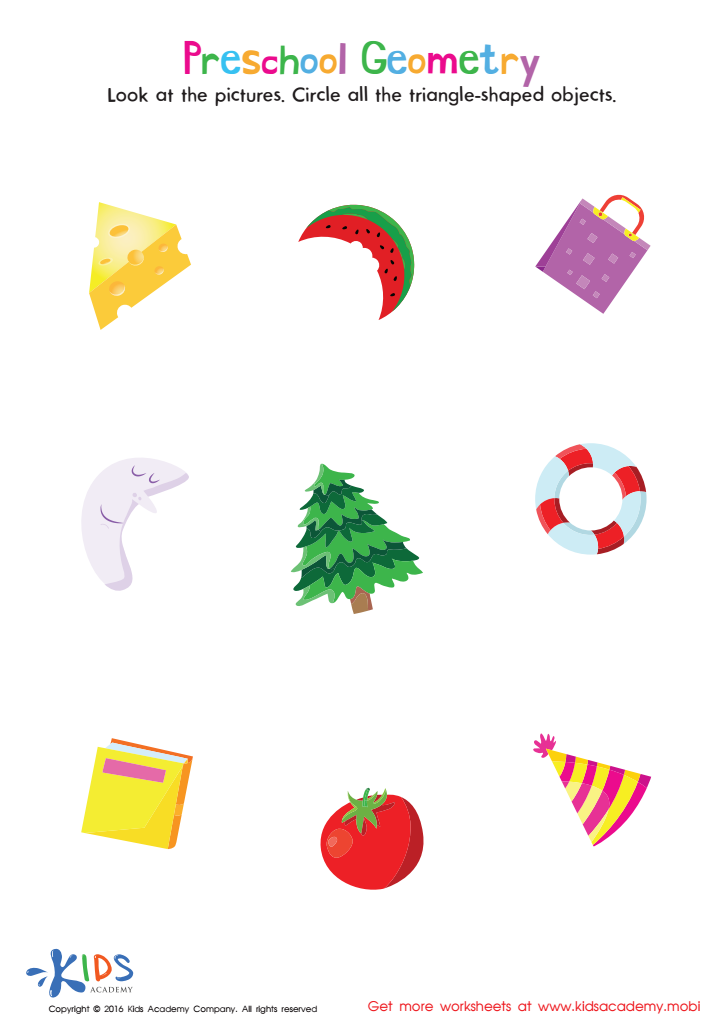
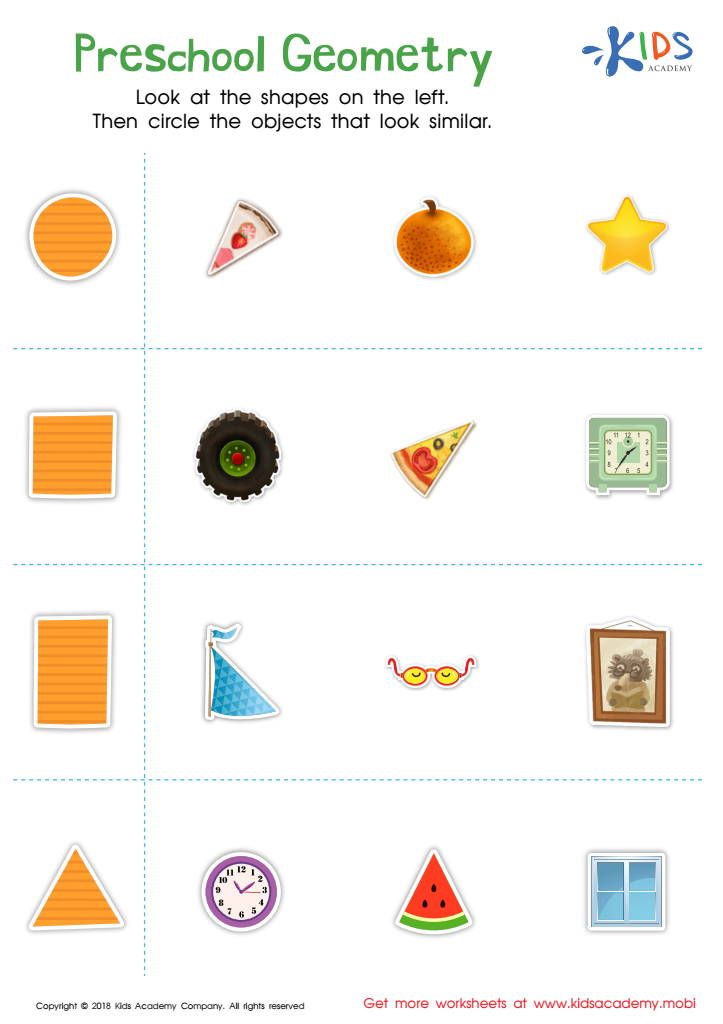
Preschool Geometry Worksheet








Basic geometry and foundational math are essential for young children, ages 3-6, because they lay the groundwork for future learning and cognitive development. At this crucial age, children's brains are remarkably receptive and adaptable, making it the perfect time to introduce fundamental concepts like shapes, sizes, and spatial relationships. These concepts are not only intrinsic to everyday life experiences but also form the basis for more complex mathematical and scientific ideas they'll encounter later.
Geometry helps in enhancing critical thinking and problem-solving skills. When children learn to identify and manipulate shapes, they simultaneously develop the ability to recognize patterns, compare objects, and think critically about their physical environment. These skills, fostered early on, support broader academic achievement, especially in STEM (Science, Technology, Engineering, and Mathematics) fields.
Moreover, understanding basic math culminates in better number sense, which is crucial throughout life. Simple activities like counting objects, sorting by shapes, or recognizing patterns contribute to a child's comfort with numbers, setting a strong foundation for future arithmetic and algebraic learning.
Thus, by valuing and nurturing a child's early exposure to basic geometry and foundational math, parents and teachers are not only investing in their existing cognitive abilities but also paving the way for future academic success and a better understanding of the world around them.








