
Spelling Skills Normal Phonics Worksheets for Ages 3-7
7 filtered results
Difficulty Level
Grade
Age
-
From - To
Subject
Activity
Standards
Discover a treasure trove of engaging Spelling Skills Normal Phonics Worksheets designed specifically for children aged 3-7! Our printable resources help young learners master essential phonics and spelling concepts in a fun and interactive way. Each worksheet encourages the development of critical skills such as letter recognition, sound blending, and vocabulary building. Perfect for educators and parents alike, these worksheets promote early literacy and boost confidence in young readers. Explore a variety of exercises tailored to enhance your child's spelling proficiency while making learning enjoyable. Start their journey to reading success today with our thoughtfully crafted phonics worksheets!
Favorites
With answer key
Interactive
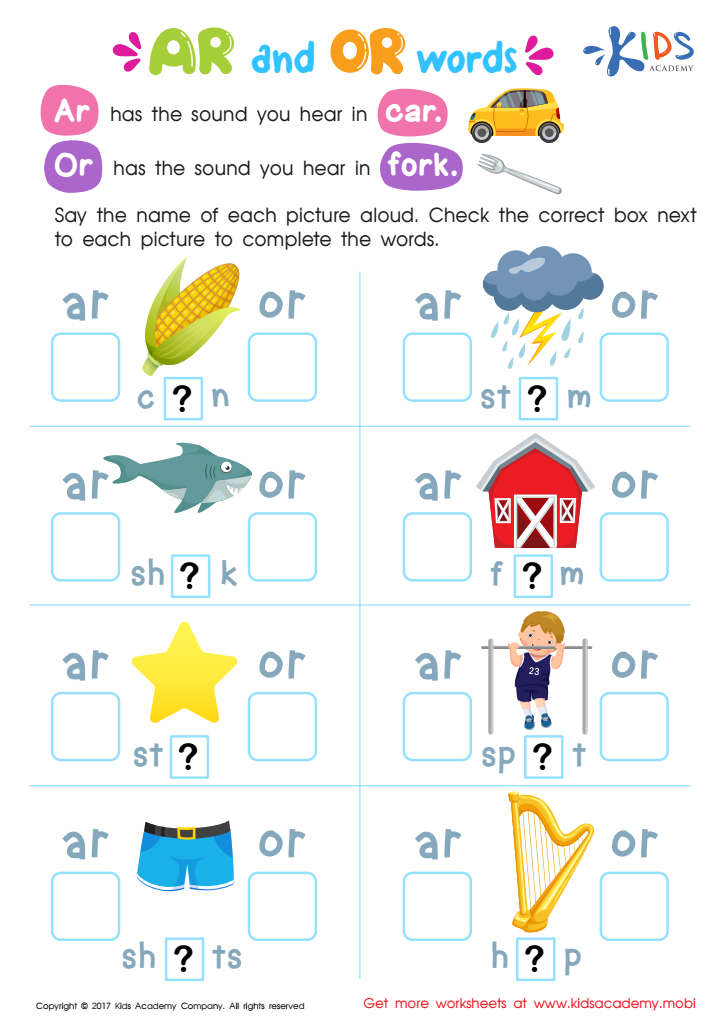
Ar and Or Words Phonics Worksheet
Master the distinct digraphs 'ar' and 'or' with this fun phonics worksheet from Kids Academy! With meaningful illustrations, it'll guide your child to choose the right one. Get ready for the great results!
Ar and Or Words Phonics Worksheet
Worksheet
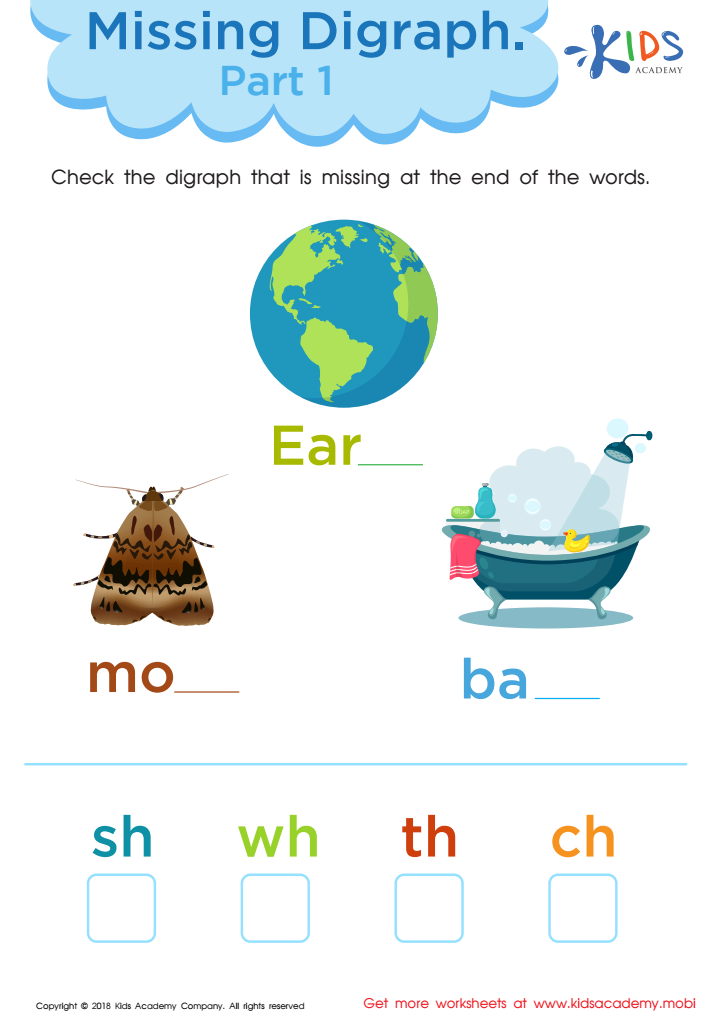
Missing Digraph: Part 1 Worksheet
Practice the 'th' digraph with this worksheet! Ask kids to say the words shown and sound out the letters below each image. Check the box with the correct digraph to complete. Examples include 'earth', 'bath' and 'moth', all ending with the same two letters. Phonics teaches that digraphs are two letters that make one sound.
Missing Digraph: Part 1 Worksheet
Worksheet
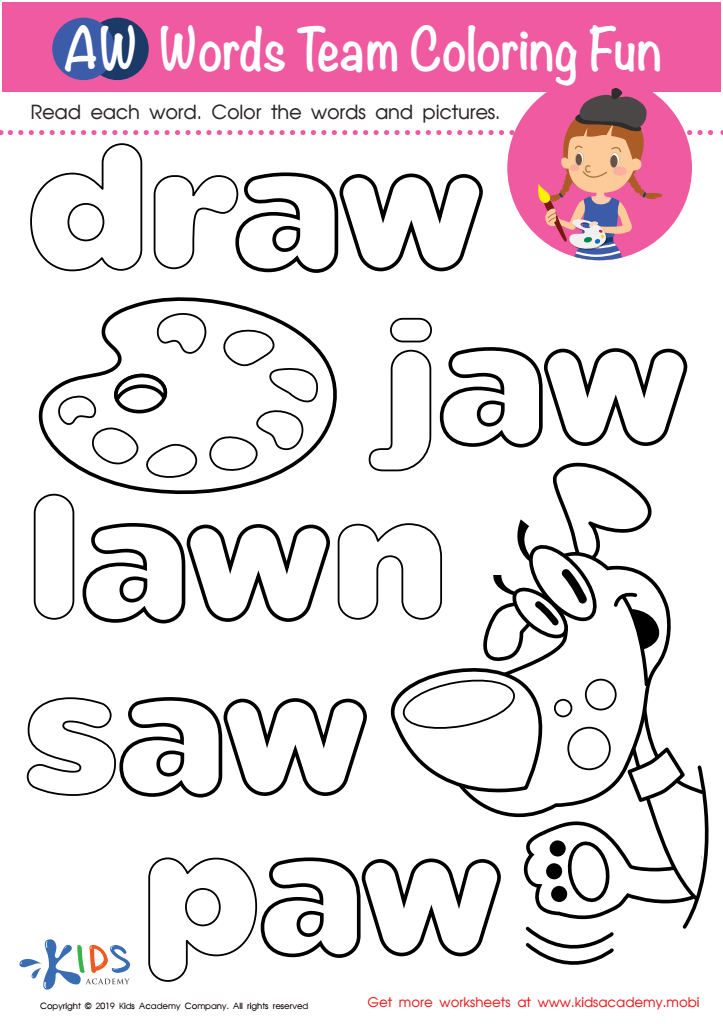
AW Words Team Coloring Fun Worksheet
Coloring words they can read is a blast for little learners! This worksheet offers emerging readers the chance to practice and gain confidence in reading words from the -aw family, while also improving fine-motor and creativity skills. Without knowing it, they'll learn about phonetic teams along the way!
Download (PDF)
 Assign to My Students
Assign to My Students
AW Words Team Coloring Fun Worksheet
Worksheet
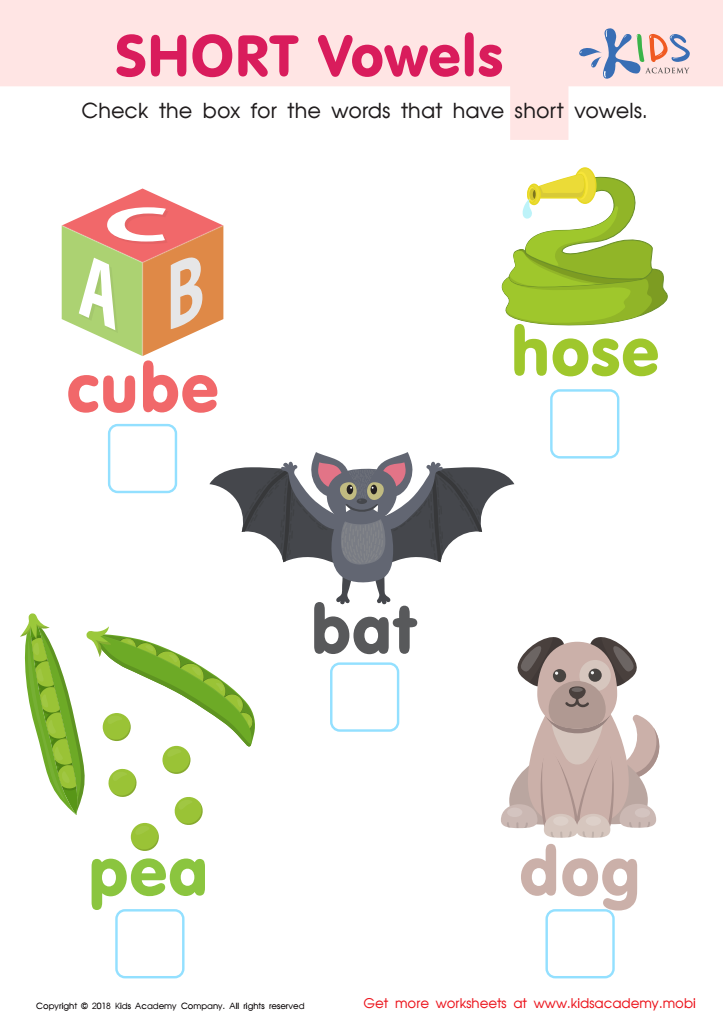
short vowels Worksheet
Say "dog" and notice how long it takes to pronounce the vowel. Is it short or long? Compare it to "pea" and use this worksheet to quickly assess your child's mastery. Have them name each picture and listen for the vowel sounds. Only check the boxes for words with short vowel sounds.
short vowels Worksheet
Worksheet
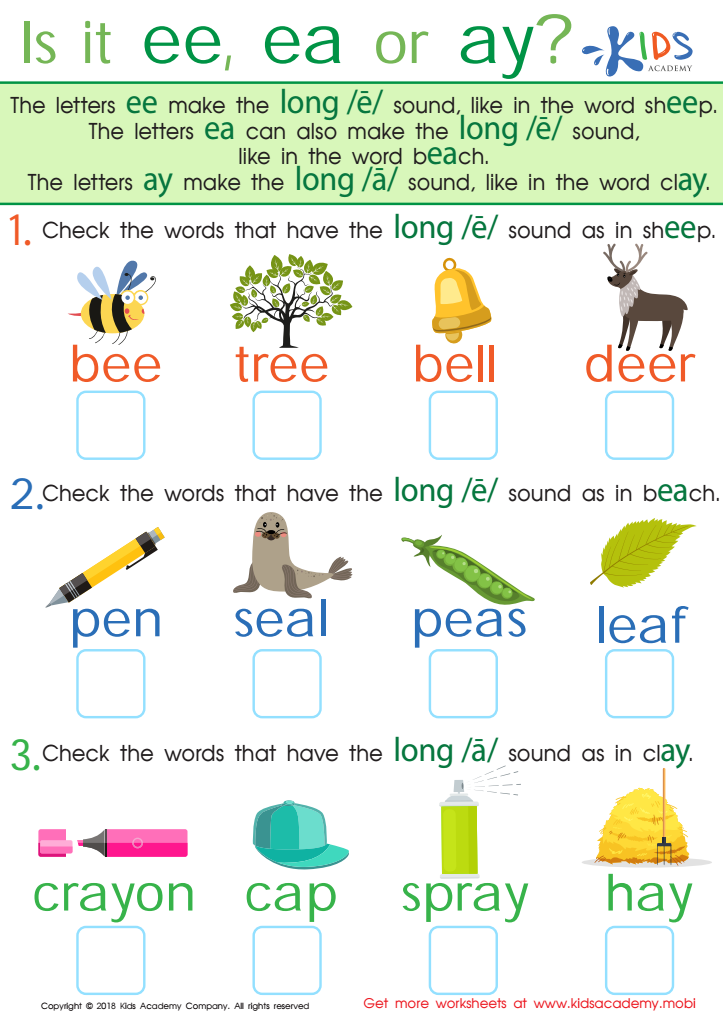
Is It EE, EA, or AY? Worksheet
When 'ee', 'ea' and 'ay' are in words, they usually make the long /e/ and /a/ sounds. Examples of words with 'ee' are "sheep", 'beach' and 'seat' with 'ea', and 'clay' and 'play' with 'ay'. Check this colourful worksheet with your kids; help them find the words that make the long /e/ sound like 'sheep'.
Is It EE, EA, or AY? Worksheet
Worksheet
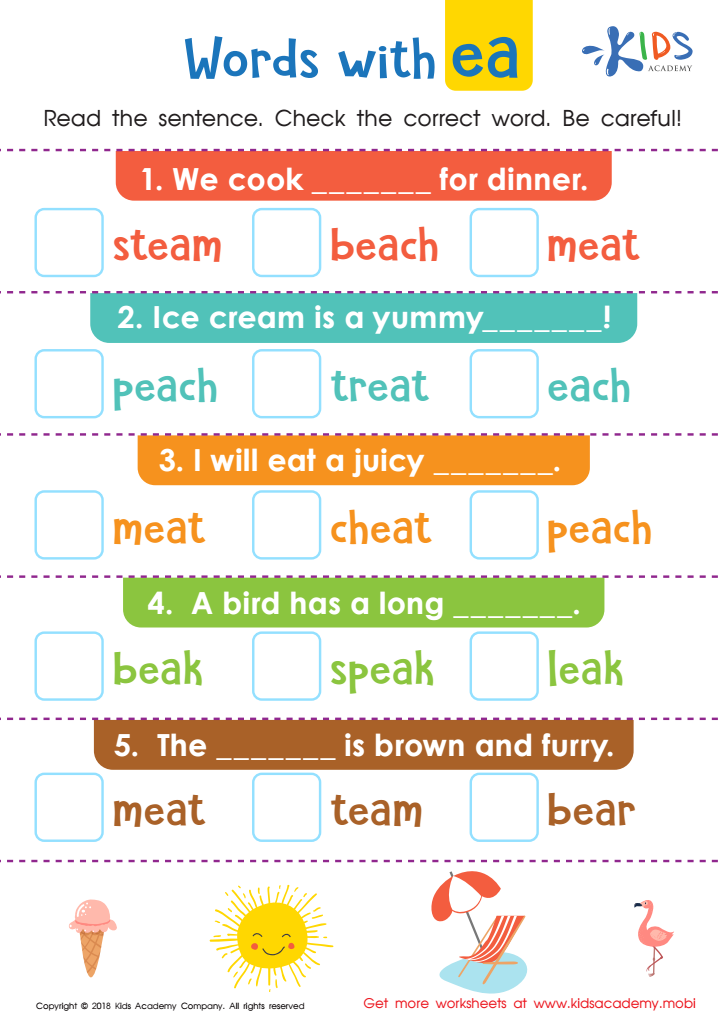
Words with ea Worksheet
Beginning readers may struggle with -ea vowel digraphs, which can have multiple sounds and be tricky to decode. This cheerful worksheet helps kids practice reading sentences with missing -ea words, using context clues to fill in the blanks. They'll also be exposed to various -ea sound examples, and build their sight word knowledge.
Words with ea Worksheet
Worksheet
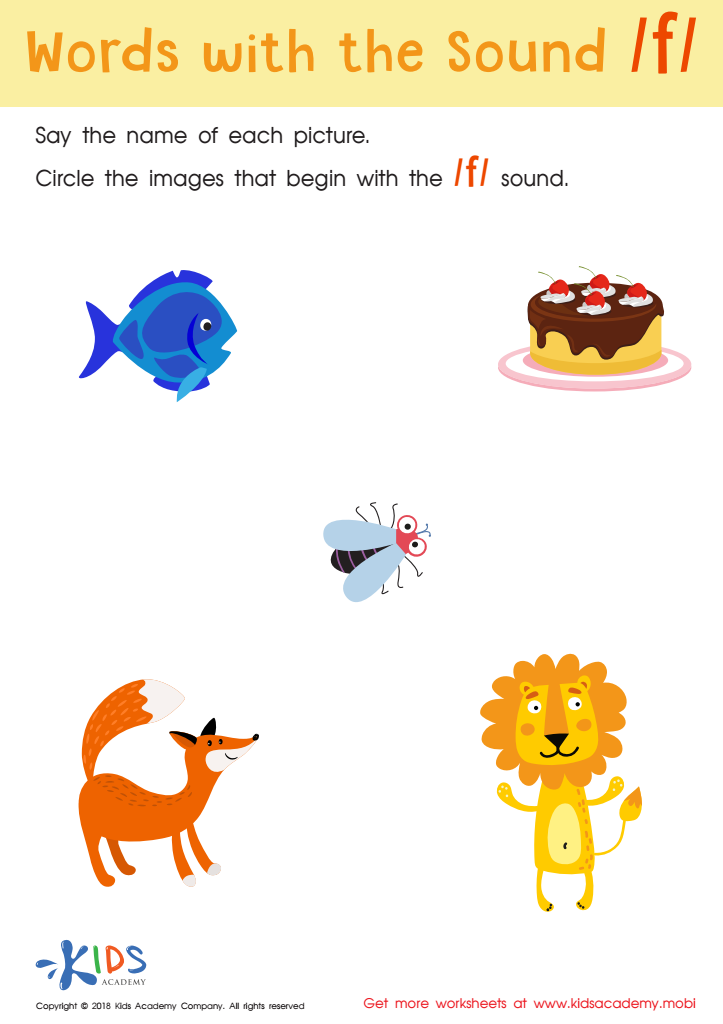
Words with sound f Reading Worksheet
This illustrated phonics worksheet is ideal for preschool or kindergarten. It helps boost learners' literacy skills with a focus on the letter "f". Ask your child to name all the pictures, listening for that sound. Examples are fish, fox, lion, bug. When they can identify which words start with "f", have them circle the images. Congratulate them on a job well done!
Words with sound f Reading Worksheet
Worksheet
Join Kids Academy for Free
Who is primarily going to use this learning content?








Spelling Skills Normal Phonics is crucial for children aged 3-7 as it lays the foundational building blocks for literacy. At this age, children's brains are highly receptive to learning phonics, which involves the relationship between letters and sounds. This understanding fosters alphabet recognition, decoding, and encoding of words, enhancing their ability to read and write effectively.
Parents and teachers should prioritize phonics instruction, as it boosts children's confidence in their reading abilities, making them more eager to engage with books and written materials. Moreover, mastery of phonics can significantly improve spelling skills, which are critical for effective communication.
Engaging children in phonics through playful and interactive methods outweighs rote memorization, allowing for a more active learning experience. Phonics instruction also supports cognitive development by enhancing auditory discrimination, memory, and analytical skills.
As children progress in their phonetic understanding, they develop better comprehension abilities, setting them up for academic success. Ultimately, fostering strong spelling skills and phonics knowledge in early childhood is an investment in a child's future literacy and can cultivate a love for reading that lasts a lifetime. Parents and teachers play a pivotal role in this essential early learning phase.







