
Understanding fact families Normal Addition & Subtraction Worksheets for Ages 3-7
3 filtered results
Difficulty Level
Grade
Age
-
From - To
Subject
Activity
Standards
Dive into the fun world of math with our "Understanding Fact Families: Normal Addition & Subtraction Worksheets for Ages 3-7." Tailored specifically for young learners, these engaging worksheets bolster foundational math skills. Children will discover the interrelationships between numbers through addition and subtraction exercises, making math both intuitive and enjoyable. Each printable activity is designed to encourage critical thinking, enhance problem-solving skills, and build confidence as students master basic arithmetic. Perfect for teachers and parents, our worksheets offer a creative approach to learning, ensuring your child’s success in early math development. Explore today and watch their skills multiply!
Favorites
With answer key
Interactive
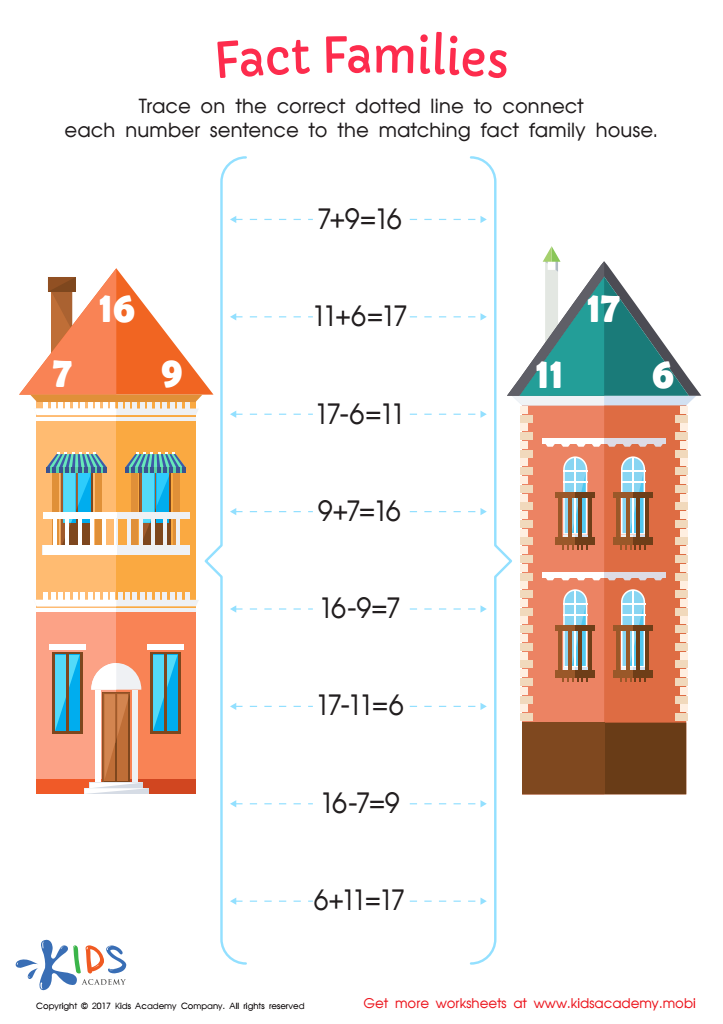
Fact Families — Add and Subtract Worksheet
Kids will love seeing how families of numbers "live" in their own houses!
 Assign to My Students
Fact Families — Add and Subtract Worksheet
Worksheet
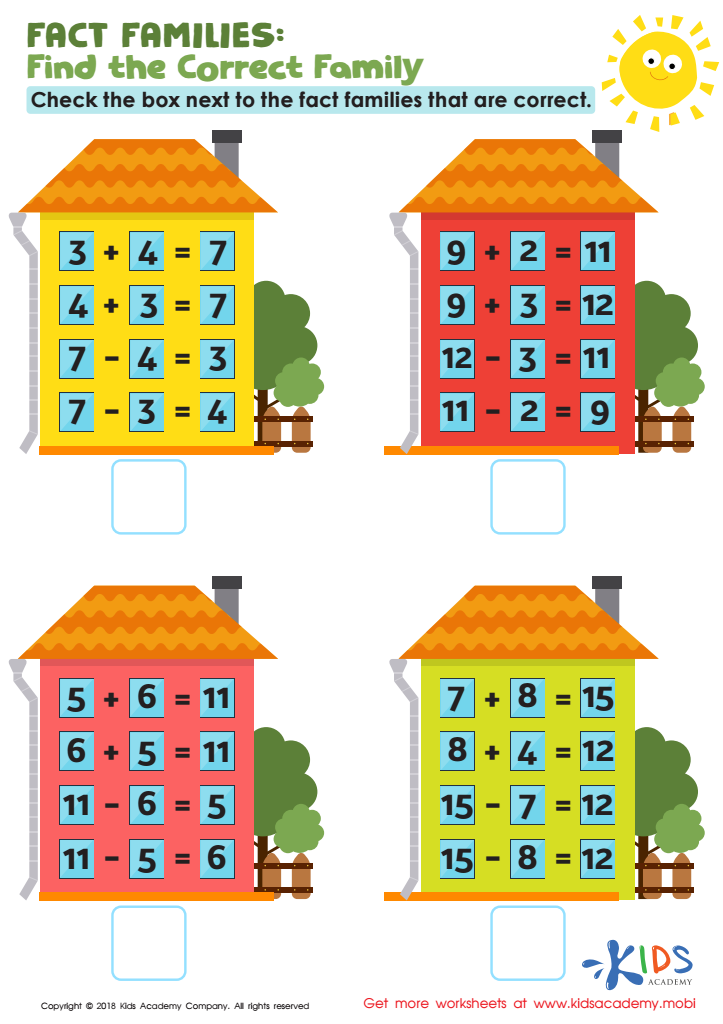
Fact Families: Find Correct Family Worksheet
Test your students' math and reasoning skills with this worksheet. It features 4 houses, each with a group of fact families on it. Some are correct, some are wrong - help students identify which are correct and circle the box next to them. This will help them progress in school.
Fact Families: Find Correct Family Worksheet
Worksheet
Join Kids Academy for Free
Who is primarily going to use this learning content?








Understanding fact families involving normal addition and subtraction is essential for young children aged 3-7 because it lays a solid foundation for their mathematical development. Fact families help children see the relationship between numbers and how they can work together through addition and subtraction. This understanding promotes number sense, an important skill in early math education that contributes to overall mathematical fluency.
When children grasp fact families, they recognize patterns and connections between numbers. For instance, knowing that 3 + 4 = 7 helps them understand that 7 - 4 = 3. These interrelationships promote cognitive flexibility, allowing them to shift smoothly between different mathematical operations. This foundational skill also boosts their problem-solving abilities, making higher-level math concepts more accessible as they grow older.
Furthermore, early mastery of fact families builds confidence. Children feel more competent and less intimidated by math when they understand fundamental concepts. This positive attitude towards math can have long-term benefits, encouraging a lifelong interest in the subject.
For parents and teachers, investing time and resources into teaching fact families ensures that children are prepared for future mathematical challenges. Utilizing engaging methods like hands-on activities, visual aids, and interactive games can make learning fun and more effective, fostering a strong mathematical foundation that benefits children's overall academic growth.








