
Differentiating shapes Normal Math Worksheets for Ages 3-7
3 filtered results
Difficulty Level
Grade
Age
-
From - To
Subject
Activity
Standards
Unleash your child's potential with our "Differentiating Shapes" math worksheets, specially tailored for ages 3-7. Designed to blend fun with foundational learning, these engaging activities help young minds identify, differentiate, and understand various shapes. Perfect for preschool and early elementary students, our worksheets foster critical thinking and spatial awareness through enjoyable exercises. Each printable sheet is crafted by educational experts to ensure age-appropriate challenges that nurture early math skills. With visually appealing graphics and clear instructions, these worksheets make learning an exciting adventure for young learners. Empower your child's shape recognition abilities with our expertly designed resources!
Favorites
With answer key
Interactive
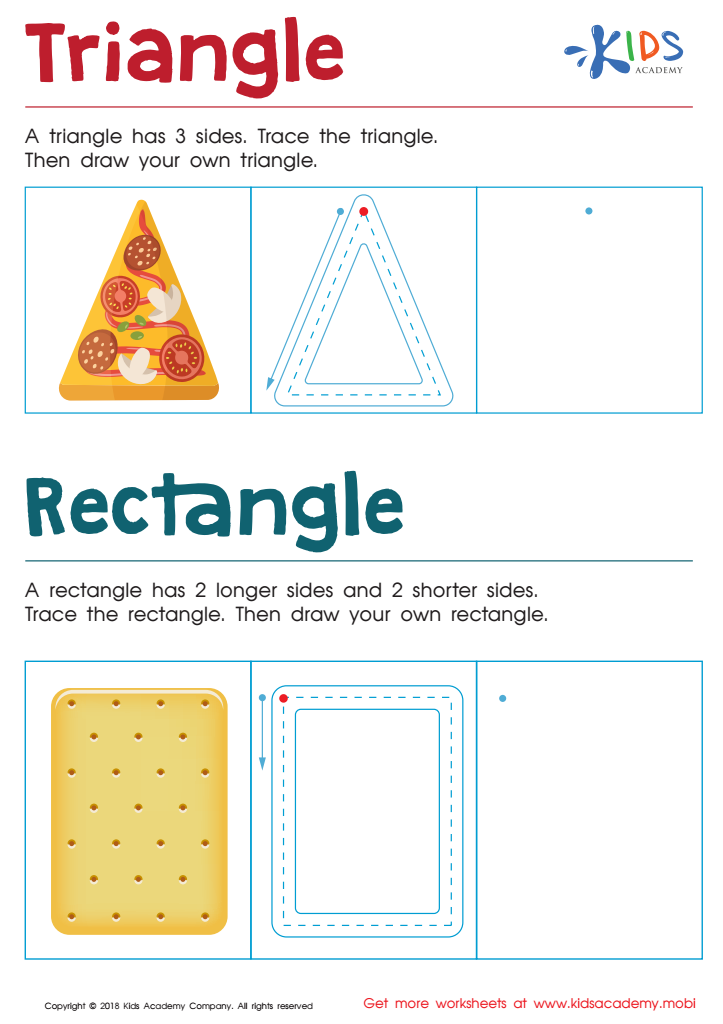
Triangle Rectangle Worksheet
This printable worksheet helps kids draw rectangles and triangles. Have your child trace the pizza and cracker shapes to become familiar, then try their own. Perfect for second graders! Coloring and creativity make this fun and educational.
 Assign to My Students
Triangle Rectangle Worksheet
Worksheet
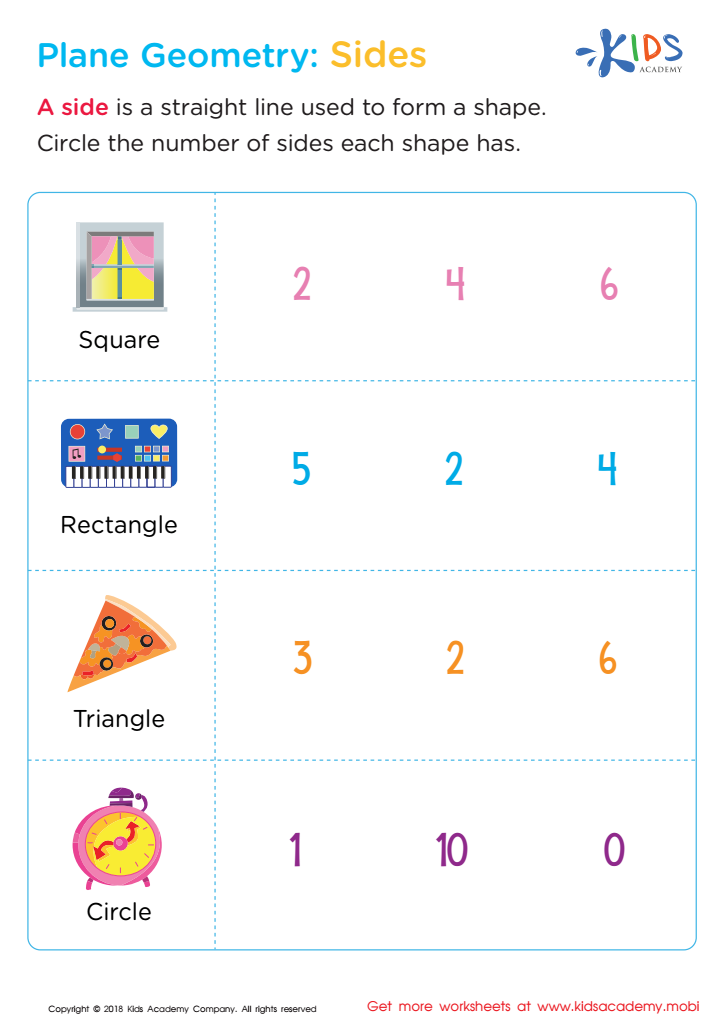
Plane Geometry: Sides Worksheet
Knowing the properties of basic geometric shapes is a great skill to have. Download this free worksheet and let your kids learn about sides and shapes using colorful pictures. They'll see each shape has its own number of sides, laying the groundwork for identifying and recognizing shapes in the future.
Plane Geometry: Sides Worksheet
Worksheet
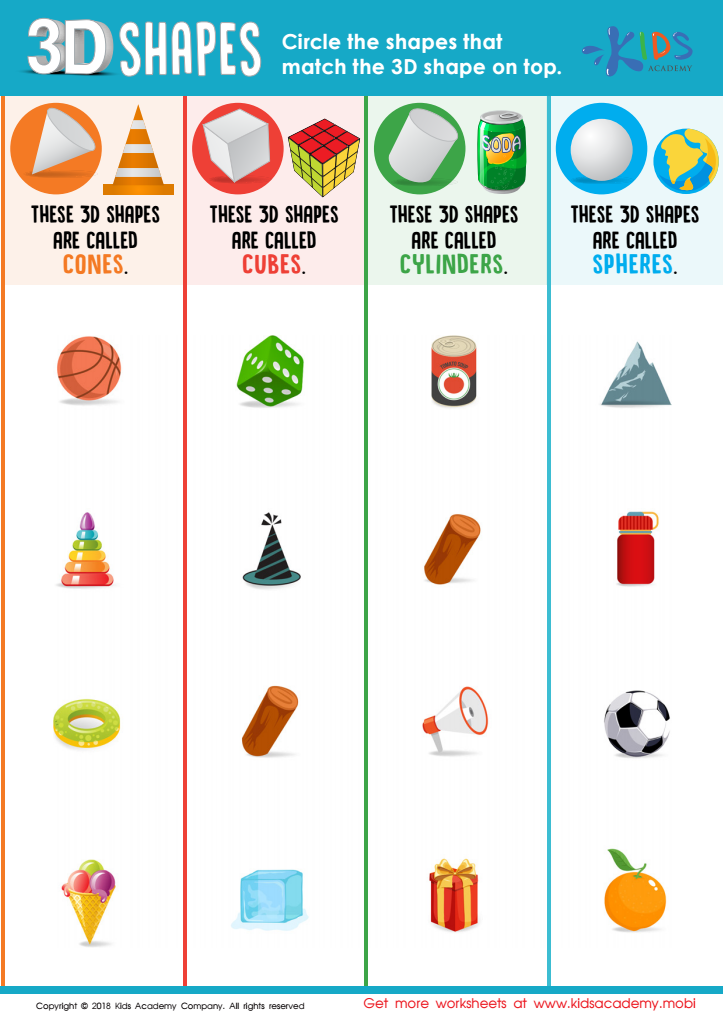
3D Shapes Worksheet
It's time to identify 3D shapes! This worksheet helps kids find and name shapes like cones, cylinders, cubes, and spheres using pictures of everyday objects. Let's explore 3D shapes in the real world!
3D Shapes Worksheet
Worksheet
Join Kids Academy for Free
Who is primarily going to use this learning content?








Differentiating shapes for children aged 3-7 forms a fundamental part of early math education, crucial for both cognitive and perceptual development. At this age, kids possess a natural curiosity and are highly receptive to learning basic concepts through play and exploration. By recognizing and distinguishing shapes, they build visual-spatial skills essential for reading, writing, and problem-solving.
Shapes serve as the foundation for more complex mathematical ideas. For instance, understanding geometric terms can help ease children into elementary algebra and measurement concepts. Early exposure to shape differentiation also supports the development of comparison, categorization, and critical thinking skills. Knowing whether something is round or square transfers into the real world, where recognizing different structures and items is necessary daily.
Moreover, shape differentiation ties closely to language development. Discussing shapes and their characteristics (like edges, vertices, and faces) enriches vocabulary and enhances expressive and receptive language abilities. It also builds fine motor skills through activities like tracing, drawing, and creating shapes.
From a parent's or teacher's perspective, embedding shape differentiation into early learning sets a solid academic foundation. Engaging children with varied and age-appropriate activities fosters a natural and enjoyable learning experience, paving the way for future success in mathematics and broader learning contexts.








