
Understanding pollination Normal Math Worksheets for Ages 3-7
3 filtered results
Difficulty Level
Grade
Age
-
From - To
Subject
Activity
Standards
Introduce young learners to the fascinating world of pollination with our "Understanding Pollination Normal Math Worksheets for Ages 3-7". These engaging worksheets are designed to help children grasp the basics of pollination while also developing essential math skills. Tailored for ages 3-7, each worksheet blends fun, colorful activities with learning objectives that support early math development. Children will count, add, and identify patterns, all within the context of nature and pollination. Ignite your child's curiosity and mathematical thinking with these expert-crafted, age-appropriate worksheets from Kids Academy.
Favorites
With answer key
Interactive
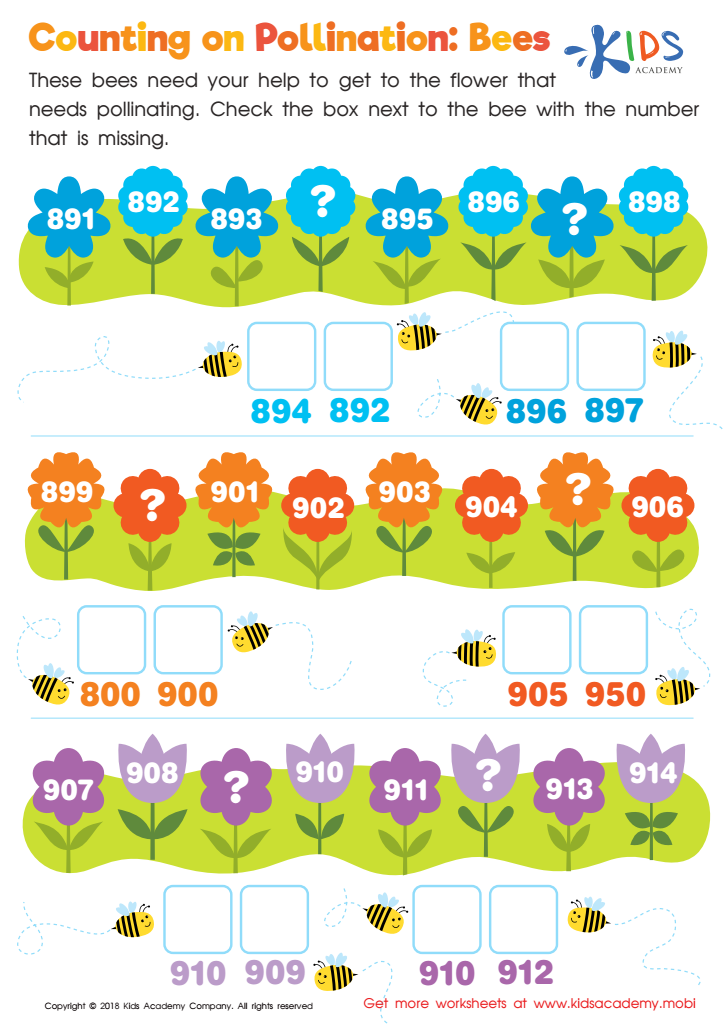
Counting on Pollination: Bees Worksheet
This downloadable worksheet helps kids improve their math skills while having fun - they'll help the bees pollinate the flowers by finding the missing number. It's an entertaining way to practice number patterns, sequences and number line skills, aiding in fast and efficient math computations.
 Assign to My Students
Counting on Pollination: Bees Worksheet
Worksheet
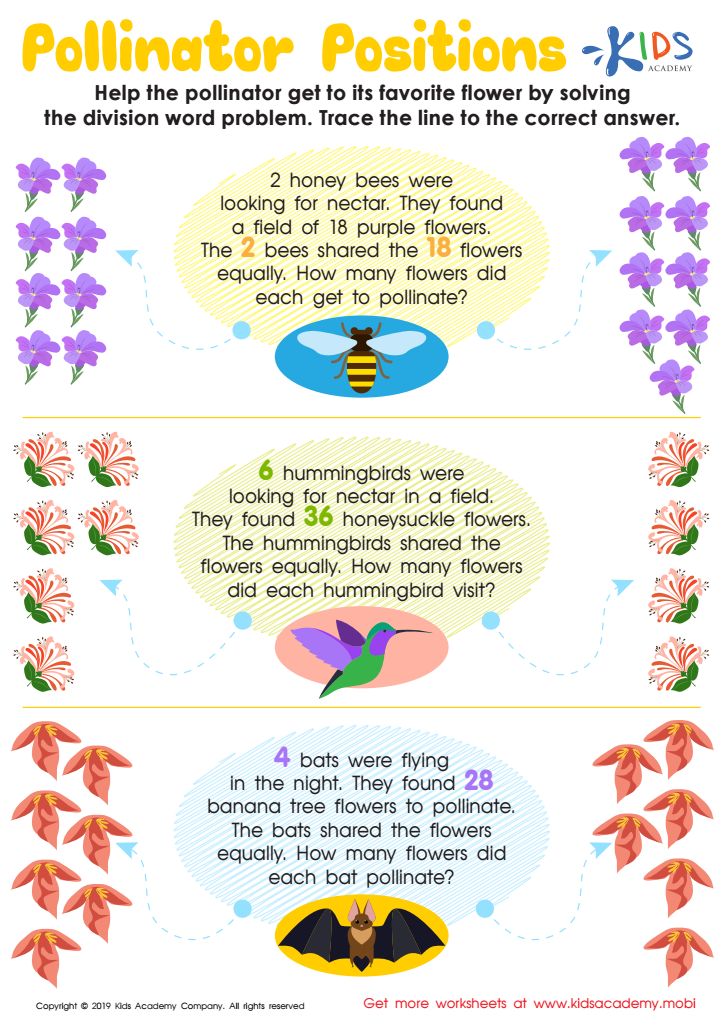
Pollinator Positions Worksheet
Kids will love learning about pollinators and how vital they are. Help their favorite friends get to the right flowers with this fun PDF. Children can solve the problems without even knowing they're doing division; just read the word problems and use the highlighted numbers. Finish by tracing the lines to the correct quotient!
Pollinator Positions Worksheet
Worksheet
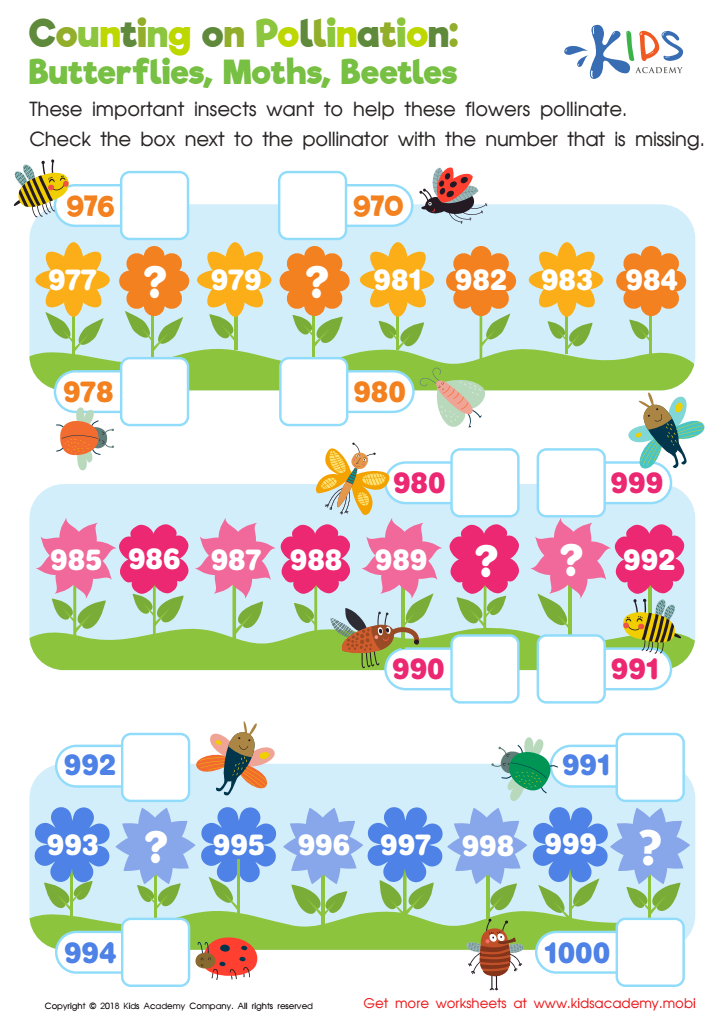
Counting on Pollination: Butterflies, Moths, Beetles Worksheet
A number line can help boost computation accuracy and efficiency. It can also be used with more advanced numbers. Help your child practice by having them identify missing numbers in sequences. This fun worksheet lets them help the pollinators in the process, as they strengthen their number sense.
Counting on Pollination: Butterflies, Moths, Beetles Worksheet
Worksheet
Join Kids Academy for Free
Who is primarily going to use this learning content?






Understanding pollination is essential for both parents and teachers of young children ages 3-7, even if it seems like a complex topic for such an early age. Pollination is the process by which plants reproduce and is crucial for the production of many fruits and vegetables that are a staple in our diet. Teaching kids about pollination can foster a deeper appreciation for nature and help them understand the interconnectedness of our ecosystem.
When children learn about pollination, they start to grasp the roles that bees, butterflies, and other pollinators play in supporting plant life and, by extension, human life. It cultivates a sense of responsibility and respect for the environment from a young age. This early exposure can encourage curiosity and a love for science and learning about the natural world.
Moreover, incorporating teaching methods around pollination involving outdoor activities and hands-on experiences, like gardening, enhances children’s observational and motor skills. It makes learning more dynamic and enjoyable.
By understanding pollination, young children can also develop early math skills. Counting the number of petals, categorizing different types of flowers, or understanding the growth process involves basic arithmetic and pattern recognition. Ultimately, it combines scientific inquiry with early math skills in a thematic and engaging manner that benefits children’s overall learning and development.








