
Understanding fact families Normal Addition & Subtraction Worksheets for Ages 3-8
3 filtered results
Difficulty Level
Grade
Age
-
From - To
Subject
Activity
Standards
Discover the importance of fact families with our engaging Normal Addition and Subtraction Worksheets, designed specifically for children aged 3-8. These worksheets help young learners grasp the relationship between addition and subtraction through fun, interactive activities. By understanding fact families, kids will build a strong foundational understanding of math concepts, making calculations easier in the future. Our resources are perfect for parents and teachers looking to enhance their students’ math skills while keeping lessons enjoyable. Explore a variety of worksheets that cater to different proficiency levels, ensuring your child develops confidence and proficiency in mathematics. Start their math journey today!
Favorites
With answer key
Interactive
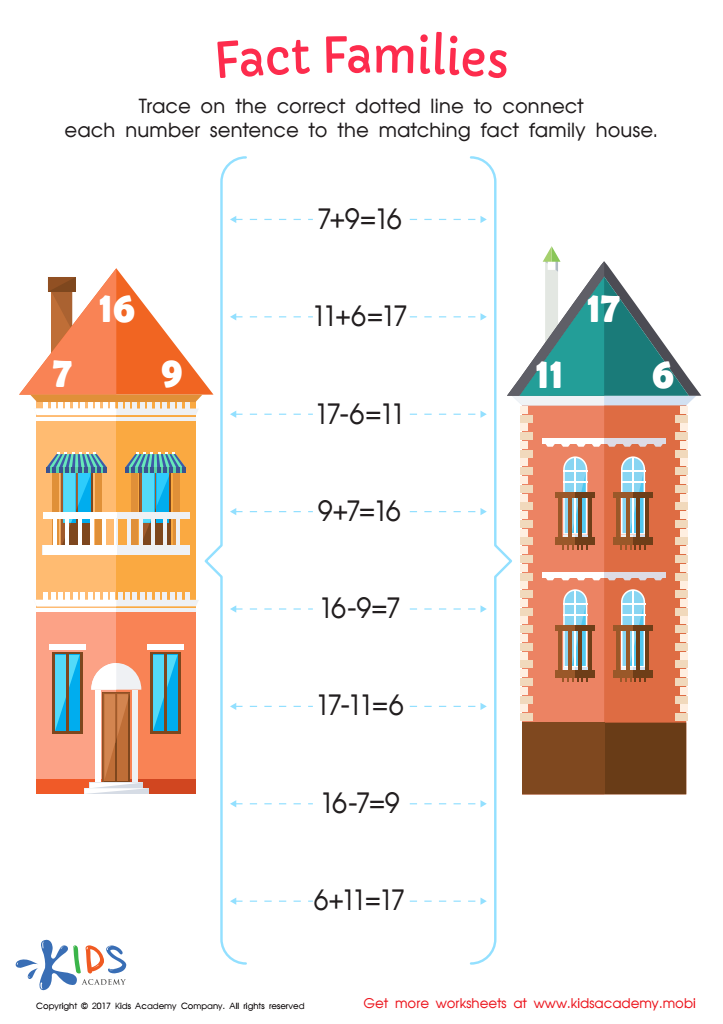
Fact Families — Add and Subtract Worksheet
Kids will love seeing how families of numbers "live" in their own houses!
 Assign to My Students
Fact Families — Add and Subtract Worksheet
Worksheet
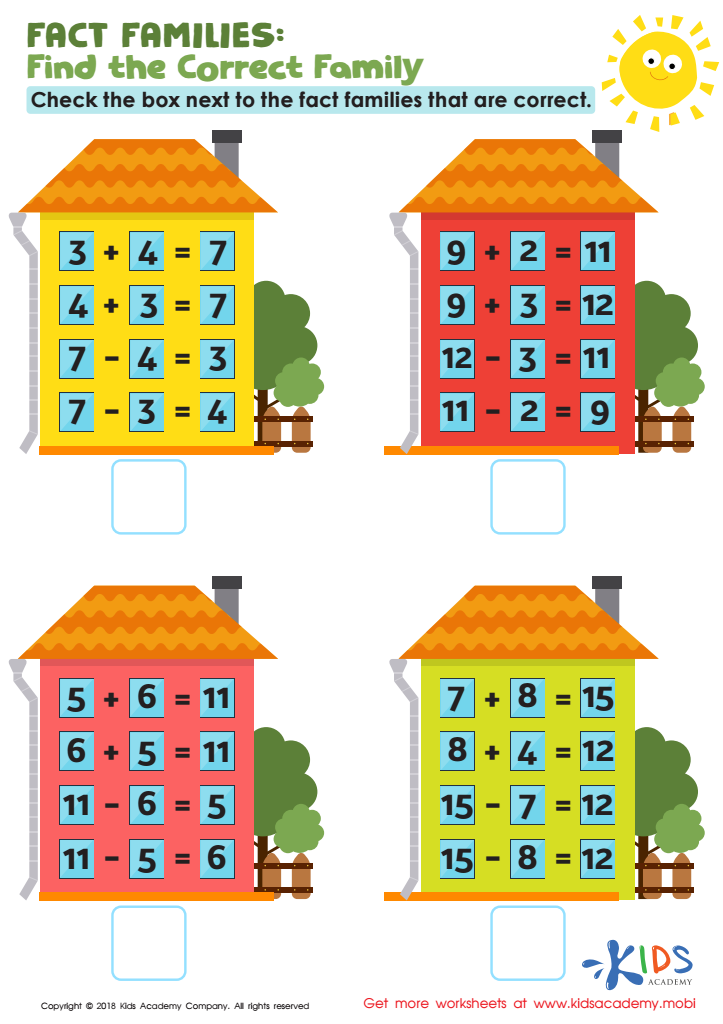
Fact Families: Find Correct Family Worksheet
Test your students' math and reasoning skills with this worksheet. It features 4 houses, each with a group of fact families on it. Some are correct, some are wrong - help students identify which are correct and circle the box next to them. This will help them progress in school.
Fact Families: Find Correct Family Worksheet
Worksheet
Join Kids Academy for Free
Who is primarily going to use this learning content?








Understanding fact families in normal addition and subtraction is crucial for children ages 3-8 as it lays the foundation for their mathematical development. Fact families consist of a set of related addition and subtraction sentences that use the same numbers. For example, for the numbers 2, 3, and 5, the facts are: 2 + 3 = 5, 3 + 2 = 5, 5 - 2 = 3, and 5 - 3 = 2.
When parents and teachers emphasize these relationships, they help children recognize patterns and make connections between operations. This skill fosters a deeper understanding of mathematics, enabling young learners to manipulate numbers confidently. Additionally, it promotes problem-solving abilities, as children can approach addition and subtraction from multiple angles.
Fact families also enhance mental math skills, reducing reliance on rote memorization. By integrating fact families into early education, adults can cultivate a sense of mathematical fluency and literacy in children. This crucial understanding prepares them for more complex mathematical concepts in the future and builds a positive attitude towards math, fostering lifelong learning. Ultimately, awareness of fact families empowers children to navigate numbers effectively and sets them on a path to mathematical success.








