
Mental arithmetic skills Normal Math Worksheets for Ages 3-8
3 filtered results
Difficulty Level
Grade
Age
-
From - To
Subject
Activity
Standards
Discover a delightful collection of mental arithmetic skills worksheets designed for children aged 3-8 at Kids Academy! Our engaging and interactive worksheets help young learners strengthen their math comprehension while fostering critical thinking and problem-solving skills. Perfect for preschoolers and early graders, these carefully crafted activities cover essential concepts, such as basic addition and subtraction, through fun exercises and colorful visuals. Each worksheet promotes independent learning and houses progressive challenges to keep kids motivated and excited about math. Give your child the tools they need for a solid math foundation and watch their confidence soar! Explore our mental arithmetic resources today!
Favorites
With answer key
Interactive
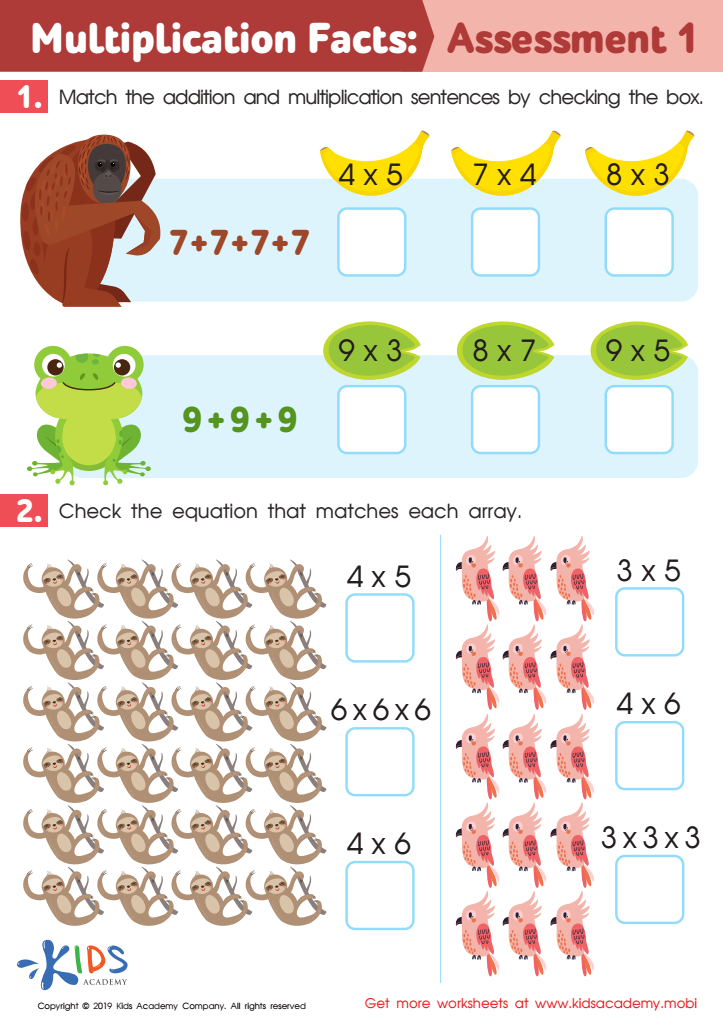
Multiplication Facts: Assessment 1 Worksheet
Teach your kids math with diligence, patience and practice. This colorful worksheet helps by matching addition and multiplication sentences, then checking the equation that matches each array. Perfect for kids having difficulty or to give extra practice. Help your little ones master mathematics with this printout.
 Assign to My Students
Multiplication Facts: Assessment 1 Worksheet
Worksheet
Join Kids Academy for Free
Who is primarily going to use this learning content?








Parents and teachers should prioritize mental arithmetic skills for children aged 3-8 because these foundational skills are essential for holistic math development. Mental arithmetic—performing simple arithmetic calculations in one’s head—enhances cognitive abilities, improves problem-solving skills, and boosts overall academic achievement. At this young age, children's brains are highly adaptable, making it the perfect time to cultivate their numerical fluency.
Developing mental arithmetic skills promotes number sense, helping children understand relationships between numbers and develop confidence in their mathematical capabilities. These skills provide a solid foundation for more complex mathematical concepts introduced later in their education. Building these skills also fosters critical thinking, as children learn to visualize numbers and consider different strategies for solving problems.
Furthermore, mental arithmetic can create a sense of accomplishment and comfort with math, reducing math anxiety that often develops later in school. It encourages a positive attitude towards learning and helps form a basis for lifelong learning habits. Overall, fostering mental arithmetic skills in early childhood is essential not only for academic success but also for empowering children to become confident problem solvers in everyday life.








