
Reading analog clocks Normal Math Worksheets for Ages 3-8
3 filtered results
Difficulty Level
Grade
Age
-
From - To
Subject
Activity
Standards
Help your child master the essential skill of reading analog clocks with our Normal Math Worksheets designed for ages 3-8. These engaging and interactive worksheets offer a fun way to introduce young learners to time-telling fundamentals. Packed with colorful visuals and simple exercises, children will practice identifying hour and minute hands, determining time, and solving age-appropriate challenges. With our well-structured resources, little ones will build confidence and competence in reading analog clocks, essential for daily life. Perfect for homeschooling or classroom use, these worksheets encourage exploration and curiosity, ensuring learning is both effective and enjoyable. Check them out today!
Favorites
With answer key
Interactive
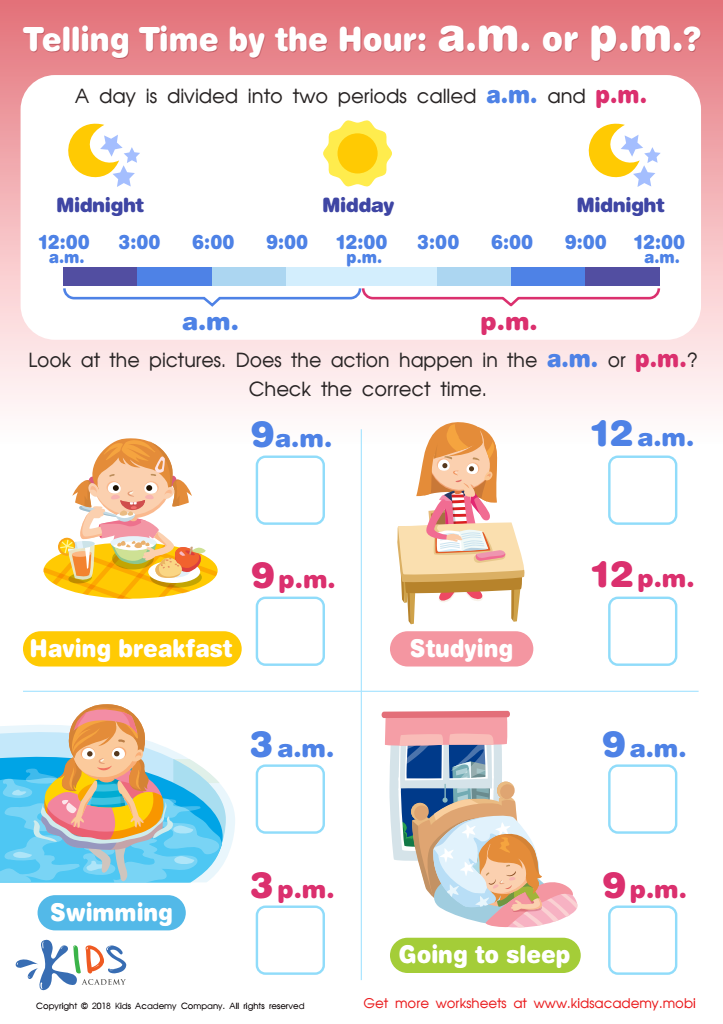
Tilling Time by the Hour: a.m. or p.m.? Worksheet
Can your child tell the time? This worksheet will help them learn. Explain a.m and p.m. and look at the pictures together. Ask your child if the activities happen in the a.m or p.m and help them check the correct time.
 Assign to My Students
Tilling Time by the Hour: a.m. or p.m.? Worksheet
Worksheet
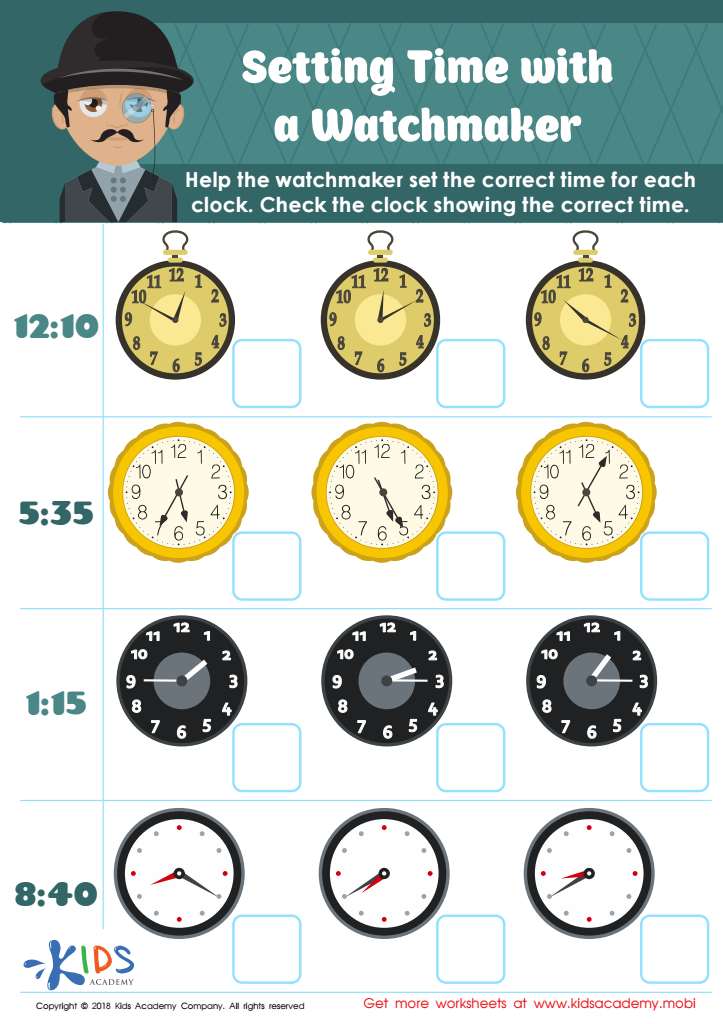
Setting Time with Watchmaker Worksheet
Can your kids tell the time? If so, this worksheet should be easy. Help them set the time for each clock: look at the time written on the left side and find the clock on the right side that matches.
Setting Time with Watchmaker Worksheet
Worksheet
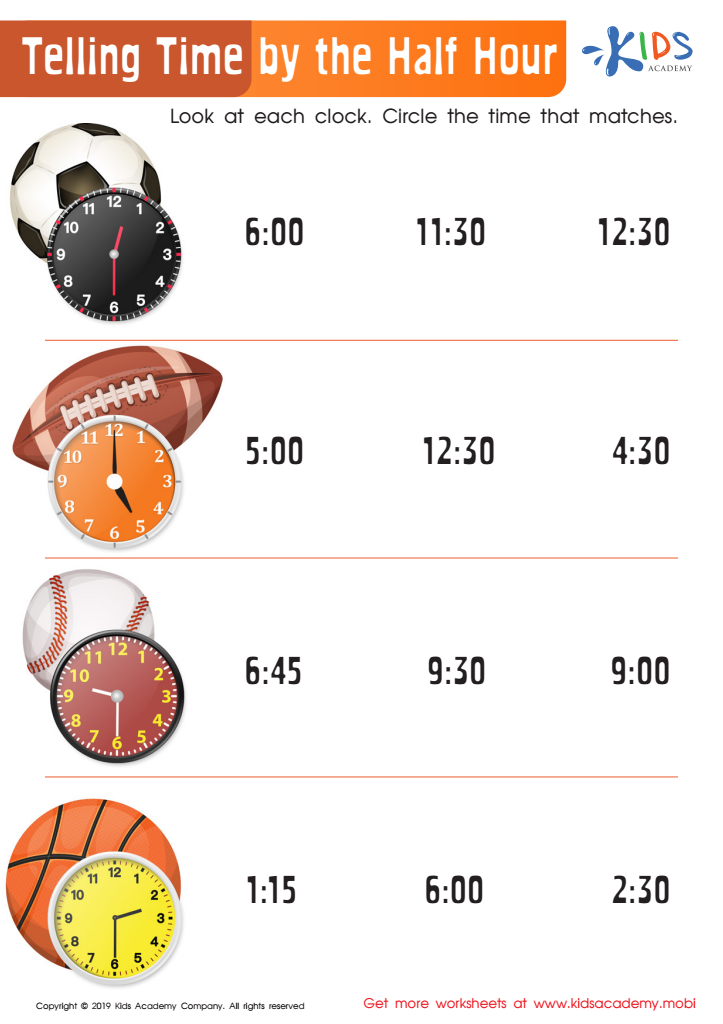
Telling Time by the Half Hour Worksheet
Teach kids to tell time with this worksheet! Four clocks are labeled with different times; help your child circle the right one. It's a great way to teach them to read analog and digital clocks, watches, and written times. Easy and fun learning!
Telling Time by the Half Hour Worksheet
Worksheet
Join Kids Academy for Free
Who is primarily going to use this learning content?






Understanding how to read analog clocks is an essential skill for children aged 3-8, and there are several reasons why parents and teachers should prioritize this learning. First, learning to tell time enhances a child's cognitive development, helping them master concepts related to numbers, sequences, and intervals, which are foundational in mathematics.
Moreover, analog clocks foster critical thinking and spatial awareness. They encourage children to visualize time in a circular format, providing a different perspective than digital clocks, which can help them grasp the concept of time more comprehensively. These skills translate into better problem-solving abilities in various subjects at school.
Additionally, telling time can build a child's sense of responsibility and independence. Knowing how to read the time allows them to manage their schedules better and promotes punctuality—both key for success in academic and social settings.
Furthermore, engaging with analog clocks can prompt family discussions about daily routines, time management, and the significance of being on time. Overall, teaching children to read analog clocks creates opportunities for learning beyond mere numbers, fostering a richer understanding of both math and everyday life skills, ultimately preparing them for future challenges.








