
Time recognition Normal Measurement Worksheets for Ages 3-8
3 filtered results
Difficulty Level
Grade
Age
-
From - To
Subject
Activity
Standards
Discover our engaging Time Recognition Normal Measurement Worksheets, designed for children ages 3-8! These ready-to-print activities help young learners grasp the concept of time while enhancing their measurement skills. With colorful illustrations and interactive exercises, kids will enjoy learning to tell time on clocks and understand daily routines. Our worksheets support early educational goals, fostering familiarization with both digital and analog time. Perfect for classroom settings or home learning, these resources promote foundational math skills in a fun and accessible way. Unlock your child's potential and boost their confidence in time recognition with our thoughtfully crafted worksheets!
Favorites
With answer key
Interactive
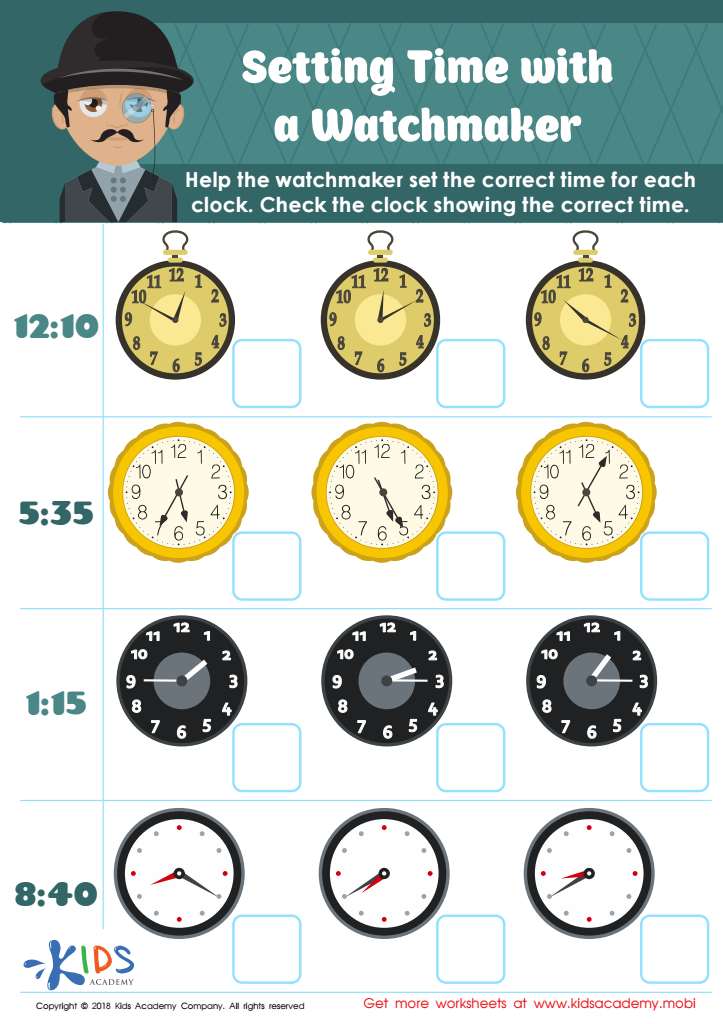
Setting Time with Watchmaker Worksheet
Can your kids tell the time? If so, this worksheet should be easy. Help them set the time for each clock: look at the time written on the left side and find the clock on the right side that matches.
 Assign to My Students
Setting Time with Watchmaker Worksheet
Worksheet
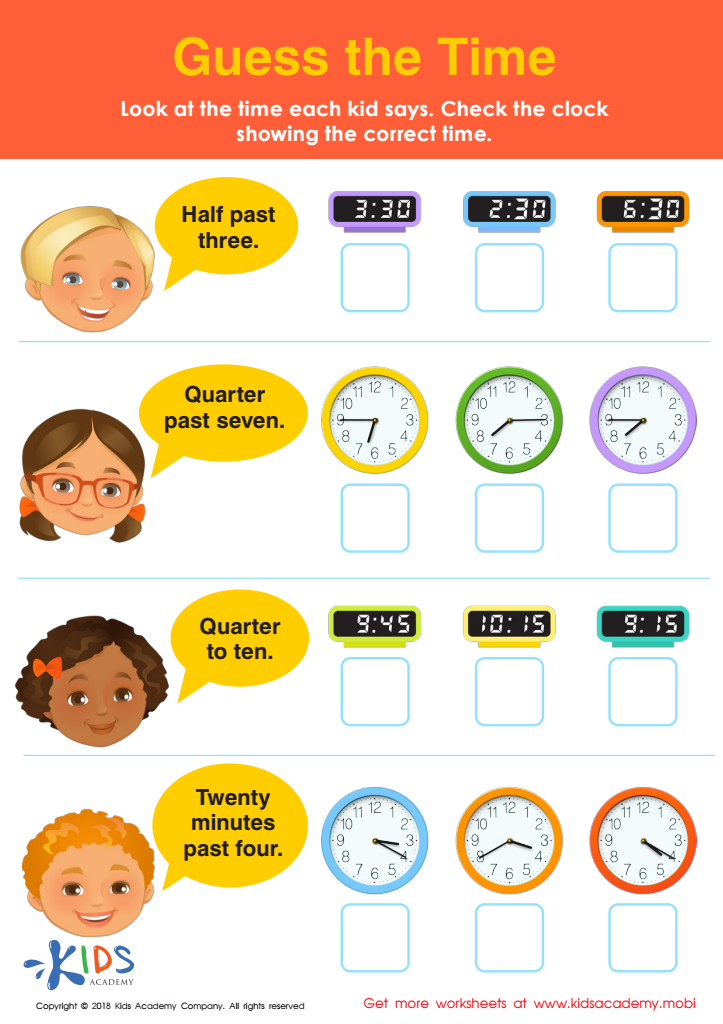
Guess the Time Worksheet
Help students tell the time accurately with this fun exercise. Read the time each person says and find the corresponding clock. Check the options on the left and have students guess the right time. This worksheet is sure to sharpen their time-telling skills.
Guess the Time Worksheet
Worksheet
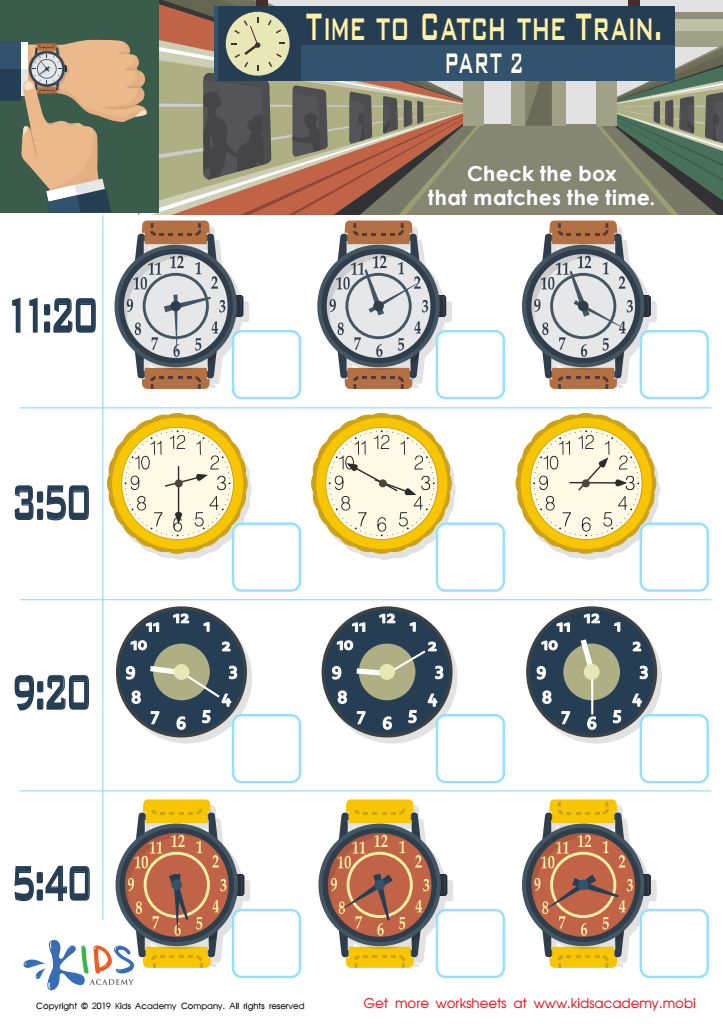
Time to Catch the Train Part 2 Worksheet
Teach your kids the importance of telling time and how to do it. Explain that there are multiple ways to show the time, such as written on the left side or watches in the picture. Guide them to check the box that matches the time. Knowing the time is essential to get things done and create order. Ensure your kids understand this and they will reap the benefits.
Time to Catch the Train Part 2 Worksheet
Worksheet
Join Kids Academy for Free
Who is primarily going to use this learning content?








Time recognition and understanding normal measurement are essential skills for children aged 3-8, laying the foundation for critical thinking and real-world problem-solving. Learning to tell time helps children grasp the concept of sequencing events in their daily lives, such as routines and schedules, fostering independence and responsibility. For example, knowing when to start or finish an activity can improve time management skills that they will use throughout their lives.
Measurement skills, on the other hand, introduce children to concepts of size, quantity, and comparison. Tasks like weighing ingredients while cooking or measuring lengths during a craft project engage children actively with their environment. These experiences enhance their observational skills and encourage curiosity about the world around them.
Moreover, early math skills are linked to later academic success. By mastering time and measurement concepts, children build a strong numerical foundation, preparing them for more complex mathematical ideas in the future.
Ultimately, fostering these skills in the early formative years ensures that children not only perceive the world around them accurately but also gain confidence in their abilities to interact with it positively. Therefore, parents and teachers should prioritize teaching these concepts in engaging ways to support holistic development.








