Pattern recognition Normal Geometry Worksheets for Ages 4-7
3 filtered results
-
From - To
Our "Pattern Recognition Normal Geometry Worksheets for Ages 4-7" offer a fun and educational way for young learners to enhance their mathematical skills. Tailored to early grade students, these worksheets focus on recognizing and predicting geometric patterns. Through engaging activities, children will develop critical thinking and spatial awareness, building a solid foundation in geometry. Perfect for use at home or in the classroom, each worksheet is designed to keep learning exciting and interactive. Help your child or students excel in math with our specially crafted pattern recognition worksheets, making geometry enjoyable and accessible for young minds.
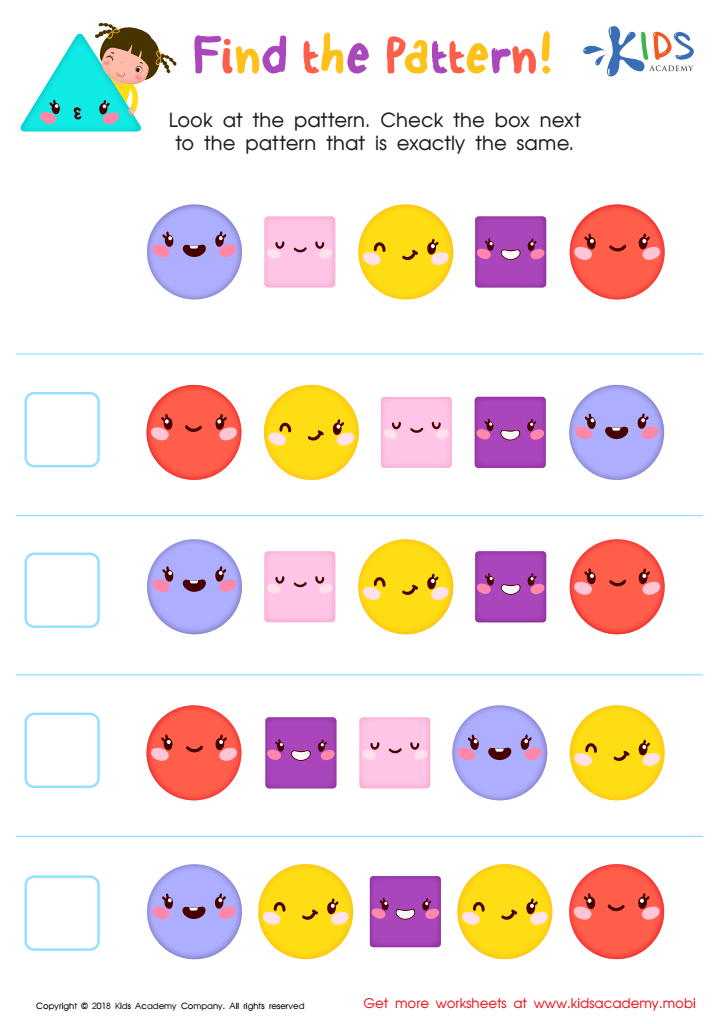
Find the Pattern Worksheet
 Assign to My Students











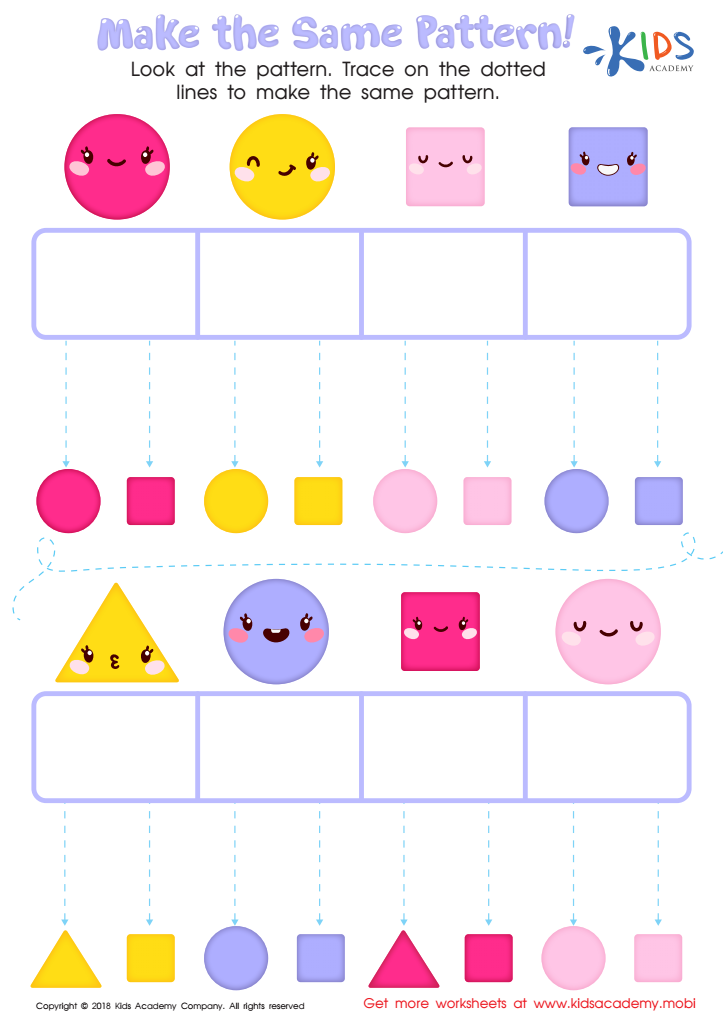
Make the Same Pattern Worksheet
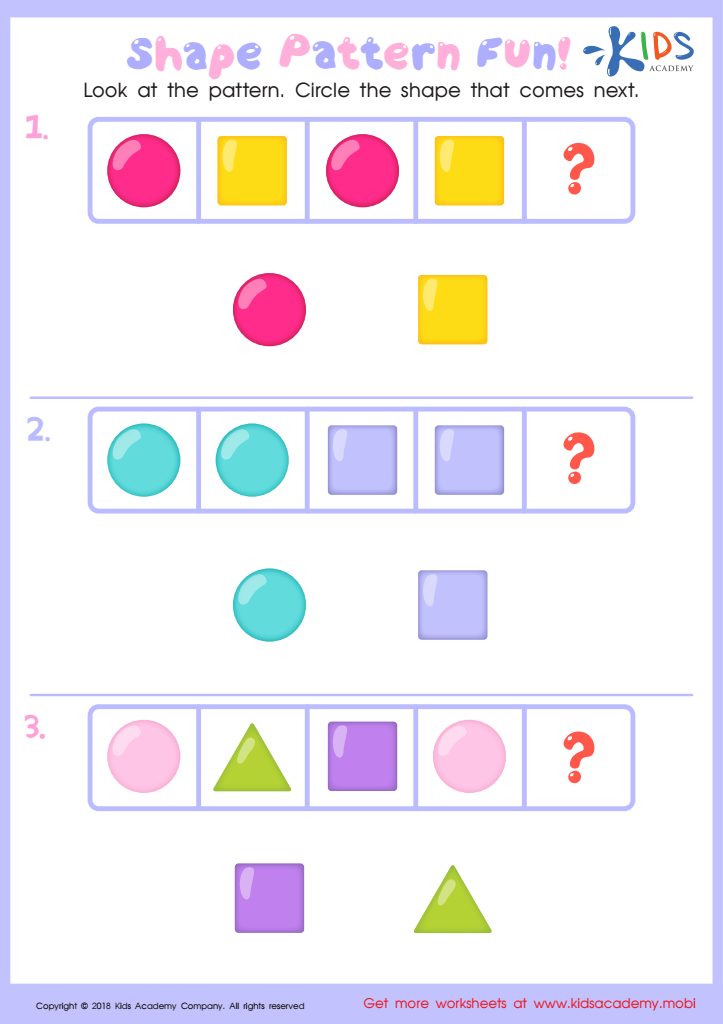
Shape Pattern Fun Worksheet








Introduction to pattern recognition and basic geometry for children aged 4-7 lays a crucial foundation for their future learning and development. These fundamental skills provide a springboard for more complex mathematical concepts and logical reasoning.
Pattern recognition helps young children comprehend the world around them more methodically. Noticing and predicting patterns enhances memory, cultivates analytical thinking, and promotes problem-solving abilities. Kids who can identify patterns understand sequences in events or numbers, aiding their early literacy and numeracy skills.
Similarly, an understanding of normal geometry — such as recognizing shapes and spatial relationships — is pivotal. It helps children develop spatial awareness and build a mental framework for the world. This comprehension trickles down into day-to-day activities, making navigation and physical activities more intuitive. Learning geometry also stimulates a child's visual-spatial intelligence, highlighting an understanding of size, form, and position consistency, which is critical for tasks ranging from simple block-play to complex future subjects like engineering.
Early immersion in these concepts doesn't just make abstract mathematics more approachable later in school, but also boosts a child's confidence and curiosity. Consequently, parents and teachers should view these early forays into pattern recognition and geometry as essential stepping stones in a holistic early education curriculum.








