
Comparing lengths Normal Math Worksheets for Ages 4-7
4 filtered results
Difficulty Level
Grade
Age
-
From - To
Subject
Activity
Standards
Our "Comparing Lengths: Normal Math Worksheets for Ages 4-7" offer engaging activities designed to help young learners develop critical measurement skills. These printable worksheets allow children to practice comparing the lengths of various objects, fostering early math proficiency and cognitive development. Perfect for preschoolers and early elementary students, our worksheets make learning fun and interactive. Each page features colorful images and simple, relatable tasks that are easy for young minds to grasp. Enhance your child's understanding of size and distance with our expertly crafted worksheets, and watch their confidence in math grow! Download and print today.
Favorites
With answer key
Interactive
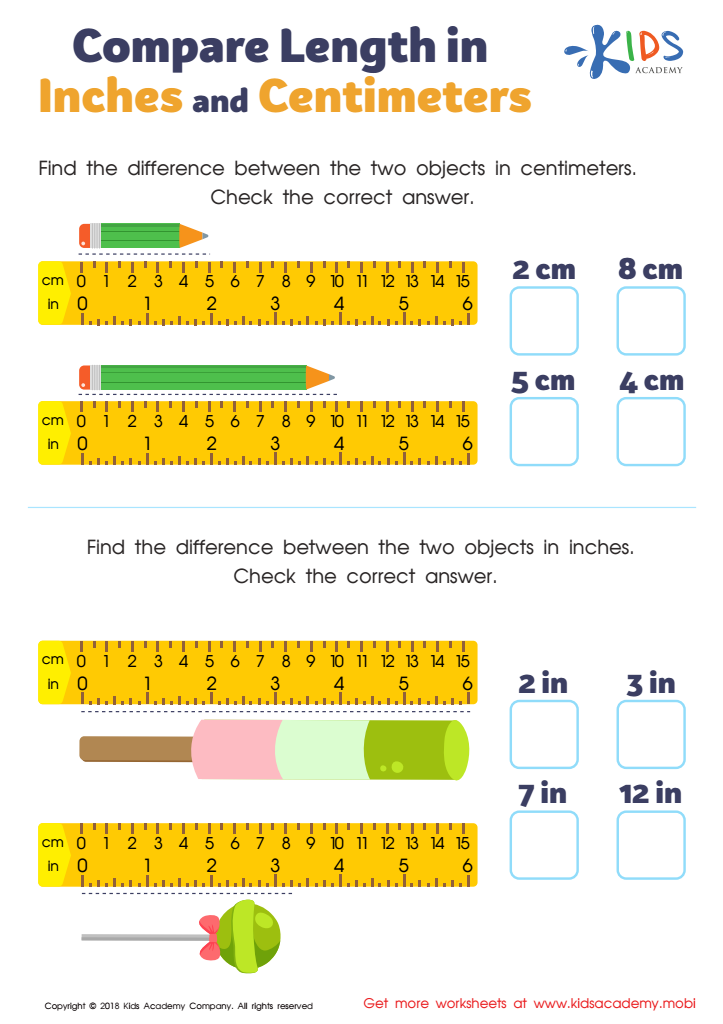
Compare Length in Inches and Centimeters Worksheet
This worksheet has your child measuring objects in both centimeters and inches. The first task requires measuring both objects in centimeters, then finding their difference. The second task is the same but in inches.
 Assign to My Students
Compare Length in Inches and Centimeters Worksheet
Worksheet
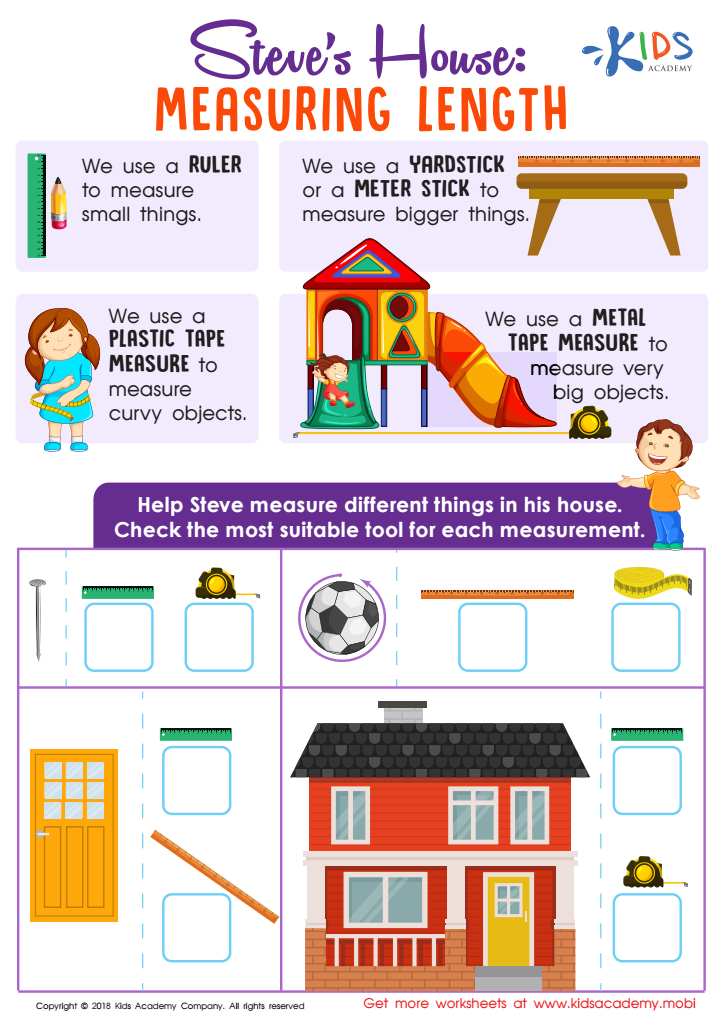
Steve's House: Measuring Length Worksheet
Introduce your kids to the various measuring tools and their uses. Explain how a ruler, plastic tape, yard stick, and metal tape measure are used to measure different objects. Guide them as they help Steve measure things in his home with the correct tool.
Steve's House: Measuring Length Worksheet
Worksheet
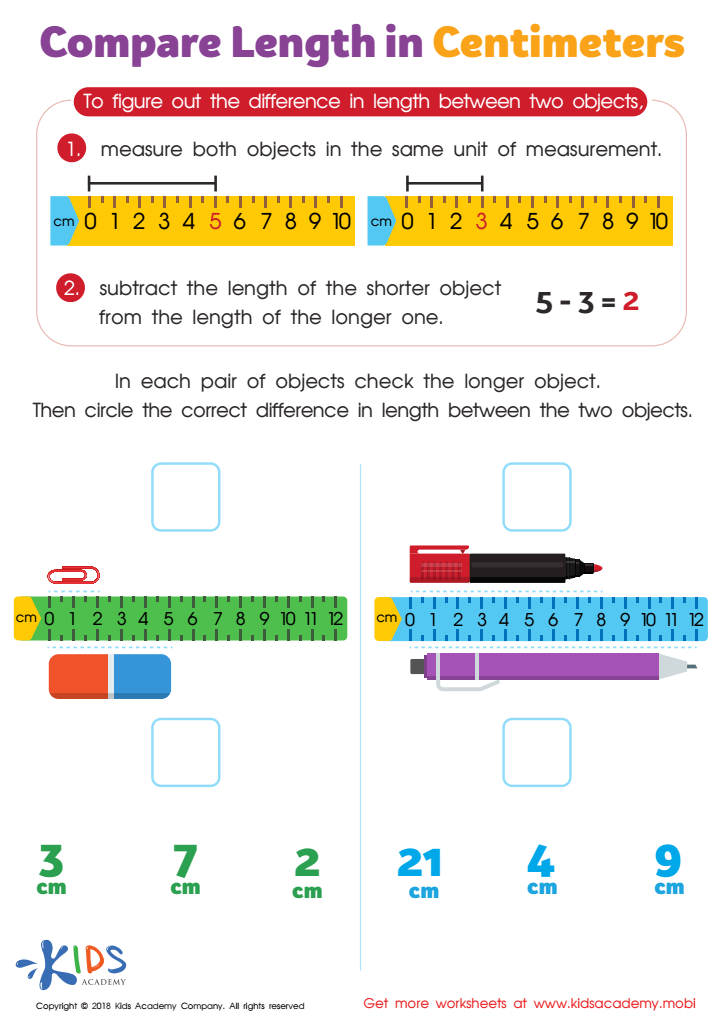
Compare Length in Centimeters Worksheet
To do this worksheet, your child needs to be able to measure accurately, add and subtract. They must measure both items and subtract the shorter from the longer to work out the difference in length.
Compare Length in Centimeters Worksheet
Worksheet
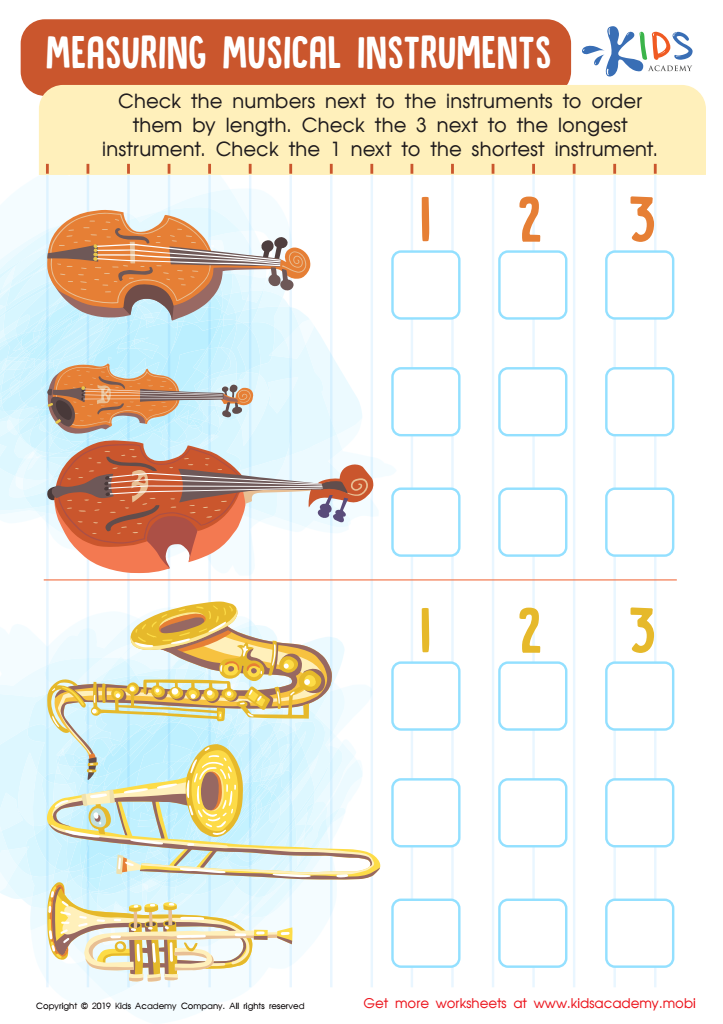
Measuring Musical Instruments Worksheet
Learning measurements can be tricky, but this worksheet makes it easy. Ask your child to identify the instruments in the pictures. Then, order them by length using the numbers. 3 is the longest, 1 is the shortest. Simple exercises like this will help them understand the different metric systems.
Measuring Musical Instruments Worksheet
Worksheet
Join Kids Academy for Free
Who is primarily going to use this learning content?







Parents and teachers should prioritize comparing lengths as a key concept in early math education (ages 4-7) because it is fundamental for developing young children’s measurement and analytical skills. Understanding how to compare lengths helps children grasp essential math principles and establish a foundation for more complex concepts. This early exposure enhances their ability to discern similarities and differences in their environment, promoting observational skills and critical thinking.
Engaging in hands-on activities, such as measuring objects with non-standard units like blocks or ribbons, makes learning both fun and meaningful. It helps children develop spatial awareness—knowing what longer, shorter, higher, and lower mean in practical scenarios, which is crucial for everyday tasks and future academic success.
Additionally, these exercises help build vocabulary and communication skills. When children discuss and describe their findings ("This string is longer than that pencil"), they practice using comparative language and reasoning. Early success with such tasks builds confidence and a positive attitude toward math, which can influence their overall academic trajectory.
Moreover, comparing lengths aligns with early childhood education standards and curricula, ensuring that children meet developmental milestones. Consistent practice supports their progression from concrete manipulations to more abstract mathematical reasoning, preparing them for advanced topics in later years.








