
Differentiating goods/services Normal Worksheets for Ages 4-8
3 filtered results
Difficulty Level
Grade
Age
-
From - To
Subject
Activity
Standards
Discover engaging and interactive worksheets designed to help young learners ages 4-8 differentiate between goods and services. Our comprehensive resources offer age-appropriate activities that encourage critical thinking and comprehension. Tailored to meet varying learning styles, the Normal Worksheets promote exploration through fun exercises, including sorting, matching, and identifying everyday examples of goods and services. Enhance your child’s understanding of these essential concepts with bright visuals and relatable scenarios that make learning enjoyable. Perfect for classroom settings or at-home learning, these worksheets provide a solid foundation for developing valuable life skills. Start nurturing curiosity and knowledge today with our dedicated worksheets!
Favorites
With answer key
Interactive
 Assign to My Students
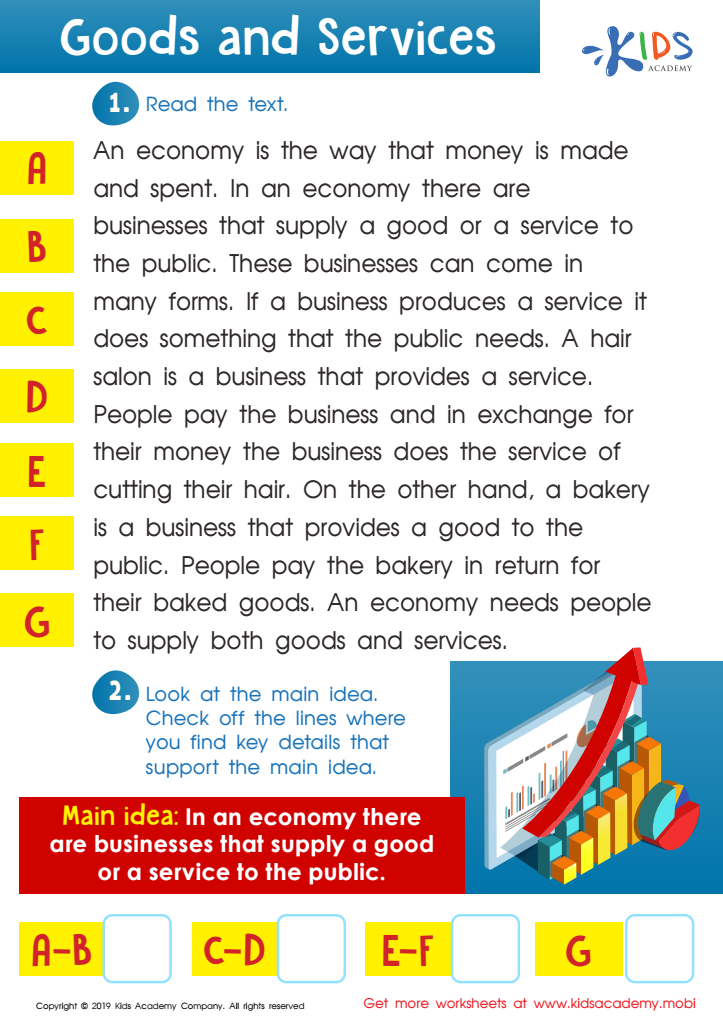
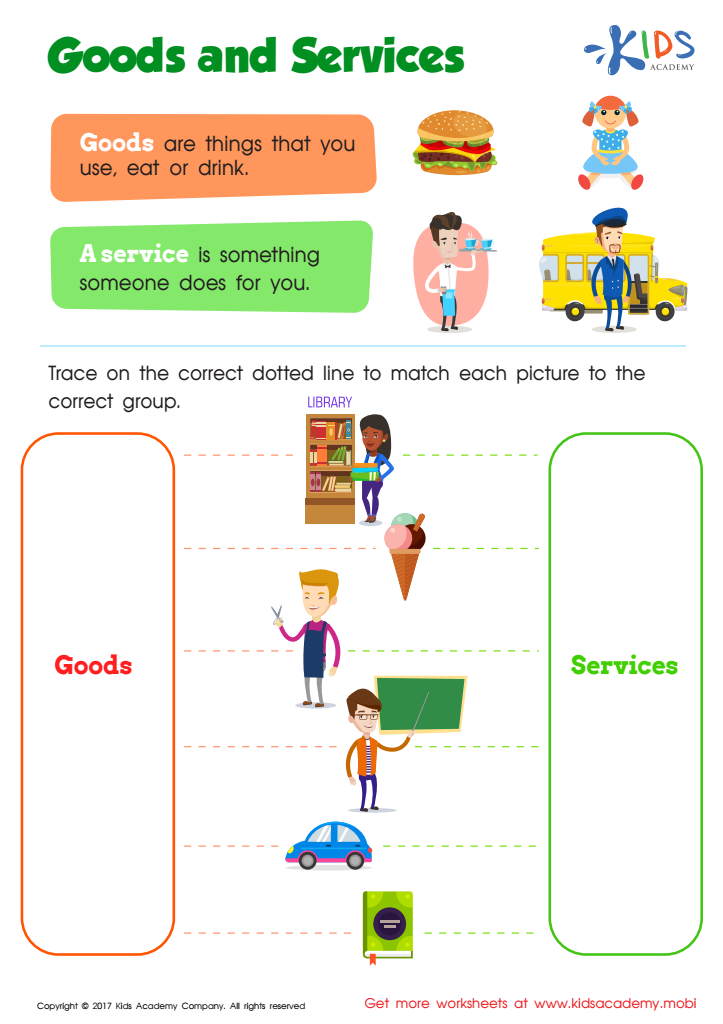
Goods and Services Worksheet
Teach your kids about the economy and businesses with this worksheet. Ask them if they know what goods and services are. After they complete the worksheet, they'll have a better understanding. Read the text to them and guide them step-by-step through the instructions. Help them learn!
Goods and Services Worksheet
Worksheet
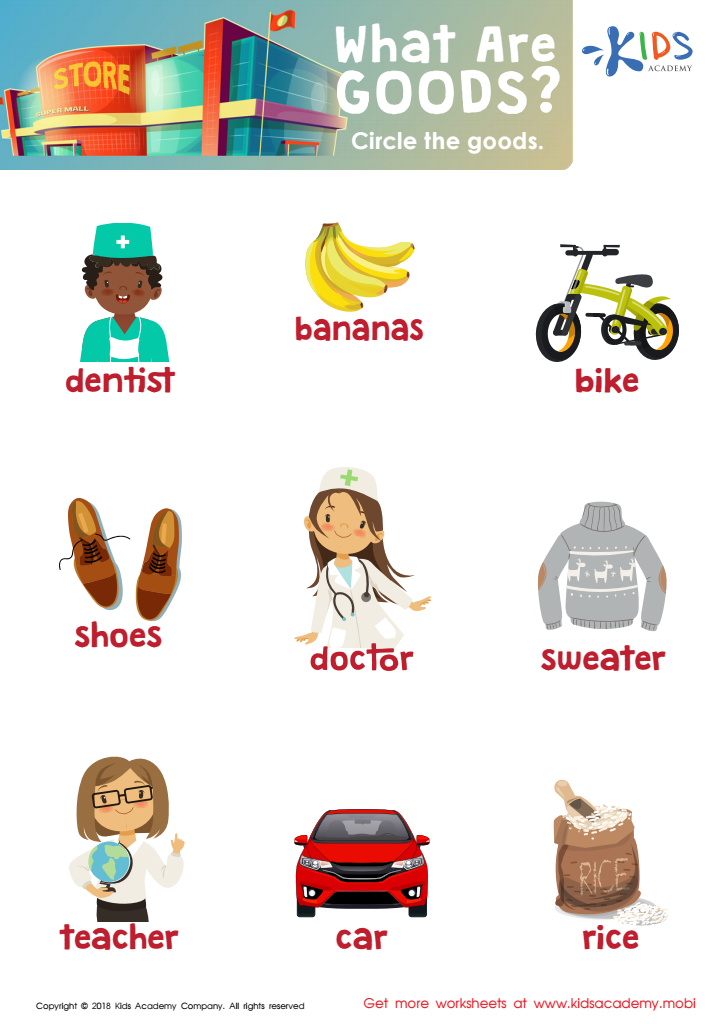
What Are Goods? Worksheet
Introduce your child to economics with this social studies worksheet! It helps kids differentiate between goods and services. Have them look at each picture, discuss what it does, and decide whether it's an object or a service. Encourage them to think carefully and circle the goods. It's a great way to start teaching the basics of economics.
What Are Goods? Worksheet
Worksheet
Join Kids Academy for Free
Who is primarily going to use this learning content?





Differentiating goods and services is crucial for children aged 4-8 as it caters to their diverse learning needs and enhances their developmental progress. At this age, children exhibit varying interests, abilities, and learning styles. By differentiating resources, educators and parents can provide tailored experiences that engage each child effectively, fostering a love for learning.
When learning materials are suited to a child's level, it boosts their confidence and encourages participation. For instance, a child struggling with reading may benefit from picture books, while an advanced reader may thrive with chapter books. Similarly, hands-on activities can cater to kinesthetic learners, nurturing their curiosity and creativity.
As children grasp concepts at their own pace, differentiation also ensures that they acquire essential skills without feeling overwhelmed. It supports their emotional growth by alleviating frustration and promoting a positive learning environment. Additionally, it helps in building inclusivity, celebrating each child’s unique abilities. By adopting a differentiated approach, adults play a vital role in shaping adaptable, resilient learners equipped for future challenges. Thus, parents and teachers should prioritize differentiation to unlock each child’s full potential and ensure a well-rounded educational experience.








