Reading analog clocks Normal Worksheets for Ages 4-8
3 filtered results
-
From - To
Introduce your child to the fascinating world of time with our "Reading Analog Clocks" worksheets, designed for ages 4-8. These engaging activities help young learners grasp the concepts of hours, minutes, and time-telling. Our carefully crafted worksheets are perfect for developing fine motor skills and boosting cognitive development. Full of colorful images and step-by-step instructions, these resources make learning to read analog clocks both fun and educational. Ideal for classroom use or at-home practice, our worksheets provide a strong foundation for time management skills that your child will treasure for a lifetime. Explore today at Kids Academy!
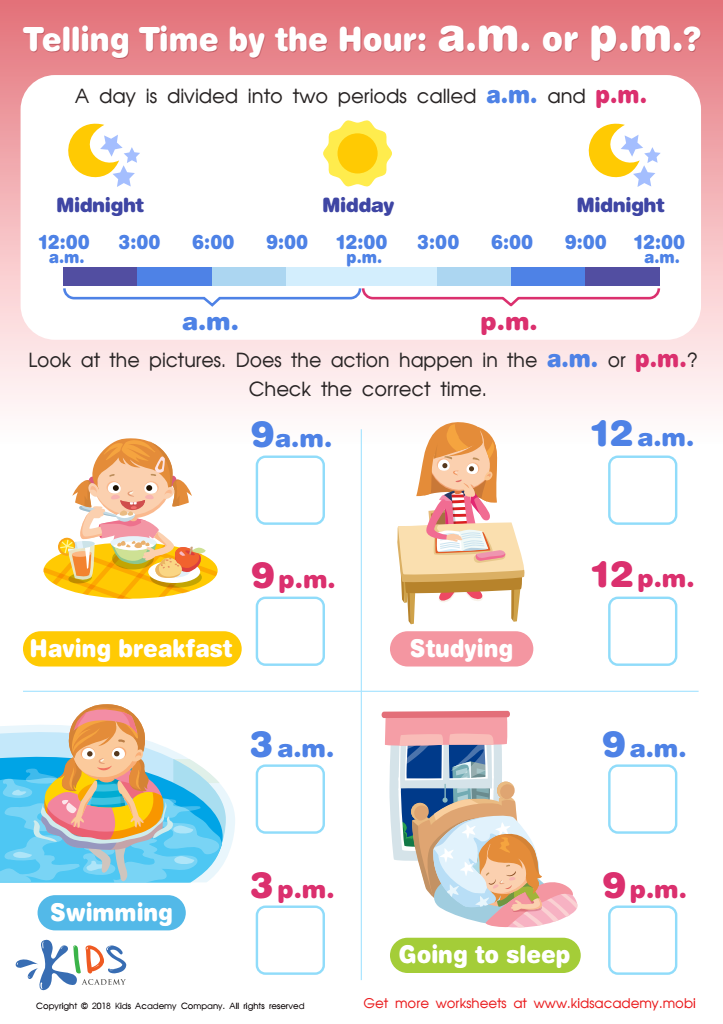
Tilling Time by the Hour: a.m. or p.m.? Worksheet
 Assign to My Students
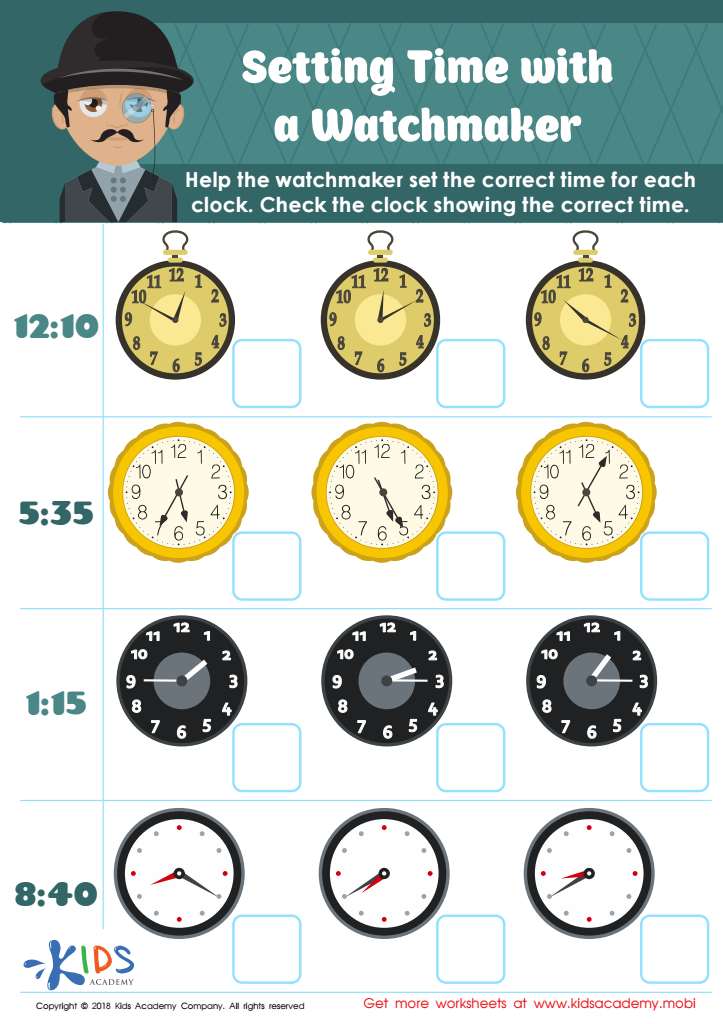
Setting Time with Watchmaker Worksheet
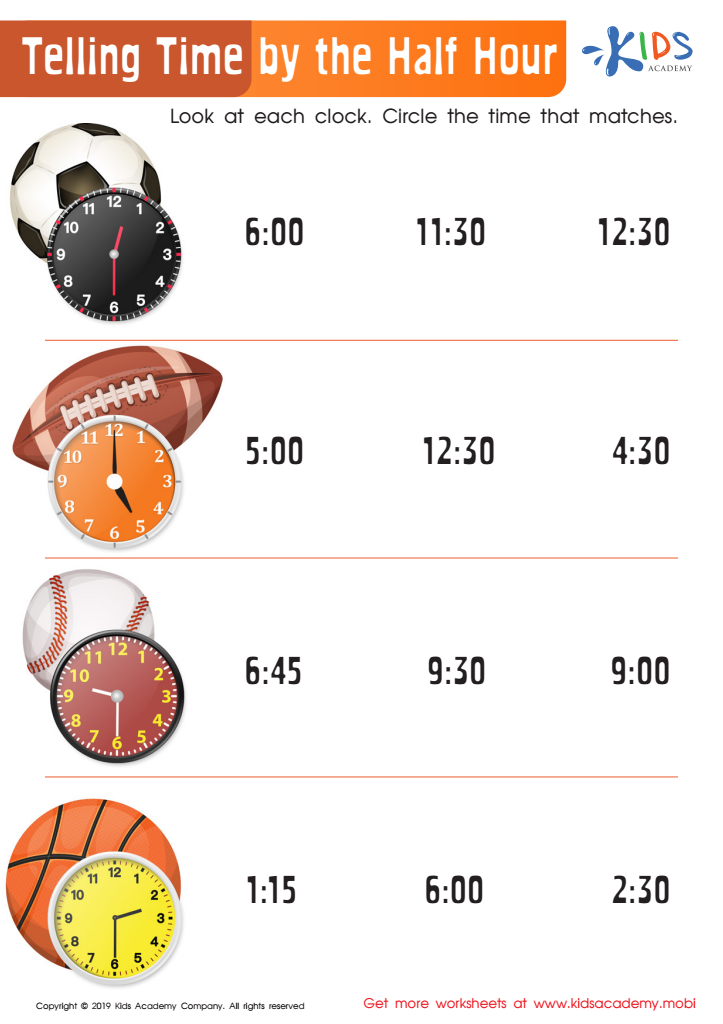
Telling Time by the Half Hour Worksheet


.jpg)
.jpg)


Reading analog clocks is a fundamental skill for children aged 4-8, and parents and teachers should prioritize it due to several key reasons. Firstly, learning to read an analog clock enhances children's understanding of time. It's a tactile way to comprehend the concept of minutes and hours, which is foundational for skillfully managing daily routines and schedules.
Secondly, teaching this skill benefits overall cognitive development. Reading an analog clock involves recognizing numbers, counting by fives, and understanding the relationship between the hour and minute hands. This supports a child's grasp of mathematical concepts and spatial awareness, thereby reinforcing their arithmetic skills.
Furthermore, analog clocks offer a concrete representation of the passage of time, unlike digital clocks which simply display numbers. This tangible visualization helps kids develop better time management and problem-solving skills. They learn the significance of time intervals, which can improve punctuality and the ability to estimate durations, such as knowing how long until dinner or how much time is left in a class.
Ultimately, fostering proficiency in reading analog clocks equips children with essential life skills, nurtures their intellectual growth, and prepares them for future academic challenges. It ties into real-world applications, making them more independent and organized in their daily lives.








