
Rhyming skills development Normal Worksheets for Ages 4-8
4 filtered results
Difficulty Level
Grade
Age
-
From - To
Subject
Activity
Standards
Enhance your child's phonemic awareness with our "Rhyming Skills Development" worksheets, tailored for ages 4-8. These engaging activities support early literacy by helping young learners identify and produce rhyming words. Our colorful and interactive worksheets are designed to make learning fun, encouraging kids to explore language patterns through various exercises such as matching, sorting, and reading. Perfect for both classroom and at-home practice, these worksheets provide a solid foundation for reading and writing. Develop your child's language skills today and let them discover the joy of rhyming with our expertly crafted resources.
Favorites
With answer key
Interactive
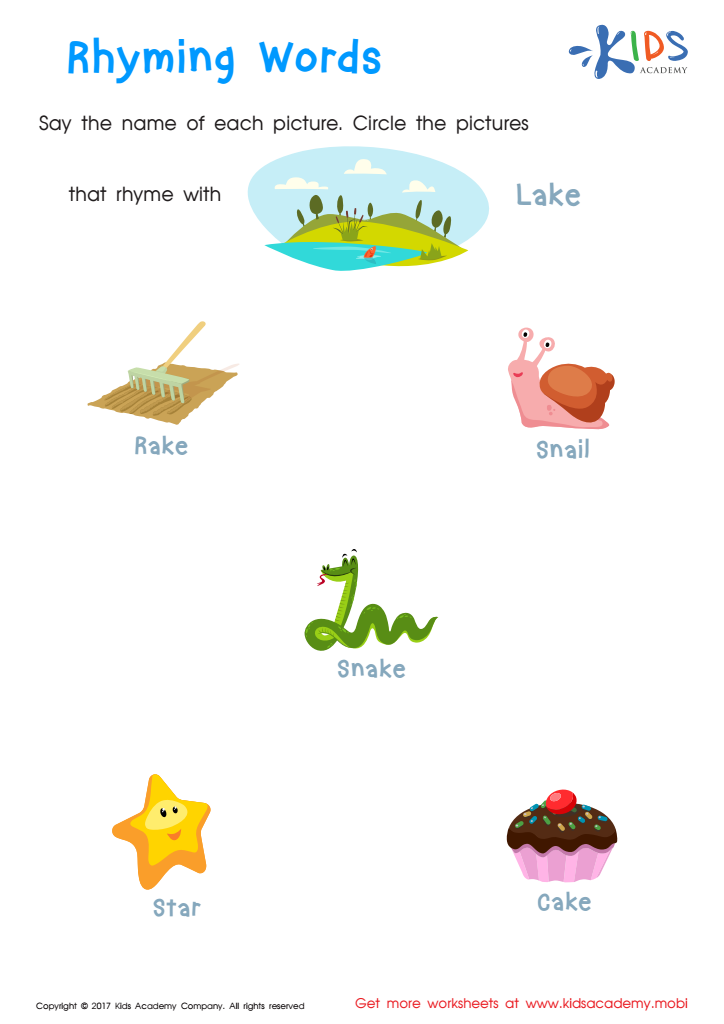
Rhyming Words Rhyming Worksheet
This worksheet is great for honing pre-reading skills. It helps kids make connections between pictures and written words, use problem-solving, and recognize sounds and words that rhyme. Have fun exploring rhyming words with your child, and they'll be rhyming in no time!
 Assign to My Students
Rhyming Words Rhyming Worksheet
Worksheet
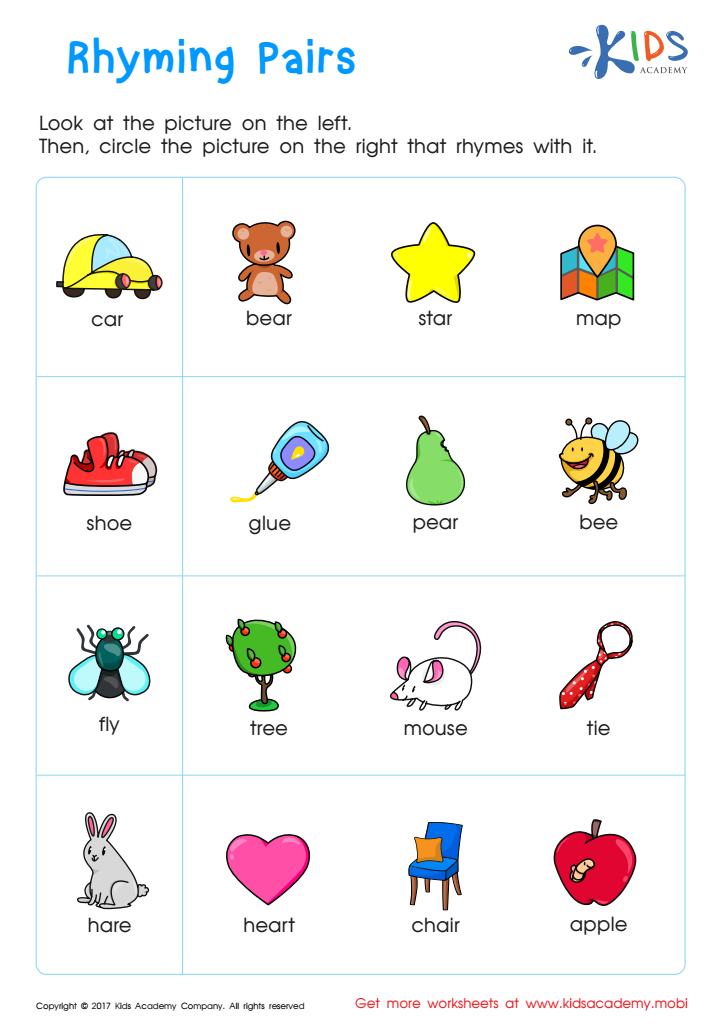
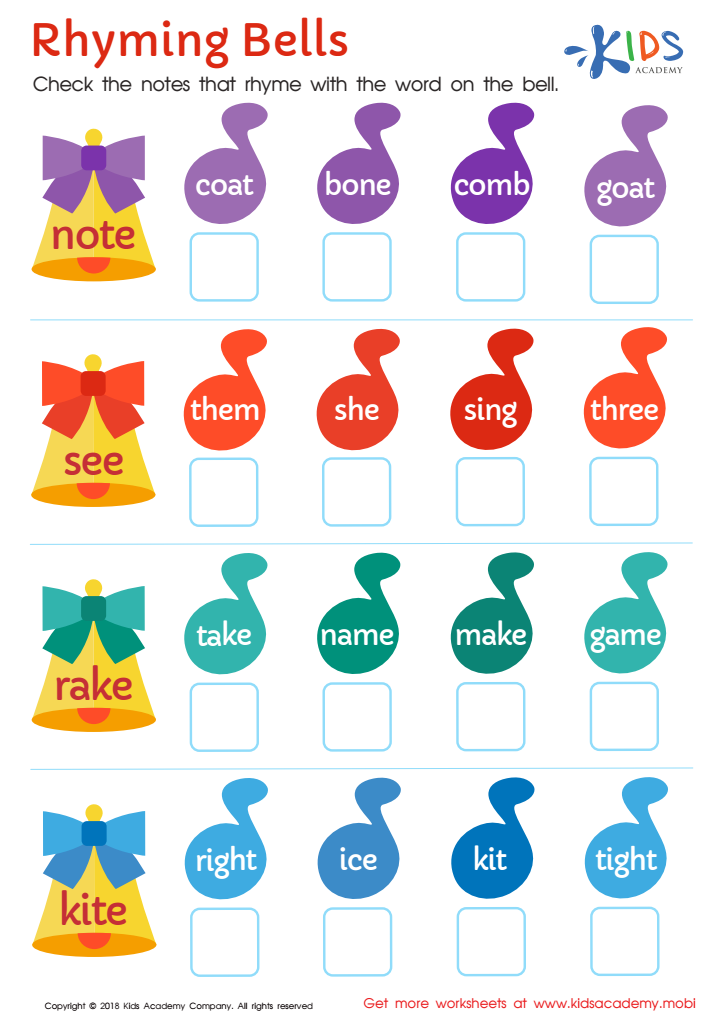
Rhyming Bells Worksheet
This printable worksheet helps students recognize rhyming words. Read a word, then pick the 4 words that rhyme. Look out for words with different spellings but same ending sound. It's a great exercise to improve understanding of rhyming words.
Rhyming Bells Worksheet
Worksheet

First Words: Picture Rhymes Worksheet
Rhyming helps kids understand language, read and write better. This printable worksheet boosts problem-solving and cognitive skills with vibrant pictures. It teaches kids to identify words, recognize rhymes, complete mental tasks and write words. An extra activity: show them how rhyming words share some of the same letters.
First Words: Picture Rhymes Worksheet
Worksheet
Join Kids Academy for Free
Who is primarily going to use this learning content?



.jpg)




Rhyming skills are a cornerstone of early childhood literacy and should be valued by both parents and teachers of children ages 4-8. These skills significantly foster phonological awareness, which is the ability to recognize and work with sounds in spoken language— a critical foundational skill for learning to read. When children can identify rhyming words, they begin to understand how sounds form words, enhancing their ability to decode new words.
Rhyming activities also improve vocabulary. Encountering words in rhymes helps children learn new terms within a pleasurable and memorable context. Moreover, the structure of rhymes aids in the retention of vocabulary, allowing children to recall and utilize words more effectively.
Language development is further enriched through rhyming, as children engage with the rhythmic and melodic aspects of speech. Rhyming stories, poems, and songs expose children to sentence structure and intonation, thus improving their overall oral language skills.
Cognitively, rhyming stimulates pattern recognition and pairs phonemic awareness with fun and engaging content, which keeps young learners interested and motivated. Socially, sharing rhymes in group settings supports cooperation and communication, valuable skills for future classroom environments.
Overall, emphasizing rhyming during crucial developmental years sets the stage for successful reading and language acquisition, forming a crucial part of an engaging, well-rounded early education.








