
Phonological awareness Normal Elementary Phonics Worksheets for Ages 4-9
3 filtered results
Difficulty Level
Grade
Age
-
From - To
Subject
Activity
Standards
Discover our curated collection of Phonological Awareness Elementary Phonics Worksheets, tailored for children ages 4-9. These engaging resources are designed to enhance early reading skills by focusing on phonological awareness, helping kids recognize and manipulate sounds within words. These worksheets offer a diverse range of activities, including rhyming, syllable segmentation, and phoneme identification, reinforcing essential literacy foundation in a fun, interactive way. Perfect for both classroom use and at-home practice, our worksheets support young learners in their journey towards confident, fluent reading. Explore and download today for a seamless, effective learning experience!
Favorites
With answer key
Interactive
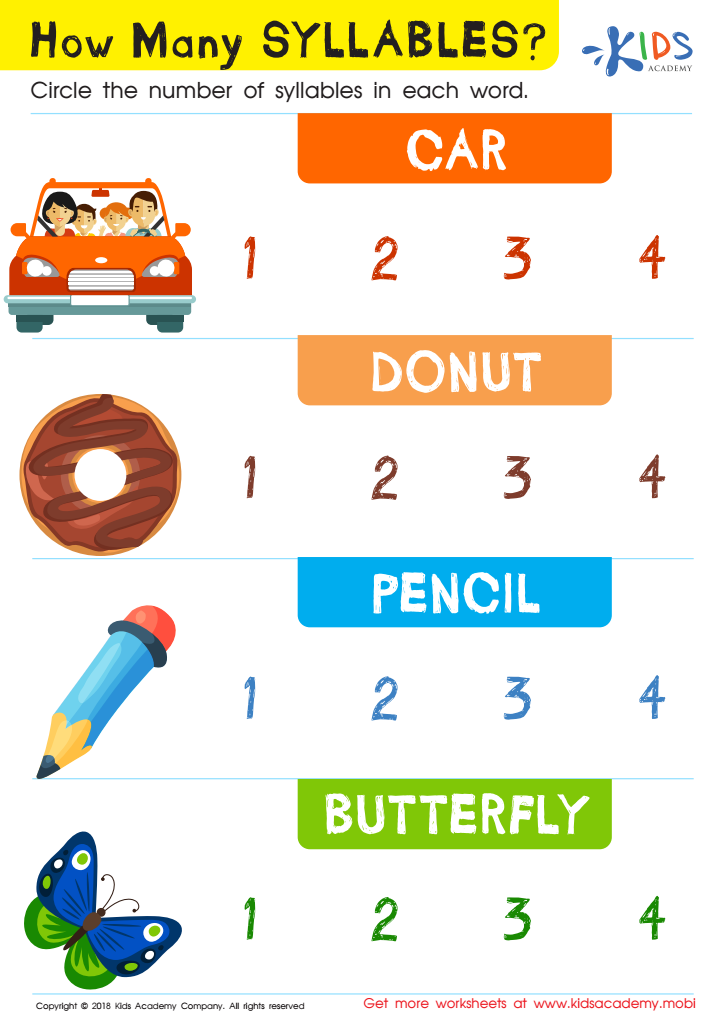
How Many Syllables? Worksheet
Syllabication or 'chunking' helps students decode words more quickly and increase fluency. This traceable worksheet is great for emerging readers, combining fun and fine motor practice with chunking words and counting syllables.
 Assign to My Students
How Many Syllables? Worksheet
Worksheet
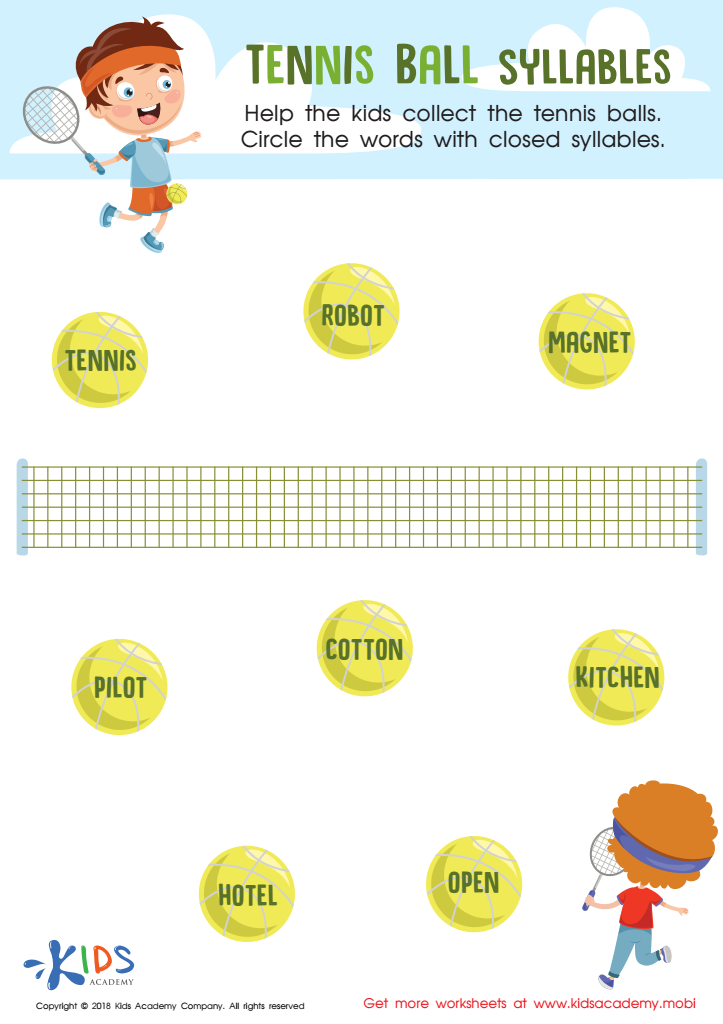
Tennis Ball Syllables Worksheet
To help your kids become fluent speakers, they need to learn syllables. A word can have one to seven syllables, with longer words having more. For this level, they will be working with one or two syllables. Assist them as they circle the words with closed syllables in this worksheet.
Tennis Ball Syllables Worksheet
Worksheet
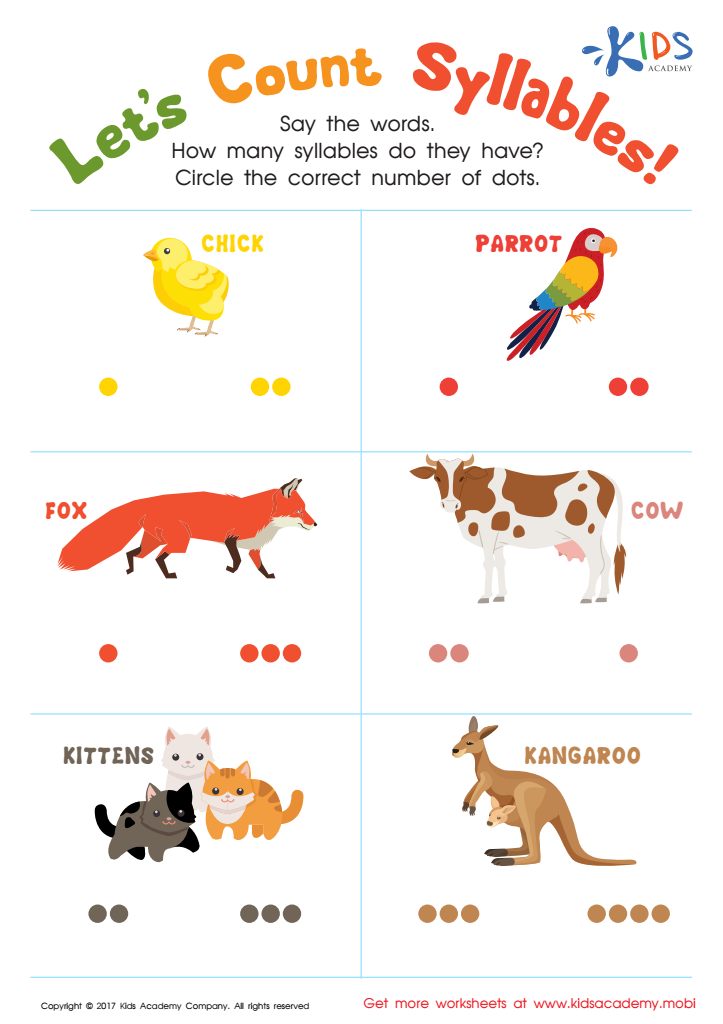
Lets Count Syllables Worksheet
This fun animal worksheet makes learning to read easier by breaking words into syllables. Bright, cheery pictures give context and help kids choose the right syllable count. Count together and enjoy as your child learns and gains success!
Lets Count Syllables Worksheet
Worksheet
Join Kids Academy for Free
Who is primarily going to use this learning content?




Phonological awareness is a critical skill that forms the foundation of a child’s reading and writing abilities. It encompasses the understanding of how words can be broken down into smaller units, such as syllables, onsets, and rimes, and individual phonemes (the smallest units of sound). For children ages 4-9, grasping this concept is crucial as it directly influences their success in elementary phonics.
Parents and teachers should prioritize phonological awareness because it is a strong predictor of future reading success. When children develop robust phonological skills, they are better equipped to decode words, which makes learning to read more straightforward. This ability to decode is directly linked to a child's competence in recognizing words quickly and accurately, fostering fluent reading.
Furthermore, phonological awareness facilitates spelling and writing. As children understand how sounds map onto letters, they can spell more effectively, which promotes their writing confidence and ability. Early mastery of these skills reduces the likelihood of reading difficulties later, ensuring a smoother academic journey.
Lastly, fostering phonological awareness can make learning enjoyable. Engaging activities like rhyming games, clapping out syllables, and sound matching play a crucial role not only in educational progress but also in fostering a child's love for learning. This formative stage is a window of opportunity where early, thoughtful intervention can set the stage for lifelong literacy skills.






