
Basic geometry understanding Normal Geometry Worksheets for Ages 5-7
3 filtered results
Difficulty Level
Grade
Age
-
From - To
Subject
Activity
Standards
Introduce young learners to the world of shapes and spatial understanding with our Basic Geometry Understanding Normal Geometry Worksheets, designed specifically for ages 5-7. These engaging and educational worksheets help children grasp fundamental geometry concepts through fun and interactive activities. Your child will explore shapes, patterns, symmetry, and spatial relationships, enhancing their critical thinking and problem-solving skills. Perfect for both classroom use and at-home learning, our worksheets provide a solid foundation for future math success. Visit Kids Academy today to download and start your child's journey toward math mastery!
Favorites
With answer key
Interactive
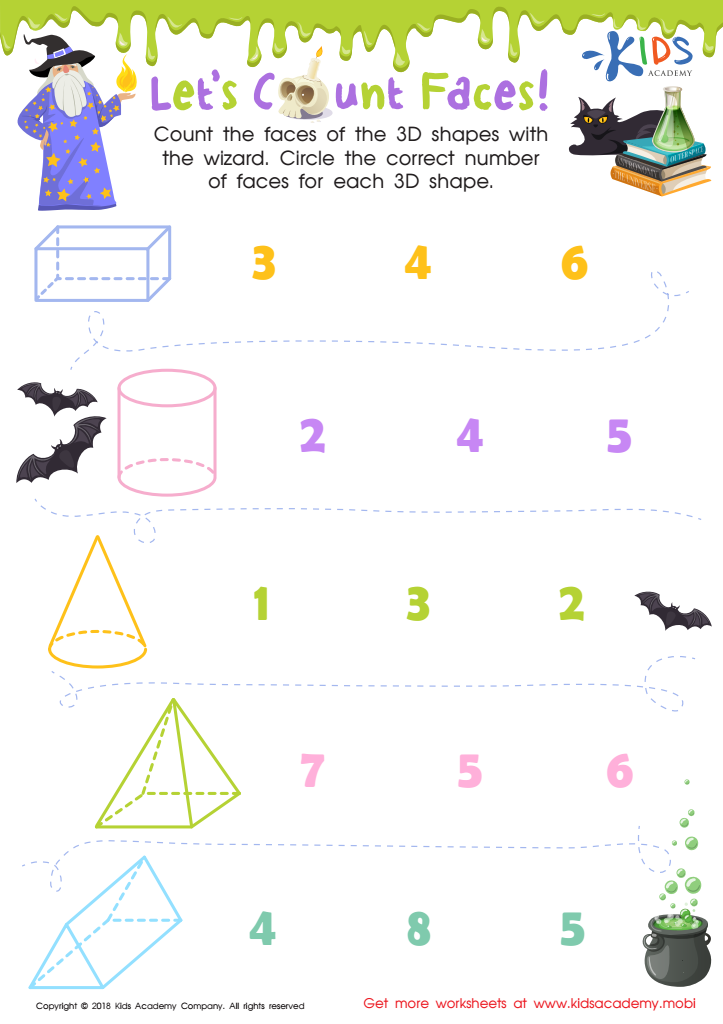
Let's Count Faces! Worksheet
Help the wizard count the faces of 3D shapes! Ask your kids to identify the shapes before beginning, then have them circle the correct number of faces. Enjoy this fun wizard-themed worksheet with your kids!
 Assign to My Students
Let's Count Faces! Worksheet
Worksheet











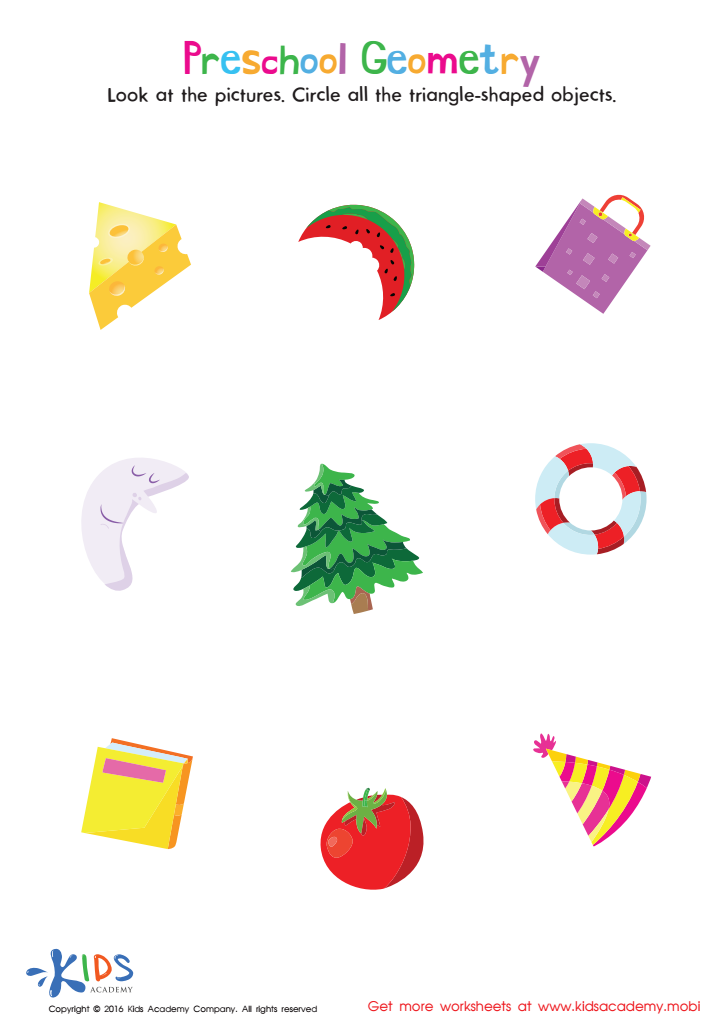
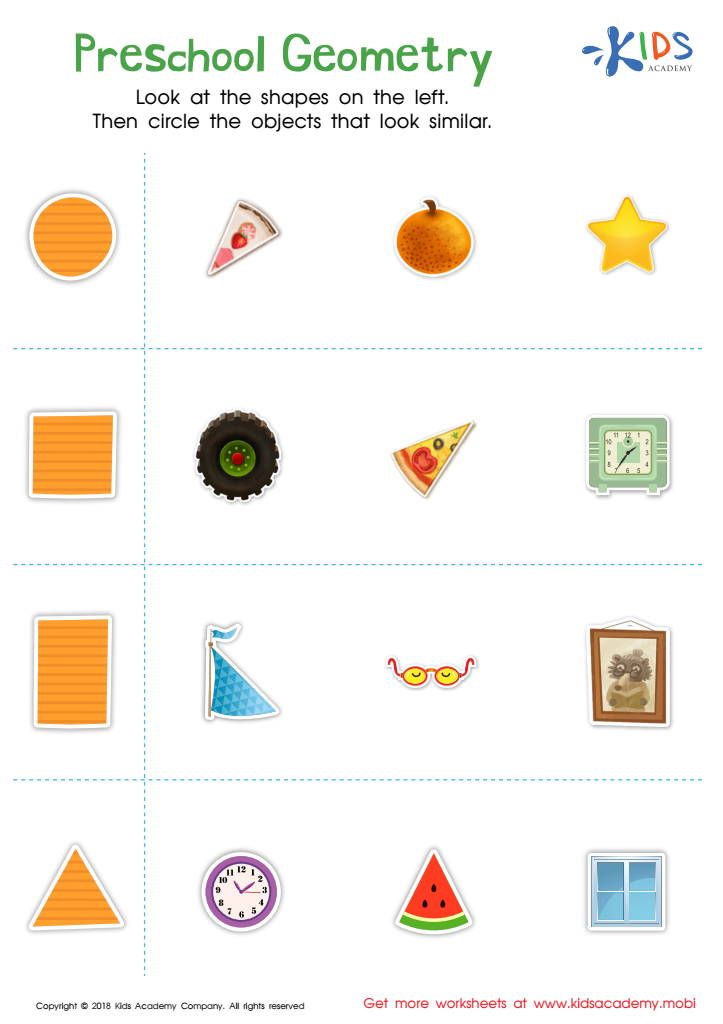
Preschool Geometry Worksheet
This worksheet gives 3rd graders the basics of geometry. Kids match everyday objects to shapes they know, e.g. an orange to a circle, a square to a slice of watermelon and a rectangle to a picture frame. It's a fun way to give them confidence to tackle more complex geometry in the future.
Preschool Geometry Worksheet
Worksheet
Join Kids Academy for Free
Who is primarily going to use this learning content?








Understanding basic geometry is crucial for young children ages 5-7 because it lays the foundation for future learning and development. At this age, children are naturally curious about the shapes and spaces around them. Introducing basic geometry helps them make sense of their world and improves their spatial awareness, which is vital in everyday tasks and other academic disciplines.
Learning about shapes such as circles, squares, and triangles helps children in recognizing patterns and organizing visual information, fostering important skills like problem-solving and critical thinking. These mental processes are essential for math, science, and even reading.
Geometry also enhances fine motor skills. Activities such as drawing shapes, building with blocks, or cutting out paper designs strengthen hand-eye coordination and improve dexterity, aiding in writing and other manual tasks.
Moreover, early exposure to geometry helps children build a positive attitude towards mathematics. Rather than thinking of math as abstract and difficult, they learn through play and hands-on activities, making the subject enjoyable and instilling a love for learning.
Hence, parents and teachers should prioritize basic geometry instruction. It supports holistic cognitive, motor, and emotional development, giving children the essential tools they need for academic success and day-to-day interactions.








